
From the Toysit archive
Domino Rally Airplane
Plan a short domino-toppling run, find the point where it stops and add a stunt only after the connecting section works.
The play at a glance
A good domino run begins with a small working section
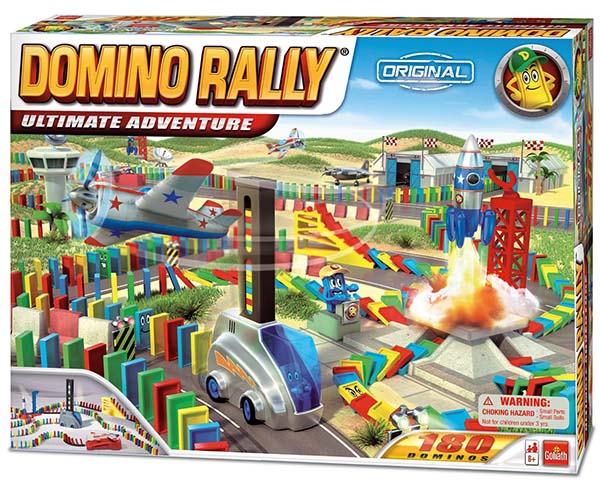
The box in Toysit’s 2013 coverage is labeled Domino Rally Ultimate Adventure. Its appeal is a chain of events: one falling piece starts the next, and a working line can lead into a larger scene.
Begin with a short row that you can reset easily. When it stops, the stopping point gives you a specific place to look and something small to change.
Make the first row easy to reset
Choose a firm, level surface and a small group of the upright domino pieces from the set. Arrange a short straight line with similar gaps, then tip the first piece gently toward the next.
Watch where the sequence ends. A gap may be too large, a piece may fall to one side, or the surface may let a piece slide instead of tipping. Look at the actual interruption before rebuilding the whole row. Exact spacing depends on the pieces being used.
Repair one gap, then add a bend
Reset the short section around the stopping point and change one thing: the gap, the alignment or the place on the surface. Try that section again before attaching it to the rest of the run.
Once the straight line works, make a gentle bend. Follow the direction each piece needs to fall. You can leave a deliberate gap between sections while building, then complete that connection when both parts are ready. Agree on who will start the finished run.
Make a stunt the next stage
The archived description names a plane launcher, rocket tower and speed tracks. Use the instructions for the actual edition to assemble and position any stunt; the photograph alone does not show its trigger, reset procedure or intended clearance.
First establish a short line that reaches the stunt’s intended trigger. Then test that join separately. Adding a launcher should give the working line a destination, not make every failed attempt require rebuilding a whole display. Keep the launch area clear as directed by the matching guide.
Tell the story of the run
Give the route a beginning and an ending: leave the station, turn the corner, reach the final event. A partner can describe what should happen before the first piece falls and then compare that prediction with what actually happened.
There is no need to count a stopped run as a lost game. Find the last successful connection, repair the next one and decide whether to try again or save the pieces for another route. This is cause and effect that can be watched directly, without the scoring rules of a matching-tile domino game.
The historical record
Original Toysit coverage
The original package description and both essays remain below. Matching-number domino games and domino toppling are different activities. The historical dates, broad compatibility statement and package counts in the older text have not been re-established as current guidance.
Knock over your dominos and let the race begin
Domino rally is back. This classic brand from the 80's is being reintroduced with all new tricks and stunts. The domino rally ultimate adventure set combines the fascinating action of falling dominoes with even more incredible and exciting stunts. It comes with a rocket tower, 2 straight and 2 curved speed tracks, a plane launcher, 36 speed dominoes and over 100 regular dominoes to stack up and watch fall. This set is hours of fun for both new domino fans, as well as the experienced pro. All domino rally sets work together to help make the biggest, coolest domino creations you can imagine.
Game of Dominoes
The game of dominoes traces its origins to ancient China, with the earliest written records appearing during the Song Dynasty (1120 AD). These early Chinese dominoes, crafted from bone or ivory, had a somewhat different configuration than the modern sets, but the principle of matching values remained consistent. The game spread to Europe by the late Middle Ages, with the most common theory being that it was introduced by returning merchants or missionaries. By the 18th century, dominoes had become popular in European parlors, especially in Italy and France. The game evolved in Europe, taking on the standardized, rectangular "double-six" set familiar to players today. Dominoes then spread across the world, spawning a variety of regional variations and rules. Today, dominoes is not just a game but also a cultural tradition in many countries, enjoyed by people of all ages and backgrounds.
Setting up and Knocking Down Dominoes
Lining up dominoes in intricate patterns and setting them off in a cascading sequence is a mesmerizing blend of art, science, and spectacle, known commonly as domino toppling. This pastime taps into the meticulous precision required to arrange the dominoes and the thrill of watching them fall in rapid succession. Practitioners often design complex setups, including branching paths, multi-level structures, and various tricks that utilize the kinetic energy transferred from one tile to the next. Beyond just linear runs, creative enthusiasts incorporate themes, patterns, and even narratives into their setups. The act of setting up the dominoes requires patience, a steady hand, and an understanding of spacing and balance. Meanwhile, the climax—a deliberate toppling of the first domino—offers an exhilarating payoff as hours or even days of preparation culminate in minutes or seconds of kinetic beauty. This hobby has found a broad audience, especially on digital platforms where videos of these mesmerizing runs garner millions of views, combining both the joy of creation and the transitory thrill of destruction.
Sources and editorial notes
The original page is filed in Toysit’s 2013 collection. Reviewed October 15, 2026 using its preserved text and Ultimate Adventure box photograph. An exact manufacturer manual for the pictured edition was not verified; a third-party 80 857 manual lead did not establish the match. The article therefore gives an editorial toppling activity rather than launcher assembly, power specifications, a replacement inventory or compatibility promises. No physical set was tested.
Images and descriptions are retained as historical material. How Toysit covers toys.
Created for Toysit by Tabbloza — the artwork in our header.