
From the Toysit archive
Buzz Lightyear Electronic Spaceship: give mission control a story to tell
Picture Buzz Lightyear’s blue spaceship and give mission control and its pilot a launch, discovery and homecoming conversation.
The play at a glance
Mission control is ready to listen
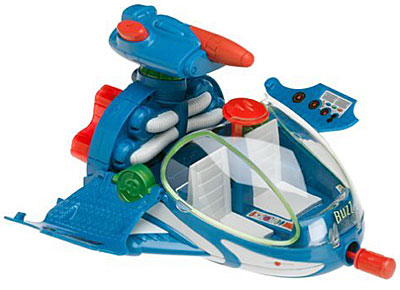
Buzz Lightyear’s Electronic Spaceship has a rounded teal-blue body, a clear curved cockpit and white panels that open around its command area. Red controls and a raised launcher give the little cruiser a busy appearance. Imagine a space-ranger mission beginning at that console: the pilot names a distant moon, mission control checks the route, and a small discovery becomes the reason for the journey.A cruiser and a command center
The ship offers two settings for a story: a cockpit for the journey and an opened command center for planning the next step. Hasbro’s guide shows the panels opening around the interior and identifies a control for engine lights and blasting sounds. Those effects can mark a departure while the players supply the destination, the crew’s observations and the reply from home.
A tiny printed console is enough to suggest a much larger operation. A player might imagine a map on one screen, a message on another and a signal waiting to be answered. The conversation gives meaning to the buttons and panels: where is the ship going, and what has its pilot noticed?
Try mission-control call and reply
Choose a name for an invented moon. Draw three large symbols on paper: an arrow for launch, a star for discovery and a house for homecoming.
- Make the launch call. The pilot names the destination and one thing the crew hopes to find. Mission control replies with a useful detail: “Look for the ridge with two bright peaks.”
- Report a discovery. Move to the star symbol. The pilot describes something specific, such as a garden of silver leaves or a row of stones arranged like musical notes.
- Ask a follow-up question. Mission control asks what is beside it, what shape it makes or whether there is a path nearby. The pilot adds a detail that changes the picture.
- Bring the story home. At the house symbol, the pilot tells what the crew will remember. Write one sentence in a logbook and add a little drawing.
Swap roles for the next moon. A single player can voice both sides, leaving a short pause between each call and reply.
Let the logbook lead the next trip
Choose one unanswered question from the first mission and make it the purpose of the next. Perhaps the silver garden has a gate, or the stone pattern points toward a second ridge. A drawn cockpit and the three symbols provide the whole activity. When using the identified ship, follow its own age and handling directions, with an adult attending to batteries. Keep the imagined radio conversation in the players’ voices.
The historical record
Original Toysit coverage
The original product account and commentary are preserved below as historical coverage.
Light year space ship with electronic light-up engines and cool sounds
When Zurg challenges freedom with a new machine, Buzz Lightyear of Star Command gets ready to send the evil action figure into orbit. Defend the universe with this electronic spaceship playset with action features. Lift the doors of the advanced cruiser to reveal the command center for special missions. The cockpit opens and you can place action figures inside. When Emperor Zurg visits, press the button to fire the toy projectile, or activate the second missile from the launcher that attaches to the top of the ship. Light-up engines simulate blast-off and make cool electronic sounds.
Buzz Lightyear, one of the central figures of Pixar's Toy Story series, is a space ranger action figure who initially believes he's a real space-faring hero sent to protect the galaxy from the evil Emperor Zurg. Several character traits define Buzz:
Confidence: From his debut, Buzz exudes a strong sense of confidence, especially when he believes he's a real space ranger. This self-assuredness, while sometimes bordering on arrogance, is part of his charm.
Loyalty: As the series progresses, Buzz proves his unwavering loyalty to his friends, especially Woody. Despite their initial rivalry, Buzz becomes an integral part of Andy's toy group and is always ready to support and rescue them from peril.
Determination: Whether it's trying to fly or embarking on a rescue mission, Buzz showcases an unyielding spirit and determination, never giving up even in the face of seemingly insurmountable odds.
Naivety: In "Toy Story," his initial inability to recognize that he's a toy leads to comedic situations. This naivety, stemming from his programmed identity, makes him both endearing and relatable, as he grapples with his own existential discoveries.
Growth: Throughout the films, Buzz undergoes significant character development. From his realization and acceptance of being a toy to confronting his own fears and insecurities, he matures while retaining his fundamental qualities of bravery and dedication.
Sense of Justice: Driven by his space ranger ethos, Buzz possesses a deep-rooted sense of justice and righteousness, always aiming to do what's right and protect those in need.
Together, these traits make Buzz Lightyear a multifaceted character, balancing heroism with vulnerability, making him both memorable and beloved by audiences of all ages.
Sources and editorial notes
Hasbro’s four-page 03173 guide text was read through web retrieval; all four mirrored diagram/background layers were inspected alongside it and match the pictured ship. The guide documents engine lights and blasting sounds, an opening command center and a trap door. Direct retrieval of the official PDF returned 403; a readable mirror is linked. Spoken exchanges are supplied by players. The complete original account, six character-trait sections, conclusion, image and August 19, 2023 update are preserved.
- Original Toysit image — Existing same-site photograph reviewed and retained unchanged.
- Hasbro 03173 Electronic Spaceship guide — Complete four-page text reviewed; manufacturer reference 03173, P/N 6479280000. Direct PDF retrieval was blocked during this review.
- Alternate view of the Hasbro guide — Mirror used to inspect the four diagram/background layers alongside the manufacturer text; confirms the photographed rounded cruiser and opening panels.
- Original Toysit coverage — Complete original product account and historical commentary preserved.

Images and descriptions are retained as historical material. How Toysit covers toys.
Created for Toysit by Tabbloza — the artwork in our header.