
From the Toysit archive
Better Now Baby
Explore Better Now Baby’s pretend-care accessories, distinguish the bracelet and drink-and-wet editions, and design a cheerful care bag.
The play at a glance
A cheerful visit built around small care props
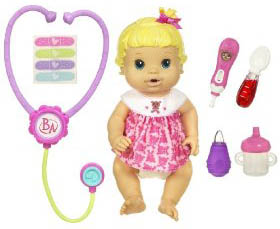
A bear-faced thermometer, a little spoon and a stethoscope give Better Now Baby a familiar pretend-care setting. The doll pictured here wears pink patterned clothing and a wrist bracelet. A player can turn the collection into a visit, with a greeting, a checkup scene and a favorite story to finish.
A bracelet starts the conversation
Hasbro’s Better Now Baby FAQ describes a bracelet-equipped version: squeezing the wrist bracelet lights the doll’s cheeks and starts a spoken complaint. That gives the player a prompt to answer. A greeting, a listening pause and an invented reply can make the exchange feel like a small conversation.
The retained photograph includes a bracelet and a collection of care tools. Use the product label and matching guide to identify an existing doll’s accessory responses and care routine.
The earlier drink-and-wet assortment
The 19267/19270 instructions describe another Better Now Baby arrangement. A bear thermometer supplies a pretend temperature reading; tilting the toy spoon makes its pretend medicine appear to disappear. A sippy cup and diapers add a drink-and-change routine. The 19270 bonus assortment also includes a stethoscope and bandage stickers.
For that documented drink-and-wet edition, the guide specifies cold water or the designated Baby Alive juice and a limit of one cup between diaper changes. Follow its filling, rinsing and drying directions for the matching doll. The bracelet edition has its own instructions.
Let a visitor bring something cheerful
Imagine a visitor arriving with a picture of a garden or a tiny storybook. The doll’s checkup can be one moment in a longer visit: the guest shares a story, asks which picture is a favorite and helps choose what to do next.
A player might give each visitor a different role. One brings a funny tale, another draws a card, and a third describes an imagined outing for tomorrow. Those contributions make the scene belong to the people playing.
Design a pretend-care bag
- Draw a large bag with three spaces inside.
- Add a storybook, a toy cup and a cheerful card.
- Give the book a title and decorate the card.
- Choose a visitor to carry the imagined bag.
- Tell how each item becomes part of the visit.
This original activity uses drawings and player-created dialogue. Keep the bag beside the doll as a story prompt.
The historical record
Original Toysit coverage
The original toy description and broader play discussion are preserved below as historical coverage.
Bear thermometer is one of the ways you help your baby doll get better now
Doll comes with shirt, aspirator, medicine, spoon, sippy cup, thermometer, and two doll diapers. Play mommy doctor with a baby doll that gets all better with love and care. Insert the bear thermometer into her mouth to see that she has a pretend fever. Hold the toy medicine spoon to her mouth and tilt it downward to see the pretend medicine disappear. She even comes with an aspirator that you can use to clear your doll’s stuffy nose. Keep her hydrated with make believe drinks from her sippy cup. She actually wets her diaper. Change her wet diaper, and she’s ready to play again. Stethoscope” and four bandage stickers come in the bonus pack.
A doll equipped with healing-focused accessories such as a thermometer, stethoscope, and medicine offers a range of valuable benefits, fostering both imaginative play and educational opportunities for children.
Encourages Empathy and Care: Playing with a doll that comes with healing accessories promotes empathy and caregiving skills in children. As they use the stethoscope to listen to their doll's "heartbeat," check the temperature with the thermometer, and administer pretend medicine, children engage in role-playing scenarios that mimic real-life situations. This encourages them to develop a nurturing and empathetic attitude towards others, enhancing their social and emotional development.
Fosters Understanding of Healthcare: The healing accessories provide an accessible way for children to become familiar with medical instruments and their functions. Through play, children gain a basic understanding of how a stethoscope works or why a thermometer is used to measure temperature. This exposure to medical tools can help alleviate potential fears children might have during real medical experiences, making doctor visits less daunting.
Enhances Language and Communication Skills: Interacting with a doll's healing accessories offers opportunities for language development. Children naturally engage in conversations while role-playing as caregivers or doctors, explaining their actions and describing the doll's condition. This type of imaginative play stimulates vocabulary expansion and encourages children to articulate their thoughts and feelings.
Supports Problem-Solving: As children take on the role of a caregiver or doctor, they face various scenarios that require problem-solving skills. They might need to decide the appropriate "medicine" for the doll's ailment, determine the cause of the doll's "symptoms," or come up with creative solutions to help the doll feel better. This type of play fosters critical thinking and the ability to approach challenges with a solution-oriented mindset.
Empowers Role-Playing and Creativity: Dolls with healing accessories offer a canvas for children to create their own stories and scenarios. Whether they're playing the role of a doctor, a nurse, or a concerned parent, children can let their imaginations run wild and explore different roles within the context of caregiving and healing. This type of imaginative play allows them to express their creativity and experiment with various scenarios.
Promotes Cooperative Play: Children often enjoy involving friends or family members in their play scenarios. Dolls with healing accessories can facilitate collaborative and cooperative play as children take turns being caregivers, patients, or even multiple roles simultaneously. This fosters social interaction, sharing, and communication among children during playtime.
A doll equipped with healing-focused accessories brings a multitude of benefits to children's play experiences. From nurturing empathy and understanding of healthcare to enhancing language skills and promoting problem-solving, these accessories offer a holistic and enriching playtime that encourages both learning and creativity.
Sources and editorial notes
Toysit’s photo shows a bracelet-equipped doll, while the original product paragraph matches Hasbro’s 19267/19270 drink-and-wet descriptions. Hasbro’s Better Now Baby FAQ documents the bracelet response; all four pages of the 19267/19270 guide were visually reviewed for the separate earlier assortment. The exact model number of the pictured doll remains unresolved. Operating details below stay with their documented editions. The care-bag activity is original; no physical testing was performed.
- Hasbro: Better Now Baby FAQ — Manufacturer description of the bracelet, illuminated cheeks and speech.
- Hasbro: Better Now Baby, 19267 — Earlier drink-and-wet product record and linked instructions.
- Hasbro: Better Now Baby bonus assortment, 19270 — Bonus accessories and linked four-page guide; all pages reviewed.
Images and descriptions are retained as historical material. How Toysit covers toys.
Created for Toysit by Tabbloza — the artwork in our header.