
From the Toysit archive
Cicciobello Care Doll
Meet Cicciobello’s blue outfit and colorful care accessories, then invent a gentle routine with story, song and rest cards.
The play at a glance
A small companion with a care story to tell
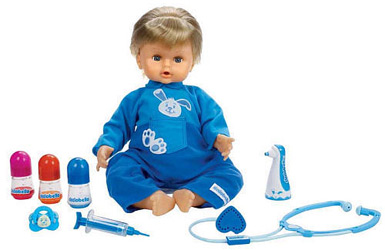
Cicciobello sits in a bright blue outfit decorated with little rabbits. Three colorful bottles stand beside a bunny-shaped pacifier, with a toy thermometer, syringe and stethoscope nearby. Together they suggest a miniature care station: a place to notice the doll, offer a comforting word and decide what happens next in a pretend day.
Notice, respond and settle down
The Love n Care leaflet describes a programmed sequence of crying, glowing cheeks and responses to the supplied accessories. It distinguishes a doll settling to sleep with its pacifier from the completion of its pretend care cycle; later cycles can vary. These are play signals and toy routines. The leaflet specifically reserves the toy thermometer for the doll.
The photograph also offers a quieter story. A player might welcome Cicciobello to a cushion-sized resting place, introduce a stuffed-animal visitor and choose a little song. Ask another player to provide the doll’s imagined answer, giving the scene a conversational rhythm.
Try comfort-choice cards
For this original Toysit activity, draw a book, a musical note and a resting blanket on three separate cards. Any suitable doll, plush companion or drawn character can join in.
- Offer a choice. Ask, “Would you like a story, a song or a quiet rest?” A second player chooses a card and voices the character’s answer.
- Make the first scene. Invent a very short story, hum an original tune, or describe the peaceful place the character would like to visit in a dream.
- Pause and ask again. Imagine that some time has passed. Let the character choose another card, or ask for the same one again.
- Welcome a visitor. A paper rabbit arrives with a friendly question. Give the resting character the final choice about how the visit ends.
Draw a three-picture record of the beginning, middle and end. The character might start with a book, enjoy a song and finish by telling the rabbit about a dream.
Keep the care station pretend
Use toy props and spoken make-believe throughout. Keep real medicine and medical equipment out of the activity, and use the supplied toy thermometer only with its intended doll. An adult should match an owned doll’s label, accessories and instructions before electronic play or battery work.
The historical record
Original Toysit coverage
The complete earlier account follows, including its broad claims about medical anxiety, therapy and development. These are retained as historical commentary, not findings demonstrated for this doll or instructions for treating a child.
Baby doll that you care for in every way
The sweet Cicci Bello doll from Italy comes with useful accessories for helping and caring. Care for baby by checking her temperature and giving medicine to make her feel better. Give her pacifier and she'll fall fast asleep. Equipment includes stethoscope, milk, juice, and medicine.
Healing Dolls: More Than Just Play
Dolls equipped with accessories such as thermometers, stethoscopes, and medicine bottles cater to a specific niche within imaginative play, emphasizing healing and care. Such dolls not only entertain but also provide invaluable developmental and emotional benefits. Let's delve into the manifold benefits of this thoughtful play theme:
1. Introduction to Medical Procedures
Children can be apprehensive about doctor visits. Playing with a healing-focused doll demystifies medical procedures, making them familiar and less intimidating. Using a toy stethoscope or reading a pretend thermometer can alleviate anxiety associated with real-life medical encounters.
2. Nurturing Empathy
Caring for a 'sick' doll helps children develop empathy and compassion. They learn to understand and respond to the needs of others, qualities that are foundational to building strong interpersonal relationships in the future.
3. Enhancing Cognitive Skills
As children diagnose and treat their doll's ailments, they engage in problem-solving and critical thinking. Determining what's 'wrong' with the doll and choosing the appropriate 'medicine' or tool promotes cognitive development.
4. Role Play & Imagination
With a plethora of medical accessories at their disposal, children can engage in diverse role-playing scenarios. Whether they are the attentive doctor, the nurturing family member, or the pharmacist, such play nurtures their imaginative prowess.
5. Boosting Communication Skills
Explaining what's wrong with the doll, discussing symptoms, and prescribing treatments allow children to articulate complex ideas and emotions. Such playtime conversations can enhance vocabulary and improve overall communication skills.
6. Emotional Processing
If a child has had recent medical experiences or challenges, playing with a healing doll can be therapeutic. It provides them with a safe space to process emotions, ask questions, and understand their own experiences better.
7. Building Responsibility
Administering 'medicine' at the right time or ensuring the doll rests enough teaches responsibility. Children learn the significance of routines and the importance of caring for someone else's well-being.
Cici Bello with her healing-focused accessories is a tool that promotes understanding, empathy, and growth. Through play, children are introduced to the world of medicine in a comforting manner, learning invaluable life skills along the way.
Sources and editorial notes
The complete four-page Giochi Preziosi Love n Care leaflet was visually inspected, with its English section read in full. It describes the pictured accessory family, but the exact regional label and production revision of Toysit’s doll remain unconfirmed. The current Bua GPZ05639 page is comparison evidence: its age guidance differs from the older leaflet, so follow the owned product’s label and matched instructions. The old article’s therapeutic and developmental claims are historical commentary, not established outcomes. No physical testing was performed.
- Original Toysit image — Existing same-site image reviewed and retained unchanged.
- Giochi Preziosi: Cicciobello Love n Care leaflet (PDF) — Manufacturer document hosted by Amazon; all four pages visually inspected, including the complete English instructions and toy-only thermometer warning.
- Cicciobello: Bua manufacturer page — Current GPZ05639 family comparison; its specifications are not transferred to the older photographed edition.
- Original Toysit coverage — Complete historical account retained, including its original claims and wording.

Images and descriptions are retained as historical material. How Toysit covers toys.
Created for Toysit by Tabbloza — the artwork in our header.