
From the Toysit archive
Croc Block Wagon
Stack blocks on the crocodile, put them inside, then find them again: a guide to the musical wagon and a simple delivery game.
The play at a glance
A place to build, a place to hide, a way to carry
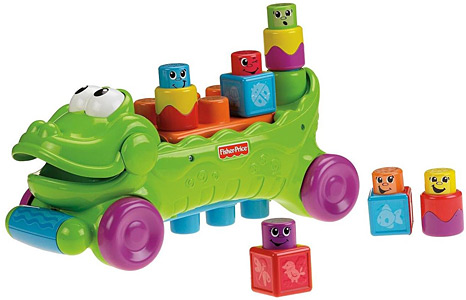
The Croc Block Wagon gives the same blocks several jobs. They can become a small stack, disappear into the crocodile or travel to another spot. The six blocks have peekaboo pop action; the wagon adds sounds and music.
Start with whichever action interests the child. A short round of putting in and taking out can be a complete game without building a tall tower or going anywhere.
Follow the blocks through the wagon
Mattel identifies this version as T4336. The back provides a building surface and opens to reveal the storage space. Opening and closing the mouth produces tunes and sound effects; pulling the wagon adds another musical response. Those sounds accompany the actions. The documentation does not describe choosing a separate musical note with each block.
- Build
- Choose a place on the back for a block or a short stack.
- Put in
- Send blocks into the crocodile’s storage space.
- Find again
- Open the back and bring the blocks out.
- Carry
- Use a short floor route when pull-along play suits the child.
Try a two-place delivery game
This activity needs only the wagon and its own blocks. Choose two nearby spots on a clear, level floor: one for collecting and one for unloading. A caregiver can name them aloud instead of adding markers or extra objects.
- Choose one block and give it a destination: “This one is going over there.”
- Put it inside the wagon. Pause to notice where it went.
- Move the wagon to the second spot, or simply move the story there while remaining seated.
- Open the back, retrieve the block and decide whether to send it home.
Repeat with a different block or carry two together. There is no need to count correctly, remember a color name or finish a prescribed route. The interesting decision is what happens to the block next.
Choose stationary or pull-along play
The instructions show the handle rotating underneath for seated play and flipping out for pulling. An adult can arrange the handle before the game. Use the low-volume setting if sound is wanted, and switch the wagon off when finished.
For a quieter variation, invent a crocodile’s voice yourself: ask for a block, announce its arrival and say goodbye when it comes out. For a building variation, unload the blocks and make a small arrangement before packing them again. Pulling is one option; it need not be a walking lesson.
Check an older wagon before play
Match the product code and look over the blocks, wheels, handle, opening back and secured battery cover. Use the manufacturer’s guide for battery replacement; do not turn the wagon into a ride-on or support for standing.
The T4336 care instructions call for wiping with a cloth dampened with mild soap and water, without immersing the toy. Keep its musical mechanism dry and leave repairs to appropriate service advice. The useful question for an older set is whether its parts are intact and working as documented, rather than whether every sound plays as loudly as remembered.
The historical record
Original Toysit coverage
The original product description and musical-block essay follow in full. The essay’s discussion of composing tunes with individual notes is broader than the documented features of this wagon; its developmental claims are retained as historical commentary.
Musical stacking toy from Fisher-Price
Musical building block toy set teaches building stacking skills while entertaining with music and sounds. The croc block wagon interacts with the child and they can pull the croc around after loading him up with blocks. Baby can stack blocks on the crocodile's back for peek-a-boo, pop-up action or enjoy put-and-take play, feeding blocks to the for musical rewards. When baby wants to walk, flip out the handle to pull the wagon along. The wagon includes six peek-a-boo, pop-up blocks to stack, with storage space inside and building surfaces. Teaches coordination skills, balance, fine motor skills, and cause and effect.
The fun of musical building blocks is an enchanting blend of creative construction and melodious exploration. These innovative toys combine the joy of building with the magic of music, offering children a unique and immersive play experience that stimulates their imagination and encourages hands-on learning.
Interactive Creativity: Musical building blocks transform the act of construction into a creative adventure. As children stack and arrange the blocks, they're not just building structures, but also crafting musical compositions. This interactivity adds a new dimension to play, allowing children to express themselves through both visual design and auditory arrangement.
Harmonious Exploration: Each block is a musical note waiting to be played. When children place or tap the blocks, they trigger delightful sounds and melodies. This fosters an exploration of musical patterns, rhythms, and harmonies. As they experiment with different combinations, children discover the joy of creating their own tunes and arrangements.
Multi-Sensory Engagement: Musical building blocks engage multiple senses, enhancing the play experience. Children see the vibrant colors and shapes of the blocks, hear the musical notes they produce, and feel the tactile sensation of handling the blocks. This multi-sensory engagement adds depth to play and encourages holistic learning.
Collaborative Play: Musical building blocks are often designed for group play, making them ideal for cooperative activities. Children can work together to construct intricate structures that double as musical compositions. Collaborative play promotes teamwork, communication, and sharing, fostering positive social interactions.
Creative Expression: Musical building blocks offer a canvas for children to unleash their creativity. They can build towers, bridges, and landscapes while integrating musical elements. This dynamic play allows children to explore different ways of combining music and design, empowering them to experiment and innovate.
Introduction to Music: Musical building blocks provide an accessible introduction to the world of music. Children become familiar with concepts like melody, rhythm, and harmony in a playful and intuitive manner. This early exposure to musical elements lays the foundation for future musical exploration and learning.
Joyful Learning: Learning through play is an essential part of childhood. Musical building blocks seamlessly integrate education with entertainment. Children absorb fundamental concepts in a joyful way, making the learning process engaging and memorable.
The fun of musical building blocks lies in the fusion of creative construction and musical discovery. Through interactive creativity, harmonious exploration, multi-sensory engagement, collaborative play, creative expression, and joyful learning, these toys provide children with an enriching and delightful playtime experience that sparks their creativity and nurtures their love for music and design.
Sources and editorial notes
Reviewed October 16, 2026 using Mattel’s T4336 product record and four-page T4336pr-0920 instructions, including the handle, storage and control diagrams. These documents match the earlier wagon described here; later product codes should be checked separately. The delivery game is an original editorial suggestion. No physical toy or audio was tested.
- Mattel: T4336 Croc Block Wagon — Historical product identity, six blocks and play features.
- Mattel: Croc Block Wagon instructions (PDF) — Four-page guide to the handle, storage, volume control and care.
Images and descriptions are retained as historical material. How Toysit covers toys.
Created for Toysit by Tabbloza — the artwork in our header.