
From the Toysit archive
Barbie Swim and Dance Mermaid
Explore Barbie Swim and Dance Mermaid’s pink-and-purple tail, flower floats and wind-up movement, then create a small underwater dance story.
The play at a glance
A pink-and-purple mermaid ready for a water dance
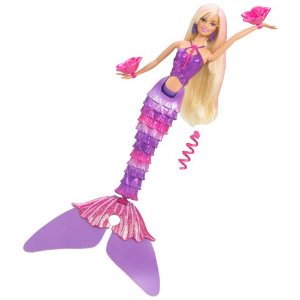
A broad purple fin spreads beneath a tail of overlapping pink and lavender layers. Pink flower floats circle the mermaid’s arms, and long blonde hair reaches toward her waist. Barbie Swim and Dance Mermaid turns a wound-up fin into movement through the water, with different poses giving the same character a swim, a seated spin or an upright dance.
Let the pose shape the movement
The T1474 guide shows three arrangements: stretched out for a horizontal swim, bent at the hips for a seated spin, and upright for a dance. The flower floats and arm positions help shape these arrangements. A spiral tie gathers the long hair before the fin is wound.
For this edition, the guide shows the fin flipped upward, wound about ten to fifteen turns in either direction, then lowered to release the movement in water. Its illustrations show the pose and float placement for each scene. Imagine the horizontal swim as an arrival, the seated spin as a greeting and the upright dance as a celebration; the player creates the occasion and the guests.
A change of color and a new scene
The earlier guide also describes a hair-color effect activated with ice-cold water, returning to the original color at room temperature. It is a detail that can become part of a story: perhaps the mermaid has arrived at a cool underwater spring or is preparing for a festival.
Keep water play under adult supervision and use a surface that tolerates splashes. The guide calls for draining, rinsing, cleaning and thoroughly drying the pieces before storage. Follow the instructions for the doll’s own edition when preparing its tail and accessories.
Make an underwater dance card
- Divide a card into three scenes: arrival, greeting and celebration.
- Draw a setting for each, such as a shell arch, a seaweed garden and a bright coral courtyard.
- Choose a doll or draw a paper mermaid to visit the scenes on a tabletop.
- Invent one gesture and one line of dialogue for each stop.
- Invite another player’s sea creature to join the final scene.
This original Toysit activity uses a dry paper setting and player-created movement. Give the celebration a new purpose each time: welcoming a visitor, sharing a song or unveiling a garden.
The historical record
Original Toysit coverage
The original swimming-doll description and mermaid-folklore essay are preserved below as historical coverage.
From Barbie's Mermaid Tale movie
A perfect pool or bathtub toy for a girl who loves Barbie dolls and mermaids, this swimming doll was inspired by the move entitled Barbie in a Mermaid Tail. The mermaid doll's tail winds up and then she swims through the water. Her hair magically changes color depending on the water temperature. She stays a float with floaties that keep her buoyant. The colors of purple, red, and white are vibrant - a cheerful doll companion in winter months, both because of the colors and because of the theme which is all about warm water and summer. Barbie is so many things (a fairy, a doctor, a princess) - here she is a mermaid, which is a dreamy, wonderful thing.
The Lore of Mermaids
Mermaids, mythical creatures often depicted with the upper body of a female human and the tail of a fish, have been woven into the tapestry of human folklore for centuries. The tales of their enchanting beauty, their haunting songs, and their interactions with humans have become legendary, capturing the imaginations of people across diverse cultures and timelines.
Their lore often places them deep within the oceans, singing songs that either entice sailors to their doom or act as omens of an impending storm or good fortune. Many legends also speak of their benevolent nature, saving drowning sailors or falling in love with humans.
It's believed that the idea of mermaids might have originated from ancient sailors who saw marine creatures, like manatees or dugongs, and mistook them for these mythical beings. Over time, the characteristics attributed to mermaids have evolved and varied across cultures. For instance, while Western depictions often present them as beautiful maidens, some Eastern legends describe them as fearsome creatures.
The Fascination of Children with Mermaids
Children, with their boundless imagination, have always been drawn to the mysterious and the magical. Mermaids embody both of these qualities. Here's why they have become a fascination for many children:
- Escape to Fantasy: The world of mermaids offers an escape from reality. A realm where humans can swim with fish and explore the depths of the ocean is naturally captivating.
- The Allure of Magic: With their shimmering tails and abilities to communicate with sea creatures, mermaids are often seen as possessing magical qualities that children find enchanting.
- Representation in Media: Films, books, and television shows targeted at children have brought mermaids to the forefront of popular culture. Characters like Ariel from Disney's "The Little Mermaid" have played a significant role in making mermaids beloved icons.
- Identity and Transformation: The idea of transformation – from a human to a mermaid or vice-versa – speaks to the broader themes of identity and change that are relatable to children, who are constantly growing and discovering themselves.
The enduring appeal of mermaids in children's imaginations is a testament to the power of folklore, storytelling, and the universal human desire to dream and explore worlds beyond our own.
Sources and editorial notes
Both pages of Mattel’s R4151-0520 guide, labeled for T1474 and T1476, were reviewed. Mattel’s T1474 support page names the blonde Barbie in A Mermaid Tale Swim ’N Dance Mermaid and links that guide; its pictured blonde design matches the retained image. The later W2055 guide was also reviewed for comparison and shows two play poses with different winding directions. The operating description here follows the earlier T1474 guide. The dance-card activity is original; no physical testing was performed.
- Mattel T1474 product support — Identifies the blonde Swim ’N Dance Mermaid and links its instructions.
- T1474/T1476 mermaid instructions (PDF) — Both pages reviewed: three poses, fin operation, hair tie, color change and care.
- Later W2055-family instructions (PDF) — Both pages reviewed for edition comparison; two poses and revised winding directions.
- Original Toysit coverage — Original photograph, description and mermaid-folklore essay preserved.
Images and descriptions are retained as historical material. How Toysit covers toys.
Created for Toysit by Tabbloza — the artwork in our header.