
From the Toysit archive
Bop It Blast
Bop It Blast’s three actions, voice/sound/light modes, solo and group formats, and a practical way to compare cues.
The play at a glance
Hear the cue and choose the action
Bop It Blast asks players to bop, twist or pull in time. Its command modes change what counts as the cue, while its game formats change whether players take turns or share the device.Three ways to receive a command
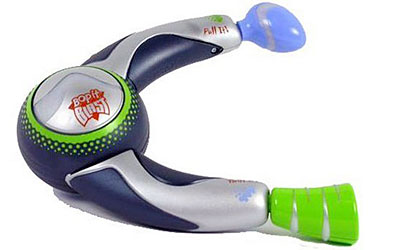
The pictured Blast uses a central Bop It button, a green twist control and a blue pull control. Its handles adjust for the grip. Hasbro’s guide distinguishes three command modes:
- Vox Bop: spoken directions name the action.
- Beat Bop: a bass-drum sound means bop, a crank sound means twist, and an upward whistle means pull.
- Light Bop: act only when the lit control matches the spoken command; wait when they disagree.
Light Bop changes the decision from “Which action?” to “Do these two cues agree?” That makes waiting a deliberate response, not necessarily a failure to react. Explain the chosen mode before comparing scores.
Pick a format as well as a mode
Solo is a personal-score game that friends can take turns playing. Pass It hands the device onward at its cue. One-on-One has two players share the unit, each responsible for a side and its control.
In One-on-One, the Bop It command creates a race between the two sides. The guide ends the game at ten points or when a player makes an error. These are documented rules, not results measured on a toy here.
Before starting a group session, say who will hold the unit first and who receives it next. Keep an ordinary handover separate from the game’s fast responses. Passing is an exchange between people, not a reason to throw the device.
A cue rehearsal without a score
Try this Toysit exercise with the game switched off. One person names a control and another points to it. Then reverse roles. The goal is to agree on the vocabulary and locations before adding pace.
Next, rehearse the idea behind an agreement rule using two spoken words. The caller says a pair such as “twist, twist” or “twist, pull.” The listener says “match” only when both words agree. This is a conversation exercise, not official Light Bop play and not a substitute for its actual lights and voice.
Ask what caused a mistake: forgetting the rule, confusing the control or responding before checking both cues. Those explanations suggest different things to try next. A single score cannot reveal which one happened.
Keep any comparison modest. If you change the handle position, command mode and player order at once, it becomes difficult to say which change affected the experience.
Keep the Blast identity intact
Use the 42401 guide to identify the controls and setup. The retained photograph shows this unit’s blue and green handles; another Bop It design may give familiar words different physical locations or offer different games.
For a secondhand unit, inspect the casing and movable controls, and use the matching instructions for power and battery handling. A seller’s statement that a game “lights up” does not establish that every control, command mode or sound works.
When recording a personal attempt, note the mode and whether play was solo or shared. That makes the record understandable later without presenting it as a general measure of speed, coordination or learning.
The historical record
Original Toysit coverage
The original description remains below. The new guide distinguishes Blast’s documented command modes and group formats instead of treating every Bop It version as interchangeable. No measured reflex improvement or hands-on performance claim is made.
New version of the electronic competitive reflex game toy
You'll have a blast with the totally cool Bop It game, featuring electronic sounds and lights that urge you to compete to the beat. The adjustable handles and automatic scoring make it easy to play. Test your reflexes alone, or compete head-to-head. One or more players can compete.
Bop It stands out due to its engaging play mechanism, where the game device itself serves as the primary interface. Players don't just press buttons; they physically interact by bopping, twisting, and pulling based on vocal prompts, resulting in a tactile, auditory, and visual experience.
Sources and editorial notes
The complete Hasbro Bop It Blast instruction scan identifies model 42401 and matches the pictured adjustable unit. Light Bop combines voice and matching lights; it is not simply a lights-only mode. The cue rehearsal is original Toysit material. No physical testing was performed.
- Hasbro: Bop It Blast 42401 instructions (PDF) — All five scan pages reviewed: controls, command modes, three games, passing and scoring.
Images and descriptions are retained as historical material. How Toysit covers toys.
Created for Toysit by Tabbloza — the artwork in our header.