
From the Toysit archive
Home Depot Work Bench
Revisit the portable Home Depot toy workbench through pretend repair, choosing tools and explaining a job, with a simple illustrated work order.
The play at a glance
A workshop for make-believe jobs
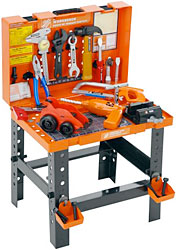
Toysit’s original account describes a Home Depot play-tool case that opens into a workbench, with detachable legs and a small race-car project. The photograph shows an orange work surface, dark gray legs and tools arranged on an upright panel.
The strongest play idea is a complete pretend job: describe a problem, choose what to do, then show someone the result.
Begin with the job, then choose the tool
Invent a small problem for a toy vehicle or a drawn object: a sign has fallen over, a wheel needs an imaginary check, or a garage needs a new shelf. Ask the builder to describe the job before selecting a pretend tool.
Different answers can make a good story. The useful question is “What would you use that for?” A tool’s appearance can suggest a role without proving that it performs the same function as a real tool.
Make the work visible
Draw the object before the imaginary repair and again afterward. Add a label or an arrow showing what changed. One person can be the customer and another the builder, with a short explanation when the job is handed back.
For the race-car project mentioned in the original account, use instructions matched to the actual set. The retained photograph is not detailed enough to reconstruct fastening steps or identify every supplied part.
Let putting away finish the story
A simple drawing of the tools in use can become a return checklist. Match each pretend tool to its drawing, count the loose project pieces and leave the workspace ready for another job.
The old description says the legs fit inside the case, but it does not provide an assembly sequence. Consult the matched instructions for setup and packing rather than forcing a guessed folding mechanism. Keep the play focused on toy props and drawings; it is not a lesson in using real power tools.
Make a pretend repair work order
Divide a sheet into four spaces: the problem, my plan, what changed and what I would tell the customer. Draw a broken-down imaginary vehicle or a building that needs an invented repair.
Fill in the spaces with pictures or a few words. Swap the sheet with another person and see whether they can follow the job from beginning to end. This independent Toysit activity works entirely on paper and does not require the original bench.
The historical record
Original Toysit coverage
The complete original description and later play-tool essay are preserved below. The eighty-eight-piece count, battery-operated drill and detailed tool list remain claims from the original account. The essay’s developmental promises are not findings from a new assessment.
Play toolset with toy power tools - wrench, circular saw - that folds into a portable case
The carrying case opens to reveal a complete set of play tools, including a jacksaw, battery-operated drill, screwdrivers, working vise, measuring calipers, and much more. There are 88 pieces in all. The toy tool set is designed with detachable legs that fit within the case, so the tiny tinkerer can set up a workbench anywhere to build the included race car kit or perform imaginary repairs around the house. Each tool is labeled, so it's easy to find the right one for the job.
A play tool set serves as an inspiring gateway for children to step into the role of builders and creators. By providing young minds with a collection of tools and materials, a play tool set empowers children to engage in imaginative and hands-on play that mimics the actions of real builders. Here's how a play tool set encourages children to feel like they are builders:
- Hands-On Exploration: A play tool set introduces children to the tactile experience of handling tools and manipulating objects. As they hold and manipulate tools like hammers, wrenches, and screwdrivers, children develop fine motor skills and gain a sense of control over their actions.
- Role-Playing: Play tool sets often come with props and accessories that resemble real construction items. This allows children to immerse themselves in role-playing scenarios where they take on the roles of carpenters, mechanics, or builders, fostering creativity and imaginative storytelling.
- Problem-Solving: While playing with a tool set, children encounter tasks that require problem-solving. As they figure out how to connect pieces, assemble structures, or fix components, they develop critical thinking skills and a sense of accomplishment when they successfully overcome challenges.
- Construction and Deconstruction: A play tool set encourages children to build and deconstruct structures repeatedly. This process of building, testing, and rebuilding helps them understand concepts of design, stability, and engineering principles in a playful and hands-on way.
- Imagination and Creativity: With a play tool set at their disposal, children can transform ordinary objects into imaginative creations. Blankets become forts, cardboard boxes become vehicles, and everyday items become parts of their construction projects, allowing their creativity to flourish.
- Independent Exploration: A play tool set provides children with the freedom to explore and experiment independently. This autonomy fosters a sense of confidence as they make their own decisions, explore different approaches, and take pride in their creations.
- Understanding of Tools: Through play, children become familiar with the names and functions of various tools. This early exposure to tools helps build their vocabulary and lays the foundation for practical knowledge they may use later in life.
- Collaborative Play: Play tool sets can facilitate collaborative play where children work together to build larger structures or solve complex challenges. Collaborative play encourages communication, teamwork, and the sharing of ideas among young builders.
- Real-World Connection: Play tool sets offer a bridge between play and the real world. As children see adults using tools for various tasks, they can relate their play experiences to the activities of builders, mechanics, and artisans in their environment.
A play tool set sparks children's curiosity, creativity, and problem-solving skills as they engage in imaginative play that mirrors the actions of builders. By providing the tools and materials to explore construction and creativity, a play tool set empowers children to experience the joy of building and the satisfaction of transforming their ideas into tangible creations.
Sources and editorial notes
The original image and text identify the portable Home Depot workbench described here, distinct from Toysit’s earlier orange and blue electronic Play Workbench. No exact maker/model label or matching instruction sheet was secured. Folding, leg attachment, battery requirements and the old tool names therefore remain unverified rather than reconstructed from the photograph. No physical toy or learning outcome was tested.
Images and descriptions are retained as historical material. How Toysit covers toys.
Created for Toysit by Tabbloza — the artwork in our header.