
From the Toysit archive
Bulk Bucket of LEGO Bricks
Identify Toysit’s red LEGO Creator bucket and explore open-ended brick building with a three-build challenge using the same selection of pieces.
The play at a glance
A bucket of starting points
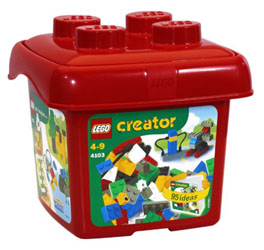
The red bucket in Toysit’s photograph is labeled LEGO Creator 4103. A LEGO catalog from 2005 also identifies 4103 as the Regular Bucket, in a section separate from DUPLO. That distinction matters because the old page’s search keywords mention DUPLO even though the pictured product carries Creator branding.
An assortment like this invites a recurring cycle: choose pieces, make something, take it apart and give the same pieces another job.
Start with a small selection
Spreading out an entire collection can make it harder to decide what to build. Choose a modest group of pieces and notice what is available: long and short shapes, flat surfaces, corners, and any special pieces you already have.
Let those observations suggest a subject. Two long pieces might suggest the sides of a boat; a wide flat area might become a stage. These are invitations to invent, not instructions that assume a particular inventory.
An idea picture is a prompt, not a requirement
The original bucket’s “95 ideas” label presents building possibilities. It does not say that every pictured idea can be assembled at once, or that there are ninety-five pieces in the container.
When following an idea, identify the part that interests you: an outline, a color combination or a way of joining two sections. Keep that feature and change the rest. A missing piece can become a design choice rather than a reason to abandon the whole project.
Keep a record before rebuilding
Give the model a name and sketch its outline. Add one sentence about what it does. After rebuilding, compare the new outline with the old one and notice which pieces are still doing a similar job.
The red Creator bucket and the yellow-lid Bulk Tub are separate archive subjects. Use the label and actual pieces of a surviving set when identifying it, rather than transferring specifications from another container with a similar name.
Three builds from one handful
- Select a small group of bricks from a collection appropriate for the builder. Keep the same selection for all three rounds.
- Build somewhere a tiny character could sit. Sketch it, then take it apart.
- Build an imaginary creature. Give one unusual shape a purpose, then sketch and dismantle it.
- Build an invented vehicle; wheels are optional because this can be a story model.
Compare your three sketches and choose one detail you would reuse. This independent Toysit challenge is not one of the bucket’s documented manufacturer models.
The historical record
Original Toysit coverage
The original short recommendation and full freeform-building essay remain below. Their preschool recommendation, universal accessibility, developmental and sustainability claims are preserved as historical statements, not newly verified conclusions about this particular bucket.
Interlocking pieces.
Preschoolers love to create structures of their own design, and there's no better building set to get them started than this basic Lego set.
LEGO, one of the world's most beloved toy brands, is renowned for its intricate building sets that come with detailed instructions. However, beyond the guided building experience, LEGO also offers immense opportunities for imaginative freeform construction. Here's how LEGO building blocks facilitate this unstructured, creative play:
- Versatility of Pieces: LEGO bricks come in various shapes, sizes, and colors, allowing for endless combinations and possibilities. This versatility encourages experimentation and creativity, as builders can mix and match pieces to create anything they imagine.
- Encouragement of Creativity: Without the constraints of following instructions, children and adults alike can let their creativity run wild. They can build abstract sculptures, invent new machines, or create their own fictional worlds, all with the same set of LEGO bricks.
- Development of Problem-Solving Skills: Freeform construction challenges builders to think critically and solve problems as they figure out how to bring their ideas to life. This process fosters cognitive development and enhances problem-solving abilities.
- Expression of Individuality: By building without instructions, individuals can express their unique personalities and interests through their creations. Whether it's a fantastical castle or a futuristic spaceship, each creation is a reflection of the builder's individuality.
- Collaborative Play: LEGO's freeform construction encourages collaboration and teamwork. Friends and family can work together on shared projects, communicating and cooperating to achieve a common goal.
- Reusable and Sustainable: LEGO bricks are designed to be taken apart and reused countless times. This sustainability encourages continuous exploration and creativity, as builders can dismantle and rebuild new creations without needing new materials.
- Accessibility: Freeform construction with LEGO is accessible to builders of all ages and skill levels. Whether a novice or a seasoned LEGO enthusiast, anyone can engage in imaginative play and create something unique.
- Integration with Other Sets: Even if a LEGO set is designed with specific instructions, the pieces can be integrated with other sets or used independently for freeform construction. This integration expands the potential for creativity and innovation.
LEGO building blocks are not just about following complex instructions; they are a gateway to unbounded creativity and imagination. The simple yet ingenious design of LEGO bricks empowers individuals to explore, invent, and express themselves through freeform construction, making LEGO a timeless and versatile toy that continues to inspire builders around the world.
Sources and editorial notes
The original photograph visibly identifies Creator 4103 and advertises 95 ideas. LEGO’s 2005 UK catalog, PDF page 34 (printed preschool page 5), was visually inspected: it lists 4103 Regular Bucket separately from DUPLO. The catalog shows different label artwork, so its age presentation and contents are not silently substituted for the photographed edition. The ideas label is not a piece count. No physical set was tested or complete inventory verified.
- LEGO 2005 UK catalog — Manufacturer-authored catalog hosted by Brickset; PDF page 34 distinguishes 4103 Regular Bucket from DUPLO.
Images and descriptions are retained as historical material. How Toysit covers toys.
Created for Toysit by Tabbloza — the artwork in our header.