
From the Toysit archive
Bulls-Eye Bounce & Roll
Explore Playskool Bulls-Eye Bounce & Roll, its colorful target and convertible lane, with an original two-route arcade postcard activity.
The play at a glance
Two routes to a bright red target
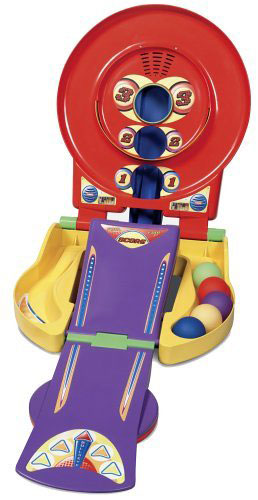
The purple lane stretches toward three holes in a tall red target. Colorful balls wait at the sides, ready for a roll or a bounce. Playskool’s Bulls-Eye Bounce & Roll makes the journey part of the game: a ball can travel along the ramp or spring from the bounce surface toward the same familiar target.Choose a journey, then a game
The hinged bounce surface opens backward to form the rolling ramp shown in the photograph. With the toy assembled as its guide directs, the two arrangements offer a satisfying visual contrast: a ball following a lane and a ball rising from a springy surface.
The three modes give those journeys different purposes. Target Practice offers open-ended aiming. Match Me asks the player to aim for the target named by the announcer. High Score Challenge gives a 45-second scoring round. A called target can become a tiny invitation: listen, look for the opening and send the next ball on its way.
Make two arcade postcards
Original Toysit activity: fold a piece of paper into two panels. On one, draw a rolling ball’s road to the red target. On the other, draw a bouncing ball’s curve. Give your pretend arcade a name and put it across the top, perhaps “Rainbow Ball Station.”
After an ordinary turn in each configuration, add one detail you noticed: the hole the ball entered, a sound you heard or the place where it changed direction. An adult can help change the toy’s setup according to its instructions. Keep the drawing beside the toy while playing.
Finish with a short postcard message: “Today our yellow ball took the high road.” The journey can be real and the ball’s personality imaginary. If you are playing on paper alone, draw two different routes to the same target and tell their stories.
Set up a small indoor arcade
The 07809 guide specifies adult assembly, an age label of three and up, and indoor use away from direct sunlight because sunlight can interfere with its light technology. Follow that guide for the rings, chute and battery compartment. Choose a clear play area where the balls can be gathered easily, and keep the paper postcards outside the ball’s path.
The historical record
Original Toysit coverage
The original product account and commentary are preserved below as historical coverage.
Playschool electronic ball arcade game
Arcade ball game at home with the Bulls-Eye Bounce and Roll toy. The action never stops with two ways to play: bounce or roll. Three challenging game modes: target practice, match me, and the high score challenge. Electronic announcer encourages play, keeps track of points, and records the high score. Game folds up for easy storage and cleanup. Take the challenge and score a bulls-eye of fun. Bulls-Eye base comes with small ring, large ring, chute, and five balls.
Reminiscent of Skee Ball
Skee Ball is an iconic arcade game that has entertained players of all ages for over a century. Originating in the early 1900s, the game's primary objective is straightforward but addictive: players roll a series of balls up an inclined lane, aiming to land them in one of several rings or holes, each with different point values.
- Gameplay: Players typically have a set number of balls (usually nine) to roll per game. Using skill and precision, they roll each ball up the lane, trying to get it to jump into one of the rings at the end. The further away and smaller the ring, the more points it's worth.
- Scoring: The scoring system varies slightly depending on the machine or venue, but typically, the holes are labeled with values ranging from 10 to 100. The objective is to achieve the highest score possible with the given set of balls.
- Design: Traditional Skee Ball lanes are made of wood and are approximately 10 to 14 feet long, with rings or holes at the end. The game has a nostalgic, vintage appeal that has largely remained unchanged since its inception.
- Popularity: Skee Ball's universal appeal stems from its simple mechanics combined with the challenge it presents. Over the decades, it has become a staple in arcades, boardwalks, and entertainment centers worldwide.
- Rewards: In many arcades, achieving a high score or hitting specific point thresholds in Skee Ball can earn players tickets. These tickets can typically be redeemed for prizes, adding an extra layer of excitement and motivation to play.
Skee Ball's enduring charm lies in its perfect blend of skill and luck, its retro feel, and the sheer joy of landing a ball in that elusive 100-point ring. For many, it's a nostalgic trip down memory lane, while for others, it's a new, exciting challenge to conquer.
Sources and editorial notes
Hasbro’s complete two-page 07809 guide was visually reviewed and matched to the original photograph. It distinguishes the three game modes and the bounce/roll configurations. The historical Skee-Ball discussion is preserved as general arcade context. The postcard activity is an original Toysit suggestion, with no physical testing claimed.
- Original Toysit image — Existing same-site photograph reviewed and retained unchanged.
- Hasbro Playskool 07809 instructions — Complete two-page 2005 guide visually reviewed, including assembly diagrams, configurations and mode descriptions.
- Original Toysit coverage — Complete original product account and historical commentary preserved.

Images and descriptions are retained as historical material. How Toysit covers toys.
Created for Toysit by Tabbloza — the artwork in our header.