
From the Toysit archive
Hot Wheels Cyborg Assault
Explore Hot Wheels Cyborg Assault through its lower route, pivoting ramp and car-holding head, then draw a story in which the route changes.
The play at a glance
A car route that changes in mid-adventure
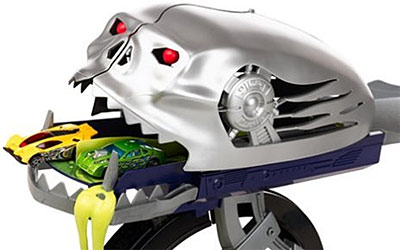
Cyborg Assault gives a car journey a mechanical character encounter. Mattel’s B5708 guide shows a lower track route and a player-selected diversion onto a tall pivoting ramp. The ramp swings toward the head and delivers a car into its jaws.
The silver face in Toysit’s photograph is part of that physical track mechanism. Its dramatic appearance supplies a character for a story; it does not imply a robot that learns, plans or adapts to the player.
Find the player’s decision
The guide’s side launcher feeds the lower circuit, while a lever diverts a car toward the pivoting track. These are different paths through the same setting. Find the decision point before trying to explain the whole mechanism.
In a drawn story, that junction can become a question: continue around the circuit or take the route toward the character? Give the driver a reason to choose, such as finding a friend or recovering an imaginary delivery.
Notice what needs resetting
The instructions distinguish car-storage and bypass settings in the head. In storage mode, arriving cars can trigger a release that sends them back onto the track. The pivoting ramp and head have preparation positions for another run.
A reset is a useful pause in a story. It lets the players change the destination, exchange roles or retell the scene with a different outcome. Use the complete manufacturer guide for an actual set.
Give the character a role
The cyborg can be an obstacle, a gatekeeper or a misunderstood helper. Decide what it wants and what the driver wants. A conversation invented by the players may resolve the scene as readily as an escape.
Keep the fictional personality separate from the toy’s actions. “The character changed its mind” can be part of a story even though the real mechanism responds to controls and moving cars.
Route open, route blocked
- Draw a start, a junction and a destination.
- Add a character beside one branch of the route.
- Tell a first version in which that branch stays open.
- Tell a second version in which it closes and the driver chooses another way.
- Draw how the two journeys end and explain the difference.
This independent paper storyboard needs no original set. Its open and blocked routes are story choices, not additional operating modes for Cyborg Assault.
The historical record
Original Toysit coverage
The full original toy description and science-fiction essay remain below. The essay discusses imagined cyborgs, identity and human-machine relationships; it is not a specification for this playset or a researched account of medical technology. The new track explanation follows the manufacturer’s diagrams rather than the original highway-ripping shorthand.
Hot Wheels Attack Track Set
An awesome challenge featuring a battle between kid versus cyborg. This deluxe diecast track has speed, power, performance, and major attitude with multiple features. Features include swinging arm action that rips the highway in two. Includes two exclusively decorated vehicles.
In the realm of science fiction, a cyborg, short for "cybernetic organism," is a captivating concept that explores the fusion of human biology and advanced technology. Cyborgs are often depicted as beings that incorporate both organic and artificial components, blurring the line between humans and machines. This concept has given rise to a range of fascinating narratives and themes:
Integration of Components: Cyborgs embody the integration of mechanical or electronic components with human physiology. These components can range from prosthetic limbs and sensory enhancements to implanted microchips and advanced neural interfaces.
Enhanced Abilities: Cyborgs typically possess enhanced physical, mental, or sensory abilities beyond those of ordinary humans. These enhancements might include increased strength, speed, accuracy, or data-processing capabilities.
Technological Adaptation: Cyborgs adapt to their environment through technology, allowing them to interface with computers, access vast databases, and even control machines remotely, blurring the boundary between the digital and physical worlds.
Identity and Humanity: Cyborg narratives often explore questions of identity, humanity, and the definition of self. Characters grapple with whether their augmented nature changes their essence or challenges their emotional connections.
Moral and Ethical Dilemmas: The concept of cyborgs raises profound ethical questions about the implications of modifying the human body with technology. Themes of consent, autonomy, and the potential consequences of merging with machines are commonly explored.
Existential Exploration: Cyborg stories delve into existential themes, as characters contemplate the meaning of existence and the nature of consciousness when part of their being is technological in nature.
Transcending Limitations: Cyborgs symbolize the human desire to overcome limitations through technological innovation, illustrating our fascination with pushing the boundaries of what is possible.
Convergence of Genres: The concept of cyborgs intersects with various science fiction subgenres, including cyberpunk, space opera, dystopian fiction, and post-apocalyptic narratives.
Representation and Diversity: Cyborgs are often portrayed with diverse backgrounds, ethnicities, and identities, reflecting the potential for technology to bridge differences and create unity.
Exploration of Fear and Fascination: Cyborgs elicit both fear and fascination, as they embody our intrigue with technological progress while evoking concerns about the loss of humanity and individuality.
Human-Machine Relationship: The concept of cyborgs invites contemplation of the symbiotic relationship between humans and machines, exploring how they might coexist and collaborate in a future world.
The concept of cyborgs in science fiction offers a thought-provoking exploration of the boundaries between human and machine, touching on themes of identity, ethics, technology's impact on society, and the ever-evolving relationship between humanity and innovation.
Sources and editorial notes
Mattel’s two-page B5708 guide was downloaded and visually reviewed. The photographed head matches the guide’s car-storage and release mechanism. Assembly, lower route, pivoting ramp and reset diagrams were inspected. No booster, release mechanism or surviving set was tested. The route-change storyboard is an independent Toysit activity.
- Mattel Cyborg Assault B5708 instructions — Assembly, route choices, head modes and reset diagrams.
Images and descriptions are retained as historical material. How Toysit covers toys.
Created for Toysit by Tabbloza — the artwork in our header.