
From the Toysit archive
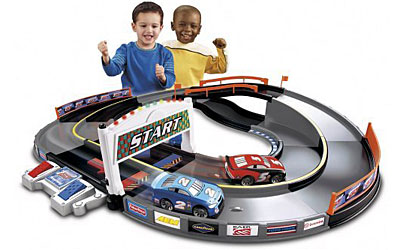
Shake ’n Go Speedway
Understand the Shake ’n Go Speedway’s cars, starting gates and announcing sign, with a simple way to compare runs and take turns.
The play at a glance
The shake starts the action; the track tells the race
Shake ’n Go Speedway combines a physical gesture with a familiar racing scene. A child shakes a powered car, sets it down and watches it travel. The announcing sign adds lights and race commentary.
The matching Fisher-Price set is H4088. Its cars and start sign have their own batteries and switches, so the act of shaking is an input to the toy, not a way of generating its electrical power.
Three parts of the race
- The child prepares the car
- With its power switched on, the car responds to shaking with engine sounds. The guide says seven or eight shakes are enough; further shaking does not extend the run.
- The car travels after release
- Put it down on the route and let go. There is no remote steering control in this set. When it stops, the instructions describe picking it up and shaking it again.
- The sign reports the race
- The start sign supplies announcements and lights that count down the race’s laps. Its role is different from the motor inside each car.
To use the starting gates, follow the guide’s setup: raise the gates, place the prepared cars on the marked arrows, wait for the announcement and press the release pedal. Match the switch markings on the actual sign; the published revisions differ in how they describe that control.
Try three runs with one car
This original activity begins with one car so there is less to follow at once. Assemble the numbered track pieces on the hard, flat surface specified in the guide.
- Choose one starting place and keep it the same for all three runs.
- Prepare the car consistently, then release it without adding a push.
- Notice where it travels and where it comes to rest. Describe the result in words, or write a short note.
- Repeat twice, then discuss whether the runs looked alike.
Do not treat a difference as proof of a single cause. Battery condition, a joint in the track or the way the car was placed can affect an observation. The point is to notice and describe, not to produce a laboratory measurement.
Add a second role before a second race
One player can prepare and release a car while another watches a particular bend or describes the finish. Swap jobs after a run. Then, if both want to, introduce the second car and the starting gates.
A child who prefers the story can be a pit-crew member or describe an imaginary driver. A session can also end after one successful trip around the route; competition is optional.
Keep the original Speedway distinct
H4088 uses three AA batteries in each car and four in the start sign, according to its guide. These are separate from Xtreme’s rechargeable-car and charger arrangement. Do not transfer charging instructions between the two sets.
The guide warns to keep hair away from the wheels, avoid loose dirt or wet surfaces, and switch the cars and sign off when finished. An adult should handle batteries and check the covers, wheels and track joints. Its cleaning directions prohibit immersion.
A shared Shake ’n Go name is not enough to identify a car’s electronics or compatibility. Use model markings and the matching guide, especially when components have been collected from different sets.
The historical record
Original Toysit coverage
The original product paragraph and sound-effects essay are preserved below. Their claims about confidence, coordination, learning and lasting memories are historical promotional commentary, not measured outcomes. The manufacturer’s wording about knowing who is winning describes race feedback; it is not evidence of general intelligence.
Put rev power in your hands with toy cars that you shake to activate
Lights and fun racing sound effects with cool toy race cars you can rev up by shaking them. The speedway knows who is winning the race. As your car makes its way around the track, you'll hear all different phrases from an announcer who actually gives you the real play-by-play. Each car has its own specific engine sound.
Toy race tracks with immersive sound effects and announcer sounds offer an exhilarating and dynamic play experience that brings the excitement of racing to life, delivering a range of thrilling experiences and benefits:
Realistic Racing Atmosphere: The combination of engine roars, screeching tires, and crowd cheers creates a lifelike race environment, immersing players in the world of competitive racing.
Sensory Stimulation: Sound effects engage multiple senses, enhancing the play experience and making it more engaging and captivating.
Interactive Play: Children actively participate in the race by triggering sound effects through their movements, encouraging physical activity and interaction.
Imaginative Play: The accompanying announcer sounds spark imaginative narratives as players take on the roles of drivers, pit crews, and race announcers.
Emotional Connection: The excitement generated by realistic sound effects and announcer commentary fosters emotional engagement and investment in the outcome of the race.
Role-Playing: Players can imitate the roles of racing drivers, pit crews, or even commentators, enhancing creativity and storytelling skills.
Hand-Eye Coordination: Controlling the toy race cars around the track while responding to sound cues improves hand-eye coordination and motor skills.
Strategy and Timing: Players learn to time their movements and anticipate sound cues to maximize their performance on the track, developing strategic thinking.
Cooperative and Competitive Play: Sound-enhanced race tracks can be enjoyed individually or with friends, encouraging both cooperative and competitive play experiences.
Learning Opportunities: Children can learn about racing, tactics, and race terminology as they hear sound effects and announcer commentary.
Engaging Entertainment: The dynamic combination of visual play, tactile exploration, and realistic soundscapes ensures hours of entertaining fun.
Positive Reinforcement: Sound effects and announcer sounds provide positive feedback and rewards for successful racing maneuvers, boosting confidence.
Social Interaction: Multiplayer race track sets encourage friends and family members to race against each other, fostering social bonding and friendly competition.
Memorable Play: The excitement of racing with immersive sound effects creates lasting memories that children carry with them beyond playtime.
Toy race tracks with sound effects and announcer sounds offer an electrifying play experience that engages the senses, encourages active play, and sparks imaginative storytelling, all while delivering the thrill of competitive racing right into the hands of young racers.
Sources and editorial notes
Reviewed October 16, 2026 using Mattel’s H4088 product record and its four linked instruction-sheet revisions. The original and later US play diagrams were visually compared. The earlier US sheet shows a power/volume switch; later sheets describe an on/off switch, so controls should be matched to the actual edition. The run-comparison activity is an original suggestion. No physical toy, sensor mechanism, speed or distance was tested.
- Mattel: H4088 Speedway — Identity and links to all listed instruction revisions.
- Fisher-Price: original US Speedway guide (PDF) — Numbered track assembly and the earlier start-sign controls.
- Fisher-Price: later US Speedway guide (PDF) — Free running, starting gates and race announcements.
Images and descriptions are retained as historical material. How Toysit covers toys.
Created for Toysit by Tabbloza — the artwork in our header.