
From the Toysit archive
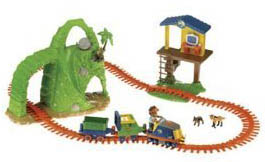
Diego Animal Rescue Railway
Plan a pretend animal-rescue route with Diego’s motorized railway: choose stops, collect toy animals and tell a return story.
The play at a glance
Choose the mission before starting the train
Diego Animal Rescue Railway combines a motorized locomotive with animal figures, rescue scenery and track that can be arranged into a route. The useful storytelling question is where the train needs to stop and why.
Start with one animal and one destination. The train supplies movement; the players decide what the rescue means and how the story ends.
Give the route three story stops
Choose a starting point, a place to collect an animal and a return destination. These can be three moments in the story rather than three separate accessories. Start with the assembled scenery and the animals already in the set.
The M8818 packaging includes a rescue station and mountain cave in its assembly panel. Its operating panel shows the locomotive’s top button starting and stopping the train, and two side buttons raising the rescue car’s platform. Follow those directions for the matching set instead of forcing a moving mechanism.
Changing a track layout changes the physical route. It does not teach the motor to recognize an animal or decide when a rescue is complete.
Try a spoken mission card
This original activity can be said aloud without making a paper card or adding props. Complete these four prompts together:
- Who?
- Choose one toy animal for this trip.
- Where?
- Decide where the train will meet it.
- What happens?
- Invent a small problem: a missed ride, a blocked pretend path or a visit to a friend.
- How does it end?
- Choose a destination and a goodbye.
Run the journey, stop to collect the animal and finish with the chosen ending. Then let another player change just one prompt. Keeping most of the story familiar leaves room to notice the new choice.
Keep the animal story open
A rescue need not become a dramatic chase. The animal might simply need a ride back to its friends. A caregiver can ask what it wants next and accept a short answer, a gesture or a change of plan.
With two players, one can handle the train while the other speaks for the animal. Switch roles for the next trip. If the child prefers arranging the scenery to running the motor, tell the journey with the figures while the train remains off.
These are pretend situations. Keep real animal care separate from the toy’s fantasy actions; the archived essay’s broad benefits do not establish that this set teaches wildlife rescue.
Check the pieces and package identity
Compare an older set with its own markings and the document’s parts panel. Check the locomotive, cars, couplings, track connections, scenery and secured battery compartment. The packaging’s list also distinguishes included pieces from separately sold expansions.
Exact track-length claims differ across the historical sources, so count and identify the actual pieces rather than treating one advertised length as a completeness test. Likewise, the original compatibility claim concerned the then-existing Diego figure range; it is not a guarantee for later figures or other train systems.
The historical record
Original Toysit coverage
The complete original description and animal-rescue essay are retained below. The empathy and conservation discussion is historical commentary. The suggested toy story is fictional and is not guidance for approaching or handling wildlife.
Fisher-Price Go Diego Go train rail track set
Diego's animal rescue railway features an innovative train track design. The track is completely flexible and the rescue locations can be placed anywhere along the track, which puts you in control of track layout. The railway comes with a motorized Diego engine with removable Diego figure, two animal rescue cars, three animals, three rescue locations and over six feet of track. Railway is scaled in the existing scale, so it can interact with all previous Diego figures, animals and playsets. This train set features a snap-together flexible track so that you can easily change the layout! Place the Diego figure on the motorized engine car and stop at the rescue location.
Toys with animal rescue themes hold a special allure for children, captivating their hearts and sparking their imaginations. The fascination with these toys can be attributed to a combination of factors that create a meaningful and enjoyable play experience:
Empathy and Compassion: Children naturally have a sense of empathy and compassion for animals. Animal rescue toys allow them to engage in acts of kindness and care, fostering a sense of responsibility and empathy.
Real-Life Heroes: Animal rescue toys depict real-life heroes, such as veterinarians, animal shelter workers, and wildlife conservationists. Children aspire to emulate these roles, experiencing the thrill of making a positive impact.
Adventure and Exploration: Animal rescue scenarios offer exciting adventures where children can embark on missions to save animals in need. This sense of exploration and discovery adds an element of excitement to playtime.
Problem-Solving: Animal rescue toys often involve problem-solving challenges, encouraging children to think critically, make decisions, and devise strategies to save animals in imaginative scenarios.
Connection to Nature: Animals are a beloved part of children's connection to the natural world. Animal rescue toys allow them to engage in play that reinforces their appreciation for animals and nature.
Creative Storytelling: Children can create rich narratives around animal rescue themes, incorporating elements of teamwork, determination, and resourcefulness as they bring their stories to life.
Understanding Consequences: Through animal rescue play, children learn about the consequences of actions and the importance of taking care of living beings, nurturing their sense of responsibility.
Learning Opportunities: Animal rescue toys introduce children to concepts related to animal care, habitats, and conservation, sparking their interest in learning more about the natural world.
Social Interaction: Playing with animal rescue toys can involve collaboration, role-playing, and shared storytelling among friends, promoting positive social interactions and cooperation.
Emotional Connection: Animals evoke strong emotions in children, and animal rescue toys allow them to express their feelings, whether it's the joy of saving an animal or the satisfaction of nurturing and healing.
Empowerment: Animal rescue play empowers children by allowing them to take on the role of a helper and a hero, boosting their confidence and self-esteem.
Positive Values: Through play, children internalize positive values such as kindness, empathy, and care for others, contributing to their character development.
Inspiration for Future Goals: Engaging with animal rescue themes can inspire children to consider careers in animal care, veterinary medicine, wildlife conservation, and other related fields.
Toys with animal rescue themes tap into children's innate empathy, curiosity, and sense of adventure, offering a meaningful and enjoyable play experience that nurtures their compassion, creativity, and understanding of the world around them.
Sources and editorial notes
Reviewed October 16, 2026 using Mattel’s M8818 record and M8818-0910 packaging artwork, including its printed assembly and operating panel. The record and Toysit say over six feet of track; the packaging says over eight feet and its parts panel lists 8.5 feet. The new guide therefore does not assign an exact track length to the photographed package. Historical figure compatibility should not be extended to all later Diego toys. Activities are original suggestions; no physical set was tested.
- Mattel: M8818 Animal Rescue Railway — Historical product identity and feature description.
- Mattel: Animal Rescue Railway packaging and instructions (PDF) — Packaging artwork with parts, assembly, controls and rescue-car diagrams.
Images and descriptions are retained as historical material. How Toysit covers toys.
Created for Toysit by Tabbloza — the artwork in our header.