
Play ideas to start with
Start with a small action: send a block home, make a delivery or give a picture a voice. These six historical profiles offer different ways to begin a story and return for another turn.
These are historical reading routes across different ages and product editions. Each article explains its evidence and model details. The complete index separates recall-aware owner guidance; the original guide below keeps infant equipment distinct from toys.
Arrange, release and repeat
Historical profile and original play idea
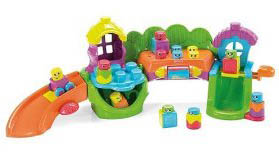
Give a block one place to visit
Choose one action station, pause for its response and bring the block back to the bin.
Stack ’n Surprise Sillytown
Historical profile and original play idea
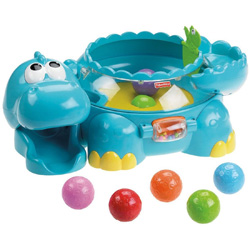
Try one ball from two starting places
Follow the toy’s own ball from the tail ramp or open base, then collect it for another short journey.
Poppity Pop Musical Dino
Give a journey a purpose
Historical profile and original play idea

Load, deliver and return
Give the train’s cargo a destination, pause at the stop and invent a reason for the next trip.
GeoTrax Timbertown Railway
Historical profile and original play idea
Send a character on a two-stop errand
Visit a shop or a friend, choose a second stop and return with a small city story to tell.
Little People Discovery City
Find a picture, then tell a story
Historical profile and original play idea
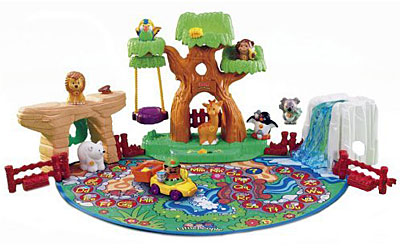
Choose an animal and a destination
Notice a figure’s shape, give it a place to visit and let a short animal story lead the play.
A to Z Learning Zoo
Historical profile and original play idea
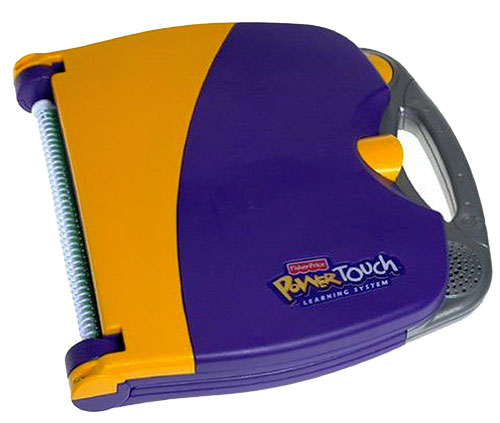
Draw a picture-page sound walk
Explore the historical talking-book system, then draw a separate page where a storyteller supplies the sounds.
PowerTouch Learning System
Explore the collection
Find a closer look at each toy, activity or historical report, grouped by what you would like to explore. The original index remains below with its earlier titles and wording.
Stacking, balls and repeated actions
- Fisher-Price Drop and Roar Dinosaur
- Fisher-Price Sparkling Symphony Stacker
- Poppity Pop Musical Dino
- Stack ’n Surprise Sillytown
Journeys, vehicles and small worlds
- Diego Animal Rescue Railway
- GeoTrax Airport — GeoAir High Flyin’ Airport
- GeoTrax Timbertown Railway
- Imaginext Sky Racers Aircraft Carrier
- Little People Discovery City
- Little People Spin ’n Crash Raceway
- Shake ’n Go Xtreme Speedway
Animal and character stories
Pictures, books and screen-linked play
- Fisher-Price PowerTouch Baby
- InteracTV: 2004 Launch and Picture-Choice Play Historical launch report and toy profile
- PowerTouch Learning System Historical launch report and toy profile
Gyms and changing play configurations
- Elmo’s Musical Peek-a-Boo Gym
- Fisher-Price Sparkling Symphony Gym
- Fisher-Price Stride-to-Ride Dino
- Fisher-Price Stride-to-Ride Lion
Recall-aware history and owner guidance
- Dora’s Talking House
- Little People Animal Sounds Farm
- Little People Wheelies Stand ’n Play Rampway Historical profile · recall information
Fisher-Price spans many kinds of play and equipment. Use the brand as a starting point for finding a model and its instructions, then evaluate what that particular item asks the player and caregiver to do.
Find the kind of play
Begin with an action the child enjoys: handling an object, stacking pieces, moving a character through a scene or making a sound. Compare toys that support that action rather than assuming every product in a familiar line offers the same experience.
Look at the parts the player actually controls. Does a button start a long performance, or can the player change what happens? Can the pieces be used in a new story? How much setup or resetting does an adult need to do? A familiar name, an educational label or a memory of an older version does not answer those questions.
Match an activity to practical checks
| Activity | Look at | Related guide |
|---|---|---|
| Handling and exploring | Intended age, grip, weight, construction and cleaning | Baby Toys for supervised awake play. |
| Stacking and arranging | Piece size, connections and room to try another arrangement | Building Toys for different construction experiences. |
| Characters and pretend scenes | Access to rooms, figure fit and parts to put away | Doll Houses and Action Figures. |
| Sounds and music | Player control, volume, off switch and power | Music Toys for making sounds versus playing recordings. |
| Rolling and vehicle play | Suitable surface, steering or pushing action, track and storage | Diecast for miniature vehicles and playsets. |
For a character-led pretend repair, Handy Manny compares figures, pretend tools and toy build sets. For a vehicle the child rides, use Kids Vehicles to examine rider fit, space and adult setup separately from miniature vehicle play.
Find the model before the manual
Record the product number from the toy, its label or its packaging, together with any other identification the maker requests. Match that information to the official instruction sheet. Similar names and appearances can conceal different assembly steps, accessories or limits.
Mattel and Fisher-Price consumer support provides routes to manuals, replacement parts and technical help. Use the relevant support route when the model is uncertain or a necessary component is missing. A seller's photograph or an old article is not a substitute for the correct instructions.
For a used toy, check completeness and condition before planning a session around it. Follow the stated assembly and care instructions. The CPSC recall database and the maker's recall information should be checked against the actual product; the brand name alone is not a safety guarantee.
Try one activity, then change one thing
With an appropriate toy already assembled as directed, let the player show what they want it to do. For a figure set, a character might arrive at a house and then visit somewhere else. For suitable stacking pieces, the next arrangement might be taller, wider or simply a different order.
Watch for the practical work between attempts. Does a track need constant adult adjustment? Are essential pieces difficult to reach? Can the sound be turned off while the rest of the play continues? These observations can help you choose the next toy without treating a session as a developmental test.
Keep infant equipment separate
This historical collection also includes monitors, high chairs, swings, rockers and bouncers. They are equipment with their own model-specific instructions, limits and recall checks. Their presence beside toys does not make them interchangeable with toys or suitable for sleep.
CPSC safe sleep guidance says to use an appropriate infant sleep product and keep its sleep space bare. Swings, rockers and soothers are not substitutes for that sleep space. A soothing feature or a sleep-themed toy name is not an infant sleep recommendation.
The archive below separately identifies its infant-equipment entries while retaining their original positions and descriptions. Older statements such as “safe and comfortable” remain historical wording, not conclusions of this guide. See Baby Toys for the distinction between supervised awake play and sleep.
Explore a talking book system
Follow PowerTouch from its printed books and touch-sensitive base to an original picture-page sound walk.
From the Toysit archive
Earlier coverage, with original titles and descriptions preserved as historical material. These descriptions include the promotional wording and claims of their time; they are not current operating instructions, safety assurances or product recommendations. Availability, pricing and app support have not been reverified. Identify the exact model and consult its current instructions and recall information.
Historical infant equipment
The following entries concern monitors, seats, swings and bouncers. They are historical equipment reports, not toy or sleep recommendations. Each requires its own current instructions and recall check. Jump to its original entry:
- Fisher Price Baby Monitor - This monitor by Fisher-Price comes with 2 dual receivers so you have twice the convenience. Historical infant equipment
- Fisher Price Cars and Trucks - Fisher Price cars and trucks are stackable.
- Cradle Swing with Mobile - This entertaining swing soothes cranky babies and keeps curious babies busy. Historical infant equipment
- Diego Animal Rescue Railway - Fisher-Price Go Diego Go train rail track set.
- Fantastic Gymnastic Dora - Fisher-Price Dora The Explorer Fantastic Gymnastics Dora.
- Drop and Roar Dinosaur Fisher-Price learning infant playset with roll around friends.
- Elmo's Musical Gym peek-a-boo baby activity center with hanging toys and Sesame Street characters.
- Dora's Talking House dollhouse with mom, dad, pets, and six areas that activate sounds, music, lights, and bilingual phrases.
- Fisher Price High Chair - The healthy care fisher high chair is safe and comfortable. Historical infant equipment
- Fisher Price Little People Farm - Little People Animal Sounds Farm.
- Musical Stacker - The classic fisher price stacking toy with the addition of music.
- Fisher Price Stand Alone Portable Baby Swing - All the features of a full-size baby swing in a compact, portable design. Historical infant equipment
- Baby Gymtastics Fisher Price activity system encourage physical movement and development.
- Geo Tracks Airport - You control the jumbo jet in this playset.
- Geo Tracks Easy Rail Station - GeoTrax train station is part of Fisher-Price timber town railway.
- Geo Tracks Timber Town Railway - RC train can easily be lined up on the track in the special track area.
- Grow With Me RC Rally - Grow With Me R/C Rally by Fisher-Price.
- Infant Toddler Rocker - With soothing vibrations. Historical infant equipment
- InteracTV interactive preschool learning platform with wireless control through which children answer questions.
- Kick and Play Bouncer - The Kick and Play bouncer is equipped with kick-activated music and lights. Historical infant equipment
- Kid Tough Tape Recorder - The most durable tape recorder for kids.
- Little People Discovery City - This playset is filled with animation, lights, speech and sound effects and all happens within familiar places for preschoolers to explore and discover.
- Little People Spin and Crash Raceway - Kids control the outcome with the press of a button.
- Stand and Play - Fisher-Price Little People vehicle ramp playset.
- Magic Hair Dora fairy tale princess explorer doll can say phrases, sing a song, and her hair magically grows while her crown twinkles.
- Fisher Price Nursery Rhymes Bus - Learning nursery rhymes bus.
- Play Laugh Learn Fisher Price learning home, table, garden, and blocks combine fun with educational songs and activities.
- Power Touch Baby reading system from Fisher Price includes learning activities, songs, playful music, sounds, textures, and stories.
- Poppity Pop Dino - Popping balls inside, dinos comes out magically.
- Shake and Go Extreme - Change track layout for different stunts on the Fisher-Price extreme speedway.
- Sing Me to Sleep Pooh - A soothing alternative to a wind-up nighttime musical toy.
- Sky Racers Aircraft Carrier - Naval battle toy on a big scale.
- Soothe and Snuggle Bouncer - Exclusive bouncer features a micro-fleece blanket with satin trim. Historical infant equipment
- Sparkling Symphony Gym - Classical music and childhood classics combine with lights and action to entertain babies and parents alike in this Sparkling Symphony Gym from Fisher-Price.
- Stack and Surprise Silly Town - Baby will love the fun surprises, motorized action and peek-a-boo faces they find exploring this creative building town from Fisher Price.
- Stride to Ride Dino - For learning to walk, then closes to become ride toy.
- Stride to Ride Lion - Walk on the wild side with a Fisher Price walker that rewards baby's first steps with lights and music.
- Tough Stuff Tape Recorder - Durable, easy-to-operate tape recorder for kids.
- Vibrating Baby Monitor - You will feel the vibrating baby monitor in your pocket; it is activated by your child's crying. Historical infant equipment
- Walk and Wag Baby Pluto - Winner of the Family Fun Toy of the Year Award and Ser Padres Award.
- Zig the Big Rig - Fisher Price Little People truck picks up cars.
- A to Z Learning Zoo Fisher Price Little People ABC zoo alphabet learning playset.
A guide to evaluating toys, not a hands-on product test. Read our editorial approach.
Created for Toysit by Tabbloza — the artwork in our header.