
From the Toysit archive
Clipo Creativity Table
Connect textured pieces, sort them into the side compartments and watch a small creation turn: a practical guide to the Playskool Clipo table.
The play at a glance
Make a small build, then change one thing
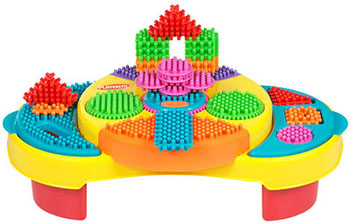
The Clipo Creativity Table combines a place to connect pieces with storage and powered movement. Its textured parts invite small constructions that can be taken apart and tried another way.
The table’s different surfaces matter: the two outer turntables move, while the central building area stays still when assembled. Choose a surface deliberately before adding a motorized turn to the game.
Identify the table and its parts
The official guide lists a base, two buckets, two peg plates, two lids, a motorized gear unit and 25 Clipo pieces. That piece count includes one originally attached to the packaging handle. The lids provide two different activities: a shape sorter and a drop slot.
Use the matching instructions when checking an older table. They show a one-time adult assembly and how the parts seat together. Other bristle-style blocks may look similar, but appearance alone does not establish a working connection.
Try build, observe and rebuild
Begin with the motor off and only a few Clipo pieces in view. This original activity is about choosing a change, not producing a model that looks like the photograph.
- Connect a small arrangement on a stationary area. Give it any name you like, or leave it unnamed.
- Point to a part that could change: one color, one piece or one position.
- Try that change and look again. Is it taller, wider or simply different?
- If you want a moving display, use an outer turntable, keeping the build small and clear of neighboring areas.
With the unit switched on, its button starts roughly ten seconds of turning. Let the motion stop and switch it off before rearranging. The guide warns about hair contacting moving parts and calls for adult supervision.
A caregiver can describe a choice without assigning a score: “You put that one beside it,” or “That part stayed in the middle.” A child who prefers taking pieces apart has found another useful way to explore the same materials.
Give the side compartments a purpose
Use one side as a supply area and the other as the place for pieces you have finished with. Make one little construction, return its parts and choose a different starting piece. This turns clearing away into part of the play sequence.
Alternatively, offer a choice between a connecting activity and a sorting activity. Keep the number of pieces manageable and add more when the child wants them. The table does not need every surface occupied at once.
Keep the setup recognizable
Before use, compare the table with the parts drawing, check that the storage lids and gear unit are properly seated and look for damaged connecting pieces. Follow the matching guide for adult battery work and storage. Keep improvised objects out of the motorized areas.
The value of a session can be as modest as making one connection, watching a turn or choosing to rebuild. Those observable actions are more useful to describe than a promise that this particular table will produce a developmental outcome.
The historical record
Original Toysit coverage
The complete original description and benefits essay are retained below. Broad claims about cognitive development, safety and durability are historical claims, not findings from a Toysit test.
Playskool learning table with snapping shapes and different colors develops cognitive skills
Work with colors and shapes while you discover and create with this creative table from Playschool. Celebrate, spin, stack, sort, and explore. With its spinning gears and bright easy-to-hold connecting pieces, the Clipo Creativity Table system is a platform for imagination and fun. At this all-in-one play station, toddlers can develop their fine motor skills while enjoying a shape sorter and a drop slot. Spinning work areas let kids display their shapes on the table or remove for stand-alone fun. Toddlers express their curiosity as they design their own creations again and again. When playtime is over, the Clipo parts can be stored in the convenient side-storage compartments. Includes table base, two storage buckets, two peg plates, two lids, a gear unit, and twenty-five Clipo pieces.
The Clipo Creativity Table, with its snapping shapes and vibrant colors, offers numerous benefits that support toddlers' cognitive, motor, and creative development. Here are some of the advantages:
Motor Skill Development: The snapping shapes of the Clipo table require toddlers to manipulate and snap pieces together, promoting the development of fine motor skills, hand-eye coordination, and finger dexterity.
Sensory Exploration: The colorful and textured shapes engage multiple senses, stimulating sensory exploration and tactile awareness. Toddlers can feel the different textures and experience the visual appeal of the shapes.
Creative Expression: The Clipo table encourages creative expression as toddlers experiment with various combinations of shapes and colors to create their designs. This fosters imagination and artistic exploration.
Color Recognition: The variety of colors present in the snapping shapes allows toddlers to practice color recognition. They can match and sort shapes by color, enhancing their understanding of basic colors.
Shape Recognition: The Clipo shapes come in different forms, promoting shape recognition and helping toddlers distinguish between circles, squares, triangles, and more.
Problem-Solving Skills: As toddlers experiment with snapping shapes together, they develop problem-solving skills by figuring out how different pieces fit and interlock. This process encourages logical thinking and spatial reasoning.
Independent Play: The Clipo table encourages independent play, allowing toddlers to explore and create on their own. This autonomy boosts their confidence, self-reliance, and sense of accomplishment.
Group Play: The Clipo table can also facilitate group play, enabling toddlers to collaborate, share, and interact with peers. This social interaction enhances communication skills and cooperation.
Language Development: Parents and caregivers can engage toddlers in conversations about colors, shapes, and the designs they create. This verbal interaction supports language development and vocabulary expansion.
Focus and Attention: Engaging with the Clipo table requires toddlers to concentrate on snapping shapes, aligning pieces, and creating designs. This helps improve their attention span and focus.
Pre-Math Concepts: Through activities like sorting and arranging shapes, toddlers begin to develop foundational math concepts such as categorization, classification, and patterning.
Long-Lasting Play Value: The Clipo Creativity Table offers long-lasting play value, as toddlers can continue to explore, create, and experiment with different combinations of shapes as they grow.
Safe and Durable: The Clipo table is designed with toddlers' safety in mind, and the shapes are large and easy for little hands to grasp. The durable construction ensures that the table can withstand hours of play.
The Clipo Creativity Table provides a fun and engaging way for toddlers to develop a range of skills while exploring shapes, colors, and their own creativity. It offers a playful learning experience that supports various aspects of their development.
Sources and editorial notes
Reviewed October 16, 2026 against Hasbro’s official two-page 09949/09942 assortment instructions. Both pages were visually reviewed, including the parts, assembly, stationary center and moving-turntable diagrams. The build-and-change activity is an original editorial suggestion. No physical toy, motor or cross-brand connection was tested.
- Hasbro: Clipo Creativity Table instructions (PDF) — Official parts, assembly, controls and play guide for 09949/09942 assortment.
Images and descriptions are retained as historical material. How Toysit covers toys.
Created for Toysit by Tabbloza — the artwork in our header.