
From the Toysit archive
UNO Moo!
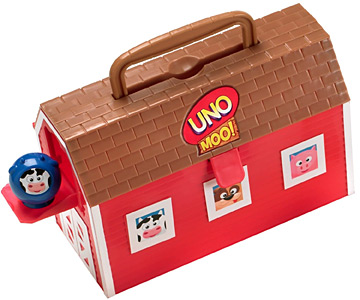
UNO Moo! explained through the original 28-figure edition: animal-or-color matching, special figures, and a separate sorting warm-up.
The play at a glance
Two ways to find a match
Look at the animal on the barn door. Can you match its color, or can you match its kind? UNO Moo! turns that choice into a game of getting your figures back into the barn.What makes a legal match?
In the N7793 edition, players begin with five figures hidden behind haystack partitions. A figure on the barn door is the target. Play a figure that shares its color or animal type, pushing the previous figure inside. There are no individual animal-shaped slots to solve.
Try this example with a yellow dog as the target. A yellow pig matches by color; a blue dog matches by animal. A red chicken matches neither. Ask the player to explain the connection before moving a figure. That explanation is more useful than simply pointing to the answer.
A farmer is wild: play it on your turn and choose the next color. The N7793 skunk makes the next player draw two figures and miss a turn. If you cannot play, draw one figure; play it if it fits, otherwise finish your turn. Consult the linked rules for special cases.
The last figure matters
Call “UNO Moo!” before your next-to-last figure touches the door. The official sheet explains the missed-call penalty and its timing. You win when your final figure reaches the door.
When introducing the game, pause before a move and ask two separate questions: “What could match?” and “How many figures will remain?” A child may recognize the match but still need a reminder about the call. Keeping those decisions separate makes the sequence easier to discuss.
Try a sorting warm-up
This is an optional Toysit activity before the game, with no winner or penalty. Put a few ordinary animals where everyone can see them. Invite one player to group them by color, then invite another to regroup the same figures by animal.
Choose a figure that moved between groups and ask what stayed the same. A blue dog is still a dog when it leaves the blue group. You can also invent a short farm story using the groups, then put everything back and begin the official game.
Keep the farmer and skunk aside during the first sorting round. Introduce them when players are ready to discuss how a game can give an ordinary-looking piece an extra job. These are conversation prompts, not evidence of a particular learning outcome.
Check which barn you have
The original Toysit page describes 28 figures. Compare your box, product number and contents with the N7793 source before adopting its rules. A missing figure and a different edition are different explanations for an unexpected count.
Photograph the contents together and keep a copy of the matching instructions with the barn. For a secondhand set, record missing partitions or unreadable markings before deciding how to use it. Use the age guidance and handling instructions supplied for your actual version.
The historical record
Original Toysit coverage
The original description and longer matching-play essay are preserved below. The essay’s references to designated animal spaces describe a different kind of activity; UNO Moo! uses a changing figure on the barn door as its match target. Its broad developmental claims are historical commentary, not measured results.
Preschool matching game in which children match the critter or the color
In a colorful red barn are colorful farm animals that help kids learn about matching. From Uno, the matching card game, the wild card is the farmer, who matches with any animal or color. The first player to get all of their figures back in the barn wins the game. The barn is a carry case that serves for storage. A total of 28 figures come in the set. Great for imaginary play which is also educational as it teaches similarities and differences between colors and objects in the form of animals.
A playset featuring a red barn and animals can provide an engaging and effective way for children to learn about matching. Here's how:
Visual Identification: The playset's colorful animals and distinct features encourage children to visually identify and differentiate between various creatures. Matching requires them to recognize similarities and differences in color, size, and shape.
Pairing Animals and Spaces: Children can learn to associate specific animals with their designated spaces within the barn. This involves recognizing where each animal "belongs" and enhancing their understanding of spatial relationships.
Memory Building: Engaging in matching activities with the playset helps children exercise their memory as they try to remember the location of different animals and their corresponding spaces within the barn.
Fine Motor Skills: Picking up the animals and placing them in their designated spots requires precise hand-eye coordination and manipulation. This fine motor practice contributes to the development of essential motor skills.
Cognitive Skills: Matching activities stimulate cognitive development as children use logical reasoning to connect animals with their appropriate spaces. They learn to make connections and categorize based on visual cues.
Problem-Solving: Children encounter different animals and spaces, and they must analyze the attributes of each animal to determine where it should go. This fosters problem-solving skills and critical thinking.
Concentration and Focus: Engaging in matching tasks with the playset requires sustained attention and concentration. Children develop focus as they work to correctly match animals and spaces.
Language Development: While playing with the playset, children can name and describe the animals they're handling. This enhances their vocabulary and language skills as they discuss different features of the animals.
Social Interaction: Matching games with the playset can be enjoyed with friends, siblings, or caregivers. This promotes social interaction, sharing, and cooperative play as children work together to match animals.
Independence and Confidence: Successfully matching animals and their corresponding spaces boosts children's confidence and encourages them to take initiative in completing tasks on their own.
Reinforcement of Concepts: Through hands-on matching activities, children reinforce the concept of pairing objects based on similarities, a skill that has applications beyond the playset.
Enjoyable Learning: The playset's imaginative and playful nature ensures that learning matching becomes an enjoyable experience for children, fostering a positive attitude toward learning.
Incorporating matching activities with a red barn and animal playset not only facilitates cognitive development but also cultivates creativity, sensory engagement, and social interaction in a playful and captivating manner.
Sources and editorial notes
This guide follows Mattel’s N7793 28-figure edition, consistent with the original description. Later UNO Moo! revisions have different contents and special-piece rules. The sorting activity is a Toysit suggestion, not an official mode. No physical testing was performed.
- Mattel: UNO Moo! N7793 — Product identification and original edition record.
- Mattel: N7793 rules (PDF) — The 28-figure game, color-or-animal matching, farmer, skunk and finishing rules.
Images and descriptions are retained as historical material. How Toysit covers toys.
Created for Toysit by Tabbloza — the artwork in our header.