
From the Toysit archive
Fashion Fever Styles for Two
Meet two Fashion Fever looks—school-day layers and a shimmering going-out dress—and invent a shared invitation with a different outfit for each character.
The play at a glance
Two looks with somewhere to go
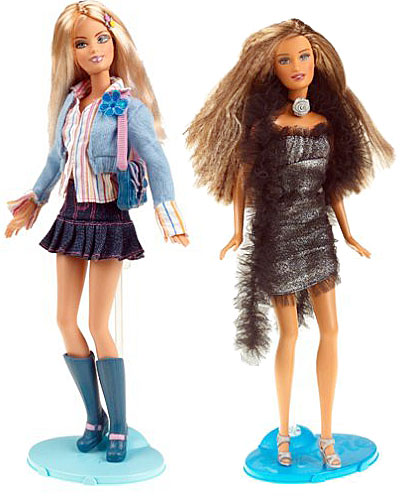
One doll wears a blue jacket over a striped shirt, a short pleated skirt and tall blue boots. Beside her, a brunette wears a shimmering dark dress with a soft-looking wrap and silver-colored shoes. The contrast invites a story: perhaps both are going to the same event, but each has a different part to play.
Look at the details that set a scene
The school-style outfit has several distinct layers to notice: stripes under the jacket, pleats below it and long boots that echo its blue. The going-out outfit concentrates its texture in the dress and wrap. Looking from one to the other is a way to begin a costume conversation: which color catches your eye first, and which small detail would you carry into a drawing?
The original Styles for 2 idea extended the fashion theme to the person playing. Mattel’s Going Out description mentions a barrette, choker and a compact styled like a purse; a related school-themed record mentions a matching notebook. The accessories varied across the range. The photograph brings two looks together for comparison.
Try the same invitation, two outfits
For this original Toysit scene, imagine that a school art exhibition is opening this evening. One character has made a painting; another has arranged the display.
- Make the invitation. Draw a small card with a place, an invented exhibition title and a picture of the artwork.
- Give each look a role. Decide what each character will do on arrival. Either outfit can belong to either role; let the players choose.
- Sketch a useful accessory. One character might bring a notebook of picture titles, the other a folder for the welcome speech. Draw these beside the outfits.
- Introduce the guests. Give each character one original line explaining what they brought and what they hope to see.
Now change one detail on paper: a new jacket color, a star-shaped badge or a patterned bag. Imagine that the exhibition has moved to a seaside pavilion. Explain how that one change helps tell the new version.
Save the costumes as a pair
Put the two sketches beside the invitation to make a tiny costume board. Players can swap character roles and give the same clothes a different meaning. Drawn figures work well for the entire scene, and keep the wearable-accessory part of the old range optional.
The historical record
Original Toysit coverage
The complete earlier product account and commentary are preserved below as historical coverage.
Back to School and Going Out Styles for 2 Fashion Fever Barbie dolls come with real accessories for the girl
Barbie doll comes dressed in an adorable outfit and ready for school. She comes with a pink fuzzy notebook, eraser and pencils with matching gifts for the girl. Outfit styles and colors may vary. Teresa doll wears an on-trend glamour outfit for going out with matching fashion accessories for the girl to wear. There is a barrette and compact that looks like a purse. Accessories include choker, purse, bracelet, barrette, and faux tattoos. Doll can also wear other Fashion Fever outfits, available separately. She has posable limbs. High-fashion Barbie with glamorous clothes and accessories. Includes matching accessories for a girl to wear.
Barbie's Constellation of Friends: A Diverse Array of Doll Companions
Barbie, the iconic fashion doll introduced by Mattel in 1959, is not just a standalone figure; she has been surrounded by a diverse and extensive cast of friends that form a constellation of characters in the Barbie universe. These friends reflect a range of personalities, professions, cultures, and backgrounds, enriching the imaginative play experience for children. Here's a glimpse into Barbie's constellation of friends:
Midge: Midge is one of Barbie's earliest companions, introduced in 1963 as Barbie's best friend. Over the years, Midge's character has evolved, and she has been portrayed in various professions and life stages, contributing to the narrative diversity of the Barbie world.
Ken: Ken, Barbie's longtime boyfriend introduced in 1961, is a staple in the lineup of Barbie's friends. His presence adds a dynamic dimension to Barbie's social interactions and allows for various storytelling possibilities.
Teresa: Teresa is another of Barbie's close friends, known for her athleticism, creativity, and adventurous spirit. She brings her unique personality and interests to the group, offering children the chance to explore different hobbies and activities.
Christie: Christie, introduced in 1968, is known for her warm and friendly personality. As one of Barbie's first African American friends, Christie's presence underscores the importance of diversity and representation in the Barbie universe.
Raquelle: Raquelle, introduced in the 2000s, adds a touch of drama and glamour to the group. Her fashionable and sometimes competitive nature offers a different perspective on friendship and social dynamics.
Summer: Summer, introduced in the late 2000s, is portrayed as a cheerful and outgoing friend. She often participates in outdoor and sporty activities, encouraging children to explore a range of interests.
Nikki: Nikki, introduced in 2007, is one of Barbie's modern friends who values environmental awareness and social justice. Her character reflects the changing attitudes and values of a new generation of children.
And Many More: Barbie's constellation of friends extends beyond these examples, featuring an array of characters with diverse backgrounds, professions, and personalities. From scientists and explorers to artists and entrepreneurs, Barbie's friends inspire children to dream big and explore different paths in life.
The inclusion of a diverse group of friends in the Barbie lineup allows children to engage in imaginative play that reflects the real world's diversity and complexity. Each friend brings a unique perspective to the Barbie universe, fostering creativity, empathy, and understanding as children explore a variety of stories and scenarios.
Sources and editorial notes
Mattel’s 2005 H0915 assortment image includes both pictured looks; H0912 identifies the going-out doll as Teresa and shows matching child accessories. H8575 supplies related school-accessory context, not an exact inventory for this photograph. “Styles for 2” connects doll and child styling; Mattel lists separate sale. Stands shown, articulation, universal clothing fit and every accessory in the old paragraph were not verified as package contents. The preserved friendship essay’s dates and personalities remain historical commentary. No physical testing was performed.
- Original Toysit image — Existing same-site image reviewed and retained unchanged.
- Mattel: Fashion Fever Styles for 2 H0915 — 2005 assortment record and image; separately sold dolls.
- Mattel: Styles—Going Out H0912 — Teresa identification, matching dress image and listed child accessories.
- Mattel: Styles for 2 H8575 — Related school-accessory record; inventories vary by edition.
- Original Toysit coverage — Complete historical account retained, including its original claims and wording.

Images and descriptions are retained as historical material. How Toysit covers toys.
Created for Toysit by Tabbloza — the artwork in our header.