
From the Toysit archive
Shake ’n Go Xtreme Speedway
Plan a route for Shake ’n Go Xtreme Speedway, distinguish its rechargeable cars from the track, and compare layouts without assuming every vehicle fits.
The play at a glance
Change the route, then watch the journey
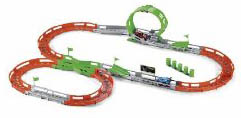
Shake ’n Go Xtreme Speedway adds track-building decisions to shake-activated racing. Its curves, crossover, loop and ramps let a player change where a car goes and what it encounters.
The P4447 set uses rechargeable cars and a separate battery-powered charger. The track itself does not need batteries. That arrangement makes this a different system from the original Speedway and its announcing start sign.
Separate the car, charger and track
The car carries the rechargeable battery that powers its movement. Shaking activates the engine sound and prepares a run; it does not recharge that battery. The P4447 charger takes four D batteries, while the assembled track supplies the route.
The later guide shows an arrow for placing the car on the charger. Yellow indicates charging and green indicates completion. Its nominal charging time describes the original equipment under its intended conditions, not a promise about a battery that has spent years in storage.
For an older set, an adult should identify the matching charger and inspect the equipment before use. Do not improvise charging connections or adapt a different power supply. The guide’s battery-removal passage concerns disposal, not permission to rebuild the car’s battery system.
Start with one documented layout
The instructions show several arrangements, including routes with different relationships between the loop, curves and crossover. Start with one that matches the pieces you have. Follow the illustrated supports and connections rather than treating the loop as a loose decorative section.
Before running a car, trace its intended route with a finger held above the track. Find the starting point, the loop and the return. This can reveal an incomplete connection before the toy is switched on.
Stop the cars before changing the layout. A reconfigurable system still has a particular set of pieces and connection rules.
Try a route-designer’s notebook
This original activity makes the building decision as interesting as the stunt.
- Sketch the first assembled route with a line and mark the loop.
- Run one suitable car as the instructions describe and note one thing you saw.
- Stop play and rebuild into a second illustrated arrangement.
- Use the same car and compare its journey: where did it turn, cross or reach the loop?
Describe outcomes rather than promising a faster circuit. Battery charge and the placement of a car can change a run. A simple note such as “reached the loop, then stopped by the curve” is enough.
Two people can take turns as designer and observer. Let each explain why a layout looks interesting before launching a race.
Use the right cars and parts
The P4447 guide shows its own cars, loop supports, ramps and track sections. It does not establish compatibility with arbitrary toy trains or every other Shake ’n Go release. Keep the matching instructions with a mixed or secondhand collection.
Keep hair clear of moving wheels, check damaged or loose connections and have an adult manage battery equipment. The guide says not to immerse the cars or charger and identifies no consumer-serviceable parts. When the equipment cannot be confidently matched, a drawing of a proposed route is a useful activity that requires no powered run.
The historical record
Original Toysit coverage
The original description and configurable-track essay remain below. The broad claim that children can adapt the track for cars and trains is not a compatibility specification. Claims about learning physics, motor development or endless play are historical commentary, not results from testing this set.
Change track layout for different stunts on the Fisher-Price extreme speedway
An interactive playset that allows two cars to race each other on a reconfigurable track and preform stunts. Playset includes the track, two cars, two ramps, a charger, multiple barrels, billboards, and flags. Both cars include a rechargeable battery. The track can easily be reconfigured into at least four different tracks and includes a loop for stunts.
Configurable play race tracks offer children a dynamic and engaging play experience that combines creativity, problem-solving, and excitement. These versatile toys allow kids to design their own racing circuits, experiment with different layouts, and immerse themselves in the world of racing. Here's why children find play race tracks with configurable patterns so much fun:
- Creative Expression: Configurable race tracks empower children to become track designers, encouraging them to explore their creativity by arranging the track pieces in unique ways. They can experiment with curves, loops, jumps, and straightaways to create their ultimate racing challenges.
- Customization: The ability to rearrange track components provides children with a sense of ownership and control over their play experience. They can design tracks that match their preferences, skill level, and the type of racing scenarios they enjoy the most.
- Problem-Solving: As children experiment with different track configurations, they engage in problem-solving and critical thinking. They learn about the physics of racing, momentum, and how track layout impacts the speed and performance of the vehicles.
- Continuous Play: Configurable tracks offer endless possibilities for play. Children can redesign the track as many times as they like, ensuring that the fun never gets repetitive and allowing for continuous exploration and learning.
- Motor Skills: Manipulating track pieces, connecting them, and aligning them requires fine motor skills and hand-eye coordination. These activities contribute to the development of children's dexterity and spatial awareness.
- Imaginative Play: Configurable race tracks serve as a backdrop for imaginative storytelling. Children can create narratives involving daring races, high-speed chases, and epic finishes, enhancing their imaginative play experiences.
- Social Interaction: Configurable race tracks can be enjoyed individually or with friends and family. Collaborative play encourages children to communicate, negotiate, and cooperate as they work together to design and race on the track.
- Adaptability: Children can adapt the track to accommodate different types of toy vehicles, from miniature cars to toy trains, offering them flexibility in the type of play they engage in.
- Physical Activity: Racing vehicles around a track involves physical movement and coordination. Children enjoy the hands-on experience of launching vehicles, guiding them through twists and turns, and celebrating victory at the finish line.
- Engaging Entertainment: The combination of design, construction, and racing action makes configurable play race tracks a source of captivating and immersive entertainment that keeps children engaged for hours on end.
Configurable play race tracks provide children with a dynamic and multifaceted play experience that nurtures their creativity, problem-solving skills, and imagination. The ability to design, build, and race on custom tracks adds an extra layer of enjoyment and excitement to their playtime.
Sources and editorial notes
Reviewed October 16, 2026 using Mattel’s P4447 record and both linked US guides, P4447a-0920 and P4447b-0920. Charger, loop assembly and layout diagrams were visually reviewed. The revisions differ in assembly illustrations and accessories shown; match the actual components. The later guide describes charger orientation and indicator colors. No battery refurbishment, charging test or runtime measurement was performed. Activities are original editorial suggestions.
- Mattel: P4447 Xtreme Speedway — Historical identity and separate car, track and charger power roles.
- Fisher-Price: P4447a guide (PDF) — Earlier assembly and play diagrams.
- Fisher-Price: P4447b guide (PDF) — Revised loop assembly, charging and suggested layouts.
Images and descriptions are retained as historical material. How Toysit covers toys.
Created for Toysit by Tabbloza — the artwork in our header.