
From the Toysit archive
Fisher-Price Stride-to-Ride Lion
Explore the Stride-to-Ride Lion’s bright mane, musical nose and changing seat, then invent a welcome chorus for imaginary visitors.
The play at a glance
A bright-maned host for a little welcome
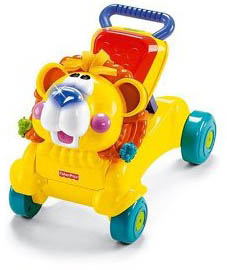
An orange mane frames this yellow lion’s face, with purple cheeks, a blue nose and a soft tuft above the forehead. The raised seat and blue handle make an arch behind its head, while teal wheels carry the yellow body. It looks ready to host a gathering of imaginary animals, each arriving with a different way to say hello.
A nose that joins the conversation
Fisher-Price’s L4511 instructions identify the nose as a control for lights and sounds. That gives the face a role in play: a child can greet the lion, pause, and hear a response. The personalities and words in the activity below come from the people playing.
The seat changes position between rider and walker forms. An adult should follow the matched guide for the seat latch and support, checking that the walker handle is secure before use. Follow the owner’s age and use instructions, supervise closely, and keep the play area level and clear of stairs, slopes and obstacles. Arrange the greeting while the toy is parked.
Try Lion’s welcome chorus
This original Toysit activity makes the lion the host of a small, friendly gathering.
- Sit beside the child and introduce an imaginary visitor: “A tiny elephant has come to say hello.” Give the visitor a quiet, playful greeting.
- Invite the child to answer with a wave, a word or a gentle sound. Wait and let the response be as small or as lively as the child wishes.
- On a matched toy ready for use, pressing the nose can add the lion’s lights and sounds. An adult’s invented lion voice can provide the welcome instead.
- Introduce a second visitor with a different greeting. A bird might say “Good morning, sunshine,” while a sleepy bear simply waves.
- Finish by saying goodbye to each guest. Repeat a favorite greeting if the child wants another turn.
Visitors can be entirely imaginary, or an adult can hold a drawing. Keep props outside any area used later for walking or riding. A drawn lion face also makes a complete version of this game.
Build a familiar cast
Give one visitor a small habit: the bird always notices the weather, or the bear asks about lunch. A returning character makes the next welcome easy to begin. The lion’s bright face supplies a setting; the family supplies the conversation.
The historical record
Original Toysit coverage
The complete earlier product account and commentary are preserved below as historical coverage.
Walk on the wild side with a Fisher Price walker that rewards baby's first steps with lights and music
Fisher Price walker that converts to a ride-on provides play and developmental benefit for baby. In the walker mode, baby has a large wheel base and large handle to aid first steps. Music, light and lion sounds encourage and reward baby as they walk or ride around the house or if baby presses the lion's nose. When baby is ready, simply put the lion's tail down and convert the walker to a ride-on. In the ride-on mode, baby will have a large seat to sit on and ample room for their hands behind the lion's soft tuft of hair around his ears.
Lions hold a special allure for children, captivating their imagination and curiosity. These majestic creatures evoke a sense of wonder and excitement that resonates with young minds. Here's why lions are so alluring to children:
- Majestic Appearance: Lions are known for their regal and majestic appearance. With their powerful bodies, impressive manes, and intense gaze, lions exude a sense of strength and authority that captures children's attention.
- Wild and Adventurous: Lions are wild animals that roam the savannas of Africa, evoking a sense of adventure and mystery. Children are drawn to the idea of these big cats exploring vast landscapes and embarking on daring quests.
- Symbol of Courage: Lions are often portrayed as symbols of courage, bravery, and leadership in various stories, myths, and cultures. Children naturally gravitate toward characters and animals that embody these qualities.
- King of the Jungle: The title "king of the jungle" associated with lions captures children's imagination. This moniker conveys a sense of authority and dominance, making lions seem larger than life in the eyes of young minds.
- Fascinating Behavior: Lions' behaviors, such as hunting in prides, roaring to communicate, and interacting with one another, are intriguing for children to learn about. These behaviors spark curiosity and a desire to understand more about these animals.
- Connection to Nature: Lions' connection to the natural world and their role in the ecosystem fascinate children who are naturally curious about the animal kingdom and the diverse creatures that inhabit it.
- Storytelling and Media: Lions often play roles in children's stories, fairy tales, movies, and animated shows. Iconic characters like Simba from "The Lion King" contribute to the lion's popularity among young audiences.
- Distinctive Features: The unique appearance of lions, including their distinctive manes and distinct social structure, sets them apart from other animals and makes them captivating subjects of exploration.
- Natural Beauty: Children are drawn to the beauty of lions' coats, which vary in shades of gold and brown. The appeal of their physical characteristics, such as the mane and the powerful paws, adds to the fascination.
- Imagination and Play: Lions inspire imaginative play scenarios where children pretend to be lions, create stories involving lion characters, and explore the world of the savanna in their minds.
Lions captivate children through their majestic appearance, symbolic meanings, wild nature, and their presence in stories and media. The allure of lions ignites children's curiosity, encouraging them to learn more about these remarkable creatures and engage in imaginative play centered around them.
Sources and editorial notes
The image and conversion match Go Baby Go Stride-to-Ride Lion L4511, not later three-in-one Lion editions. All six pages of L4511pr-0920 were visually reviewed; the other listed guide was downloaded for reference. The earlier general claims about development and children’s universal attraction to lions remain historical commentary. No physical testing or recall clearance is claimed.
- Original Toysit image — Existing same-site image reviewed and retained unchanged.
- Fisher-Price: L4511 product support — Identifies the 2007 Go Baby Go Lion and its instruction editions.
- Fisher-Price: L4511 instructions — Six-page guide reviewed for assembly, latch and support conversion, nose response, batteries and care.
- Original Toysit coverage — Complete historical account retained, including its original claims and wording.

Images and descriptions are retained as historical material. How Toysit covers toys.
Created for Toysit by Tabbloza — the artwork in our header.