
From the Toysit archive
Vidster Digital Video Camera
Vidster’s curved handgrip and small viewing screen invite short scenes, still pictures and an original disappearing-prop film.
The play at a glance
A little camera with a story to tell
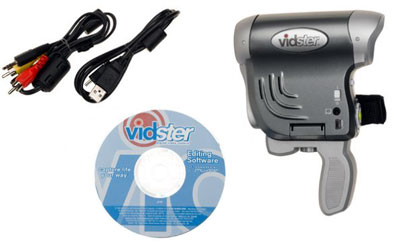
Vidster’s gray body curves down into a removable handgrip, with its viewing screen above the controls. The original photograph places cables and a software disc beside it: this was a camera for collecting pictures and scenes, then carrying them to a larger screen or computer. A small toy on a table is enough to begin a first story.
Choose a picture or a scene
Mattel’s guide describes separate photo, video and playback choices, with a central button for taking a picture or starting and stopping a scene. Pictures and clips are stored in memory. The guide specifies 32 MB built in and support for SD/MMC cards up to 512 MB, alongside television playback and computer transfer.
The accompanying editing guide introduces a computer workflow for combining pictures, video and music. The appealing creative choice comes first: decide what the audience should see, and what should happen between one view and the next.
Try the disappearing prop film
Set a toy beside a folded paper curtain and draw three frames. First, show the toy clearly. Second, show the curtain covering it. Third, reveal a surprising replacement: perhaps the little car has become a paper boat, or a dinosaur has left a flower in its place.
Give the change a reason. “The traveller needed a boat to cross the puddle” makes a different story from “The dinosaur left a present.” A narrator can read one line for each drawing while another player reveals the frames in order. The paper strip is a complete little film to keep.
For an optional camera version, plan separate short shots around the covered view and the reveal, then use an available editing method to arrange them. Keep the viewpoint steady and the scene easy to see. This is a storytelling trick supplied by the players; the surprise comes from changing the prop between views.
Give the film an audience
Finish with a title and a closing credit for each participant. Invite viewers to guess what changed and which detail gave it away. An adult can help choose suitable current equipment and handle any sharing; ask permission before recording other people. A live showing of the drawings works just as well for a small premiere.
The historical record
Original Toysit coverage
The complete earlier product account and commentary are preserved below as historical coverage.
Versatile videocamera for children comes with three-step photo and video editing software
In October 2005, the Vidster Digital Video Camera from Mattel was a virtual movie studio in a box that enabled kids to produce their own music videos and movies. Combining a versatile videocamera with three-step photo and video editing software, the Vidster Digital Video Camera gave children everything they need to shoot, edit, and distribute short films.
"Vidster was designed for today's tweens and teens who want to capture events in their lives and tell stories visually," said Phil Jackson of Mattel. "We've developed a hardware-plus-software combination that, in essence, is a movie studio in a box for kids. It includes the functions most applicable for this age group: taking digital photos with zoom capabilities, shooting video footage that can be easily assembled into short movies using the super-intuitive software, and plug-and-play connectivity that enables viewing footage on their TVs or computers. And frankly, with Vidster, parents can feel comfortable that their own high-end cameras are not bouncing around in their kids' backpacks."
Vidster was ergonomically designed specifically for kids, with ease of use being paramount in its creation. With 32 MB of on-board memory, kids can use the camera right out of the box and capture up to ten minutes of footage and dozens of digital photos.
At eleven ounces, Vidster can be used with one hand - all of its functions can be controlled with just five, thumb-able buttons and a selection switch. Its recessed lens, viewfinder, and durable casing enable kids to keep it in their backpacks with other day-to-day items, so they can pull it out quickly and not miss any action from their everyday lives.
Vidster and its bundled photo and video software were built from the ground up and designed to work seamlessly with one another. Its video editing software, a Vidster version of muvee Technologies' autoProducer, enables kids to add digital music files, and edit and customize their footage and still photos into complete short films or music videos in three simple steps. Films can be easily e-mailed to family and friends, uploaded onto Web sites or burned onto DVDs.
Vidster features a 2.0 digital zoom lens, built-in microphone, color LCD viewfinder, tripod mount and removable hand grip attachment. An expansion slot accepts up to a 512 MB SD card for hours of footage and photos that can be captured and stored. The camera connects directly to a TV via standard A/V cables for easy video and photo playback or to a PC via USB cable.
Vidster Digital Video Camera sold for $79.99.
How a video camera can be an inspiring and educational gift for a creatively inclined child
- Encourages Creativity: A video camera allows children to explore their creativity by making their own videos, short films, or documentaries.
- Develops Storytelling Skills: Children can learn to craft narratives and tell stories through visual media, enhancing their communication and storytelling abilities.
- Teaches Technical Skills: Operating a video camera introduces children to basic technical skills, such as focusing, zooming, and editing, which can be valuable in today's digital age.
- Promotes Collaboration: Making videos often involves teamwork, encouraging children to collaborate with friends or family members on projects.
- Builds Confidence: Seeing their ideas come to life on screen can boost a child's confidence and sense of accomplishment.
- Enhances Observation Skills: Using a video camera helps children pay attention to details and observe the world around them more closely, fostering curiosity and critical thinking.
- Provides a Creative Outlet: For children with a vivid imagination, a video camera offers a medium to express their thoughts, ideas, and emotions in a creative way.
- Encourages Outdoor Exploration: Filming outside can motivate children to explore nature and their surroundings, promoting physical activity and environmental awareness.
- Introduces Film Appreciation: Working with a video camera can lead to a deeper appreciation for movies, documentaries, and other visual arts, cultivating a well-rounded cultural understanding.
- Creates Lasting Memories: Videos captured by children can become cherished memories, reflecting their growth, interests, and milestones over time.
- Supports Future Interests: For children showing an interest in filmmaking, journalism, or content creation, a video camera can be an early step towards a potential hobby or career path.
Sources and editorial notes
Mattel’s J2130 record and all 13 PDF pages of the camera guide were read; selected grip, control and specification diagrams were visually reviewed. The separate 20-page scanned editing guide was reviewed on PDF pages 3–6 for its overview, historical requirements and introduction to editing, not in full. Its Windows ME/2000/XP requirements are historical, not present compatibility advice. The camera guide and photographed bundle differ on whether a USB cable is included. The preserved 2005 price, promotional quotation and broad benefits remain historical claims. No software was installed and no equipment was tested.
- Original Toysit image — Existing same-site image reviewed and retained unchanged.
- Mattel Vidster J2130 support record — Manufacturer identification and historical product documentation.
- Mattel Vidster camera instructions (PDF) — 13-page PDF read; selected grip, control and specification diagrams visually reviewed.
- Vidster editing guide (PDF) — Selected pages 3–6 reviewed for overview and historical system requirements; software not installed.
- Original Toysit coverage — Complete historical account retained, including its original claims and wording.

Images and descriptions are retained as historical material. How Toysit covers toys.
Created for Toysit by Tabbloza — the artwork in our header.