
From the Toysit archive
LeapFrog Spanish LeapPad
Explore the original Spanish-language LeapPad book system, with a guide to identifying language and matching materials and a simple shared storytelling activity.
The play at a glance
Start with the language of the story
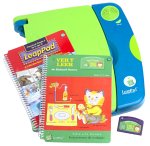
The old Toysit entry presents a Spanish-language version of the paper-book LeapPad system. The photograph shows the earlier platform, books and cartridge rather than a tablet screen. The first useful question is what language the particular book and audio use, not how many languages a device name seems to promise.
Spanish content is not the same as translation
LeapFrog’s 2002 report lists Spanish content for its original LeapPad library. A Spanish-language story can be enjoyed by a child who already uses Spanish, or explored with someone who knows the language. That does not by itself establish an English-to-Spanish translation function or a bilingual mode.
Read the exact title and language information on the materials in front of you. A familiar character or similar cover design is not enough to identify which recording belongs with a book.
Identify a set before describing its lessons
- Platform: record the model and edition rather than relying only on the LeapPad name.
- Book: look at the language, title and printed activity instructions.
- Cartridge: compare its label with the book; keep the two together.
- Audio: for an already working set, listen together to a short section and note what it actually says.
This is an inventory approach, not a claim that cartridges interchange across every region or generation. Later LeapPad tablet apps are a different kind of content. LeapFrog’s legacy support notice says parts and support for the original book-and-cartridge systems are no longer available.
Let listening lead to conversation
Choose one picture or short passage rather than trying to finish every activity. Invite the child to point to something they noticed, describe it in the language they are comfortable using, and ask a question. Repeating a recorded word can be one part of the exchange; understanding what it refers to gives you something to talk about.
If neither reader knows a word, leave room to check it with a reliable language resource or someone who does. There is no need to guess a pronunciation or treat the toy’s subject list as a complete course.
Tell the picture again
Draw three small pictures of an imaginary outing: leaving home, finding something interesting and returning. Take turns telling the story in the language or languages your family uses. The listener points to the matching picture, then adds one detail for the next telling.
This independent Toysit activity works without the old electronics. It makes room for listening, pictures and family conversation without promising fluency or testing the child.
The historical record
Original Toysit coverage
The original Spanish LeapPad introduction and broader language-learning discussion are retained below. The general essay is not evidence that this particular unit translates, switches languages or provides personalized instruction.
Interactive stories that develop learning and reading skills
The Leap Pad learning system, in Spanish, brings books to life with fun, interactive stories and activities that develop fundamental learning and reading skills. When your child is ready to read, the Leap Pad will teach letters, words, spell out words phonetically, or play fun learning games. Leap Pad teaches phonics, reading, vocabulary, geography, science, music, and more!
Electronic toys that teach the Spanish language offer an exciting and interactive way for learners, especially children, to become familiar with a new language. These toys engage users through various sensory channels—such as auditory and visual cues, touch-sensitive buttons, or even motion sensors—that make the learning process dynamic and fun. Users can learn everything from basic vocabulary and phrases to more complicated sentences and dialogues, all while playing. This gamified approach to language learning can be particularly motivating for children, helping them associate learning Spanish with a sense of achievement and joy. The electronic format also allows for repetition and reinforcement, crucial elements in language acquisition.
Sources and editorial notes
LeapFrog’s 2002 annual report lists Spanish among the languages of the original LeapPad content library; the relevant product and international sections were inspected visually. This establishes period language offerings, not the contents or settings of the photographed package. An exact manual for this Spanish edition was not secured. Current LeapPad tablet support pages were not used to assign features to this older book system. No Spanish audio, cartridge compatibility or physical unit was tested.
- LeapFrog 2002 annual report (PDF) — The original LeapPad library’s language offerings and period international context.
- LeapFrog original-system support notice — Parts and support status for the earlier book-and-cartridge family.
Images and descriptions are retained as historical material. How Toysit covers toys.
Created for Toysit by Tabbloza — the artwork in our header.