
From the Toysit archive
LEGO Agents Aerial Defense Unit (8971)
Explore LEGO Agents Aerial Defense Unit 8971 and invent a signal-window mission using a stationary twin-rotor helicopter and a shared shape code.
The play at a glance
A helicopter waiting for the next signal
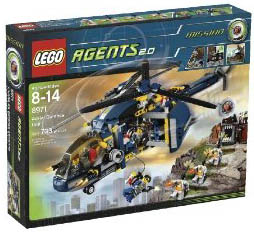
Two large rotors stretch above a long dark-blue helicopter, with yellow accents picking out its body. On the ground, a dish and a dark structure on a rocky base provide another place for the story to happen. LEGO Agents Aerial Defense Unit can become the center of a signal mission: the ground team knows the next step, and the crew needs to read its message.
A crew above and a station below
The helicopter’s long body offers several places to imagine a crew at work. Its canopy and side panels open, and the instruction diagrams show hand-operated rotors, a winch and a small sled-like craft. On the ground, the dish gives the smaller build a recognizable communications role in the scene.
Three blue-uniformed agents face a commander and three magma drones in the booklet’s figure lineup. Players can use that cast for the original adventure or give the figures new jobs in a story about sending and interpreting messages. The helicopter can stay on its landing wheels while the mission unfolds around it.
Try the signal-window mission
- Agree on three signals. Draw a large triangle, circle and square on separate cards. Choose meanings together: “Visit the station,” “Wait for a reply” and “Take a new route,” for example.
- Set the scene. Place the helicopter on a flat surface and give the ground team a station beside it. Draw two possible routes between the crew and a pretend meeting point.
- Show one card. The ground player holds up a signal. The crew player says what it means before moving a figure or changing the paper route.
- Tell the next action. A triangle might send a messenger to the station; a circle might leave time to read a reply. Add a reason for each message to the story.
- Swap roles and invent a new code. Write down the revised meanings before starting. See how the same three shapes produce a different mission.
A solo player can shuffle the cards and reveal them one at a time, keeping a short mission log. A drawing of the helicopter and station works too. The activity uses stationary models and paper messages, without needing spinning rotors or launched pieces.
Give the code a purpose
Choose a shared goal, such as bringing every messenger to the meeting point with the correct report. If a signal is misunderstood, let the characters ask for it again and clarify the plan. Save the code card with the mission log so the next adventure can begin with a message everyone remembers.
The historical record
Original Toysit coverage
The original product account and commentary are preserved below as historical coverage.
New 2.0 action adventure building set from Lego
Dr. Inferno's giant robot is threatening the city. Dr. Inferno's hot-headed henchman Magma Commander is unleashing his magma-drones on the city. Your Lego mission: to take out his satellite broadcaster and neutralize the drones. To do it, you'll need the newest agents aerial defense vehicle - the enormous, gadget-packed twin-propeller agent chopper. Defend with your aerial defense unit. Fire up twin rotors and take to the sky to save the city. You control the actions.
The concept of being secret agents, with their covert missions, high-tech gadgets, and thrilling adventures, has long enthralled children as they play. This fascination taps into a child's natural curiosity, sense of adventure, and desire to explore the unknown. It allows them to engage in imaginative play that is both exciting and empowering.
Children often take on the roles of spies or secret agents, creating intricate missions that require problem-solving, teamwork, and strategic thinking. They may devise secret codes, construct hidden compartments, and use toy spy gear to communicate and gather intelligence. The excitement of sneaking around, uncovering secrets, and outsmarting imaginary foes adds a layer of intrigue and challenge to their playtime scenarios.
The concept of secret agents has also been popularized through books, movies, cartoons, and video games targeted at children. Characters like James Bond, Kim Possible, and Spy Kids have become iconic figures, providing inspiration and role models for aspiring young agents. These media portrayals often emphasize values such as loyalty, courage, and integrity, reinforcing positive character traits and moral lessons.
Secret agent-themed toys and playsets further enhance this fascination, offering tools and accessories that simulate real spy experiences. Whether using fingerprint kits, night vision goggles, or voice-changing devices, children can immerse themselves in the world of espionage, developing skills such as observation, deduction, and collaboration.
Through secret agent play, children not only engage in fun and imaginative adventures but also learn valuable life skills. It fosters creativity, critical thinking, social interaction, and ethical reasoning, turning playtime into a meaningful and enriching experience. The allure of being secret agents continues to be a captivating theme for children, providing endless opportunities for exploration, learning, and growth.
Sources and editorial notes
The box and both reviewed LEGO booklets identify Aerial Defense Unit 8971 (2009). The pictured package reads 733 pieces, while LEGO’s current instruction index lists 930; that discrepancy is unresolved, so the new description does not adopt a count. The giant robot in the original opening concerns the wider Agents range: booklet 2 advertises 8970 separately. The diagrammed hand-operated mechanisms do not establish powered flight or the condition of an older toy. The signal code is an original Toysit activity. No physical testing was performed.
- Original Toysit image — Existing same-site photograph reviewed and retained unchanged.
- LEGO instructions: Aerial Defense Unit — Official edition record and both 76-page booklets; figures, helicopter features and separate 8970 advertisement reviewed. Online piece count conflicts with the original box.
- Original Toysit coverage — Complete original product account and historical commentary preserved.

Images and descriptions are retained as historical material. How Toysit covers toys.
Created for Toysit by Tabbloza — the artwork in our header.