
From the Toysit archive
LEGO Atlantis Neptune Carrier (8075)
Explore LEGO Atlantis Neptune Carrier 8075, its little scout vehicles and a dry tabletop seabed, then map three imagined discoveries.
The play at a glance
A red carrier for an imagined blue world
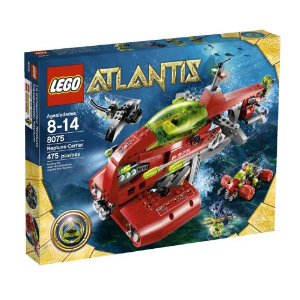
A long red nose, a transparent green canopy and a large fan at the rear give the Neptune Carrier an unmistakable exploration silhouette. Smaller vehicles can set off from the big craft, taking its divers into different parts of an invented seabed. On a dry tabletop, a few paper landmarks can turn that departure into a voyage worth mapping.
A large craft with smaller journeys inside
The carrier’s broad red side sections flank a space beneath the cockpit. Its transparent green canopy curves over the crew area, and a gray fan fills the rear frame. The instruction scenes show a small wheeled rover heading down the lower ramp and a little red sub taking a separate route. Those different shapes suggest different jobs for the expedition.
Three divers, a blue sea character with a trident and a black ray-like creature give the setting several possible viewpoints. A diver could be searching for a landmark while a local character knows its name. The round treasure-key piece can become a clue in the players’ story; they decide what it means and where the next stop should be.
Try a three-landmark survey
- Lay out a dry paper seabed. Draw a shell garden, a stone arch and a rocky ridge on three sheets. Leave space between them for a route.
- Choose the expedition’s path. Draw a small map showing the order of the stops. Put the carrier or a paper craft token at the starting point.
- Send a scout to each landmark. Move an assembled small vehicle or a drawn token along the route. Decide whether the scout is looking closely at the ground or surveying the wider scene.
- Record one discovery. At the garden, perhaps the shells make a spiral. Under the arch, a carved arrow points toward the ridge. Sketch each imagined finding beside its landmark.
- Draw the route again. Turn over the first map and redraw the journey from memory. Compare the two maps and add any landmark that deserves a clearer symbol.
One player can describe discoveries while another draws them. A solo explorer can keep a small log with one sentence per stop. The finished map becomes a record of a particular expedition, rather than just a picture of the model.
Let the map invite a return visit
Give the blue sea character a message about a fourth landmark. Add it to the edge of the map and choose which scout should visit first. Follow the matching instructions for the model’s ramp and other features, while the whole imagined ocean remains on the tabletop.
The historical record
Original Toysit coverage
The original product account and commentary are preserved below as historical coverage.
Interconnected undersea building set
The ready dive team is able to get out into deep water. Use the treasure keys to unlock secret chambers. Beware of the shark attack which lurks in the ocean. Let your undersea adventure include building activities. What does Lego bring to any scenario? The creativity of building. There are always two paths in Lego: one is to build according to plan, the other is to build according to your own whims. The neat thing about Lego's built-in interconnectivity is the way that other kits can be brought in. Most people who love legos have a huge bin of lego parts from different kits. This Atlantis kit then becomes an opportunity to bring in a new theme to one's Lego collection. That is what collections of Lego are, not a chance to build something stand-alone, but to bring to one's larger Lego world a new theme.
The legend of Atlantis, the mythical island city that supposedly sank into the ocean, has been a source of fascination and intrigue for centuries. Its mysterious existence, advanced civilization, and tragic downfall have particularly captured the imaginations of children, inspiring a wide range of playtime adventures.
Children are drawn to the idea of a hidden, underwater city filled with treasures, magical artifacts, and advanced technology. In their play, they may become explorers searching for the lost city, mermaids and mermen living in the underwater kingdom, or archaeologists uncovering ancient relics. The blend of history, mythology, and fantasy allows them to create rich and imaginative narratives, where they can navigate underwater labyrinths, encounter mythical creatures, and discover hidden secrets.
The legend of Atlantis has also inspired various toys, games, movies, and books targeted at children. These resources provide engaging visuals and interactive experiences that further fuel their curiosity and creativity. Whether building Atlantis-themed LEGO sets, playing video games based on the legend, or reading stories that transport them to the mythical land, children are offered endless opportunities to immerse themselves in the captivating world of Atlantis.
Through the legend of Atlantis, children are encouraged to think critically, ask questions, and explore the boundaries of reality and fiction. It fosters creativity, problem-solving, and a sense of wonder, turning playtime into a magical and educational journey. The enduring allure of Atlantis continues to be a testament to the power of storytelling and the boundless imagination of children, making it a timeless theme for play and exploration.
Sources and editorial notes
The original box and LEGO’s official record identify Neptune Carrier 8075 (2010). Both booklets, 48 and 60 pages, were visually reviewed in page overviews, with enlarged figure and feature checks. They confirm the carrier, small sub and rover, three divers, a ray-like creature and blue sea character. The underwater setting is fictional; this activity stays dry. The original Atlantis mythology, broad compatibility and learning claims remain historical commentary, not guarantees about every LEGO system or measured outcomes. The survey is an original Toysit activity. No physical testing was performed.
- Original Toysit image — Existing same-site photograph reviewed and retained unchanged.
- LEGO instructions: Neptune Carrier — Official 2010 record and both linked instruction booklets; craft, submodels, figures and feature scenes reviewed.
- Original Toysit coverage — Complete original product account and historical commentary preserved.

Images and descriptions are retained as historical material. How Toysit covers toys.
Created for Toysit by Tabbloza — the artwork in our header.