
From the Toysit archive
LEGO Racers Monster Jumper (8165)
A lime-green body, oversized tires and a compact ramp give this little truck a big entrance. Create a three-scene stunt show with your own commentary.
The play at a glance
A bright truck ready for its announcement
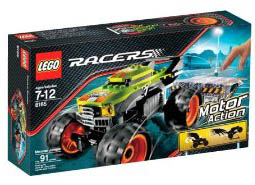
Lime-green panels sit above four large black tires with orange centers. A dark rear spoiler and a silver-colored grille finish the Monster Jumper’s bold outline. Beside it is a compact ramp with a worn-track print and striped edges: a miniature stage for a truck that looks ready to make an entrance.
Build the star and its stage
The official guide builds the truck around a compact motor unit, then adds the black chassis, green body panels and four wheels. The ramp is assembled separately from a printed curved surface and supports. Looking at the two side by side makes the idea of the set immediately readable: a wheeled performer and a place for its big moment.
The box presents the set as Motor Action, and the earlier Toysit account describes pull-back play. For an actual run, follow the matching LEGO guide and use a clear floor area with room around it. A narrated show can also be played as a sequence of drawings.
Give the truck a stage name based on something you can see. Orange Comet might suit the wheel hubs; Green Flash might suit the body. Draw the name in large letters on a separate announcement card.
Run a miniature stunt-show desk
Make three cards: Opening parade, Practice run and Finale. Sketch the truck’s position in each scene, with the ramp shown in the background or alongside its route. A simple line drawing is enough to establish where the action takes place.
Choose an announcer and a scene director. The director reveals the first card while the announcer introduces the truck’s colors, name and imagined crew. For the practice scene, describe one ordinary detail: the crew has checked the route, or the driver is waiting for the opening cue.
Let the finale be a story moment rather than a distance contest. Perhaps the truck arrives beside a giant drawn birthday banner, or its driver salutes a crowd of paper characters. Keep all paper scenery beside the running area if you use the actual toy.
Make the replay a different kind of show
Retell one scene as a comic strip with three panels. In the first, show anticipation; in the second, the truck’s moment in the spotlight; in the third, the crew’s response. Add a speech bubble that only the announcer could have invented.
A second storyteller can report the same event in a completely different voice: a very serious sports commentator, a cheerful parade host or a whispering wildlife presenter observing an imaginary four-wheeled creature. The physical set stays the same while the story changes.
The historical record
Original Toysit coverage
The complete earlier coverage follows. Its product descriptions and broader claims remain part of the historical record; researched context and qualifications appear in Sources.
Toy racing cars with pull-back action
Lego Racers have fantastic speed and that satisfying pull-back motor mechanism of stored kinetic energy. They come with race tracks but work well off track as well, on any flat surface. But be sure you have plenty of room, because they want to go far. Each toy car racing kit has its own characteristics. The Lego Racers Thunder Raceway features high-speed stock racing. Unfold the portable plastic storage container into a racetrack plate with two race cars, lap counter, winner’s podium, and pit area. The Lego Racers Monster Jumper comes with a ramp on which the big-wheeled racing machine does stunts.
Toy cars with a pull-back mechanism have been a source of endless fun and fascination for children and adults alike. This simple yet ingenious feature allows the toy car to store kinetic energy when pulled back and then shoot forward when released. Here's a closer look at what makes this mechanism so enjoyable:
Easy to Use: The pull-back mechanism is incredibly user-friendly. Even young children can easily grasp the concept of pulling the car back and then letting go to watch it zoom forward. It's a hands-on experience that provides immediate gratification and encourages repeated play.
Exciting Motion: The sudden burst of speed as the car shoots forward creates a thrilling and dynamic play experience. The car's rapid movement captures the imagination and simulates the sensation of real-life racing, adding an element of excitement and adventure to playtime.
Exploration of Physics: The pull-back mechanism offers a tangible way to explore basic principles of physics, such as potential and kinetic energy, force, and motion. Children can experiment with different pulling distances and angles, observing how these variables affect the car's speed and trajectory. This playful exploration fosters curiosity and understanding of scientific concepts.
Interactive Play: Pull-back toy cars are perfect for interactive play with friends and family. Whether racing against each other or setting up obstacle courses, these cars provide opportunities for social interaction, competition, and collaboration, enhancing communication and teamwork skills.
Creativity and Imagination: The pull-back mechanism invites children to create imaginative scenarios and stories around their toy cars. They can pretend to be race car drivers, police officers, or explorers, integrating the cars into broader play themes and narratives. The possibilities are limited only by their imagination.
Variety and Collectibility: Many toy car lines feature pull-back mechanisms, offering a wide variety of designs, colors, and styles. Children can collect different models, compare their performance, and even customize them, adding to the long-term appeal and enjoyment of these toys.
Toy cars with a pull-back mechanism provide a multifaceted and engaging play experience that combines simplicity, excitement, education, social interaction, and creativity. The joy of pulling back a toy car and watching it race forward is a timeless pleasure that continues to captivate and inspire, making these toys enduring favorites for people of all ages.
Sources and editorial notes
The original box and official 8165 guide match. LEGO’s service record lists 2008 and 91 pieces. Assembly diagrams on pages 3–19 were visually reviewed, including the motor unit, wheels and separate ramp; this is not a measured performance test. Thunder Raceway is a different product discussed in the retained account. Its general stored-kinetic-energy wording is imprecise: a wound spring stores potential energy, while kinetic energy describes motion. The earlier August 12, 2023 update and already-damaged punctuation in the historical text are retained. The companion activity is an original Toysit suggestion. No physical toy testing was performed.
- LEGO: Monster Jumper 8165 — Official identity, 2008 year and 91-piece record.
- LEGO: Monster Jumper instructions — Truck and ramp construction diagrams reviewed; no distance, speed or durability measurements.
- Original Toysit coverage — Complete earlier text, raw SSI values and historical image preserved.
Images and descriptions are retained as historical material. How Toysit covers toys.
Created for Toysit by Tabbloza — the artwork in our header.