
From the Toysit archive
LEGO Universe
LEGO Universe’s minifigure adventures, personal properties and animated creations, with an original pocket-world building activity and preserved historical coverage.
The play at a glance
A world to explore and a place to make your own
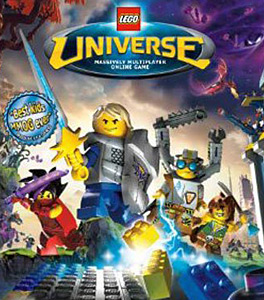
LEGO Universe brought minifigures into an online fantasy adventure, with colorful equipment, scattered worlds and places for players’ own creations. The cover crowds its heroes around the game’s name as though they are gathering for an expedition. Building had a place within that adventure: a player could make a small corner of the world feel personal.
Adventure and construction in the same universe
In LEGO’s retrospective, the designers describe a shattered world and the Imagination Nexus, with the Nexus Force resisting the destructive Maelstrom. These are elements of the game’s invented setting. They gave the minifigures a reason to travel between places and undertake adventures.
The same account describes personal building spaces called properties and a system called behaviors. Players could connect simple instructions to creations so that something happening nearby prompted an action, such as movement or sound. A model could therefore be both a shape to look at and part of an interaction.
LEGO’s retrospective records the original service’s closure on January 31, 2012. The subscription offer preserved below belongs to that earlier game. Its imaginative idea—building a place and deciding how visitors encounter it—also works as a small tabletop project.
Try this: a pocket-world welcome station
Use paper shapes or suitable bricks you already have to make three connected places: a bridge, a mailbox and an observatory. Keep the world small enough that you can explain it in one sentence: “Visitors cross the bridge, leave a message and climb up to look at the sky.”
Invent three visitors with different wishes. A mapmaker wants a clear sign; a musician needs somewhere to put an instrument; a night traveler would like a light by the bridge. Change one feature for each arrival. A folded paper sign, a little shelf or a bright drawn lantern can be enough.
Add a “when someone arrives” card. Perhaps the observatory keeper waves, the mailbox opens or a paper flag goes up. Act out the response by hand. Then ask a visitor to leave a picture postcard showing the detail they liked most.
This is an original Toysit building-and-story invitation, separate from the game’s official missions and programming system. The welcome station can change whenever a new visitor joins the story.
The historical record
Original Toysit coverage
The complete earlier product account and commentary are preserved below as historical coverage.
Online video game that combined building and battle
Lego is a universe unto itself so it makes sense to name a game (really a collection of virtual sets) after the universe. Intended to reach to the stars and beyond, the Lego Universe system brings the created mythology of Lego sets to a new level, one in which good and evil is opposed in a battle. Includes first month free. Subscription required for new content and continued game play. Internet connection required.
The idea of space travel and exploring the galaxy and the universe has long captured the hearts and minds of children. This fascination with the cosmos transcends cultures and generations, sparking curiosity, creativity, and a sense of wonder. Here's how this grand concept has fueled the imagination of children:
Endless Possibilities: Space represents the ultimate frontier, filled with infinite possibilities and mysteries waiting to be uncovered. The vastness of the universe invites children to dream big, imagine distant worlds, and envision themselves as explorers and pioneers, reaching for the stars.
Connection to Science and Technology: The idea of space travel introduces children to various scientific disciplines, such as astronomy, physics, engineering, and robotics. They learn about rockets, satellites, space stations, and cutting-edge technologies that make space exploration possible. This connection fosters a love for science and encourages critical thinking and problem-solving skills.
Inspiration for Play and Creativity: Space-themed toys, games, and media provide rich and engaging play experiences. From building spacecraft with construction sets to role-playing as astronauts, children immerse themselves in imaginative scenarios that transport them to other planets and galaxies. This creative play enhances their spatial awareness, storytelling abilities, and artistic expression.
Heroes and Role Models: Astronauts, scientists, and space explorers become heroes and role models for children, embodying qualities such as courage, perseverance, intelligence, and collaboration. These figures inspire children to pursue their dreams, set goals, and work hard to achieve them, whether in space-related careers or other fields.
Understanding Our Place in the Universe: Exploring space also leads to philosophical and existential reflections, even in young minds. Children begin to grasp the concept of Earth as a small part of a vast cosmos, fostering a sense of humility, wonder, and appreciation for the interconnectedness of all life.
Encouraging Global Collaboration: Space exploration often involves international cooperation and teamwork. Children learn about the importance of working together, transcending national boundaries, and embracing diversity to achieve common goals. This understanding promotes empathy, tolerance, and a global perspective.
The idea of space travel and exploring the galaxy and the universe resonates deeply with children, igniting their imagination, curiosity, and ambition. It opens doors to learning, creativity, personal growth, and a broader understanding of the world and beyond. The allure of space continues to inspire dreams and shape the future, making it a timeless and universal theme that transcends age and culture.
Sources and editorial notes
LEGO’s Bits N’ Bricks episode 13 feature and transcript were reviewed in selected sections for the story, properties, behaviors and closure. This is a retrospective with developer recollections, not a matched retail manual. The original subscription text and broad space-play commentary remain historical coverage. No software, property system or fan revival was tested; broad learning benefits in the older prose are not established by this review.
- Original Toysit image — Existing same-site image reviewed and retained unchanged.
- LEGO Bits N’ Bricks: LEGO Universe, part two — Official feature and interview transcript, selected PDF pages 2, 4, 11–12 and 15–16 reviewed for the setting, player properties, behaviors and January 31, 2012 closure. Selected pages rendered and inspected; audio was not reviewed.
- Original Toysit coverage — Complete historical account retained, including its original claims and wording.

Images and descriptions are retained as historical material. How Toysit covers toys.
Created for Toysit by Tabbloza — the artwork in our header.