
From the Toysit archive
Little People Wheelies Stand ’n Play Rampway
Identify the cars affected by the Stand ’n Play Rampway recall, then explore the historical ramp, lift and service-station playset.
Recall identification
Check the included cars first
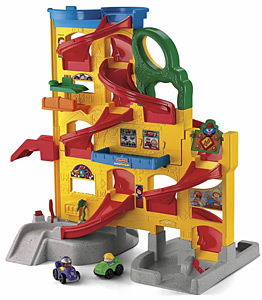
Certain purple and green cars supplied with this rampway were recalled because their wheels could detach and become a choking hazard. Take affected cars away from children and follow the manufacturer’s recall guidance.
The recall concerns particular cars, not every Wheelies vehicle or all parts of the rampway. The identification details below matter more than the color of the building or a resemblance to the photograph.
Identify the affected cars
The recall was announced on September 30, 2010. CPSC lists rampway models T4261 and V6378. Fisher-Price’s identification guide also lists T5095 and shows where to find the model number: on the packaging and underneath the gray rampway base.
For the cars supplied with the rampway, check these features together:
- The car is purple or green.
- Its underside is marked “Mexico.”
- There is no yellow dot on the bottom.
Keep cars matching those criteria away from children. Use Fisher-Price’s illustrated identification guide if the markings are unclear. The old announcement described replacement cars; contact Fisher-Price through its recall route for present arrangements rather than assuming an old remedy remains available.
The manufacturer says other Wheelies vehicles and the remaining rampway pieces are outside this recall. That is the scope of this particular recall, not a general guarantee about the condition of an older toy.
What the rampway was designed to do
The T4261 guide shows cars traveling down the winding ramps, with a lift and elevator giving the setting places to stop and return. It also shows two separate sound actions: lowering the sign triggers stop lights and sounds, while lifting and lowering the gas hose produces car sounds.
The battery-powered lights and sounds are distinct from rolling a car down a ramp. The set is not a remote-controlled roadway, and its electronics do not decide where a child’s story goes.
The original photograph matches this tall, two-sided arrangement. It documents the historical presentation; it cannot establish whether a secondhand example is complete, correctly assembled or fitted with unaffected cars.
Read the route as a small town
After recall identification and an adult’s condition check, an unaffected, appropriate vehicle can be given a simple itinerary: start, stop at the sign, visit the service area and park. Use the assembled route as intended rather than adding height or unsupported extensions.
For a quiet alternative, look at the photograph together and tell the journey without operating a toy. Where would the driver pause? Who might be waiting at the bottom? A complete story needs only a destination and a return.
These are original storytelling suggestions. They do not override the recall or establish a developmental benefit.
Check the structure as well as the cars
The guide calls for adult assembly and uses numbered ramps, color-matched connection points and screws. An incomplete set should be checked against that parts diagram, not assembled from a small publicity photograph.
Look for damaged connections and a secure battery compartment before use. The manual says not to immerse the toy or take it apart for servicing. Keep recall identification separate from routine cleaning: cleaning a recalled car does not address a detachable-wheel hazard.
The historical record
Original Toysit coverage
The original description and general Little People paragraph are preserved below. The broad claim about safety and absence of small parts must not be used to judge this set: certain included cars were recalled, and the assembly guide identifies small parts before assembly. The old developmental claims are not findings of a new Toysit test.
Fisher-Price Little People vehicle ramp playset
Stand and Play is a ramped track for Little People wheelie vehicles. It becomes like a racetrack as you drop vehicles from the top and they speed down the spiral ramps. Lights and sounds abound in the play center. A mechanic's lift is ready to take a car in and up for pretend work. Double A (AA) batteries are required, so like many other toys, it is a good idea to be fully stocked ahead of time.
One of the standout features of Little People is their durability and safety. Crafted from sturdy materials, these toys are built to withstand the energetic play of young children. Rounded edges and vibrant colors add to their visual appeal, while the absence of small parts minimizes choking hazards. As children engage with these figures, they not only develop their fine motor skills but also enhance their cognitive abilities by inventing scenarios, understanding cause-and-effect relationships, and practicing social interactions.
Sources and editorial notes
Reviewed October 16, 2026 using CPSC recall 10-360, Mattel’s current recall identification page, product record T4261 and the T4261 instruction sheet. Assembly and play diagrams were visually checked. CPSC names T4261 and V6378; Mattel’s US/Canada identification page also includes T5095. The recall route was checked, but no remedy order was placed or fulfillment confirmed. The original image cannot show the cars’ underside markings. No physical toy was inspected or tested.
- CPSC: Stand ’n Play Rampway recall — September 30, 2010 announcement, affected-car criteria and stop-use direction.
- Fisher-Price: recall identification guide — Model location, car markings and current manufacturer route.
- Mattel: T4261 Rampway — Historical product identity and features.
- Fisher-Price: T4261 instructions (PDF) — Parts, assembly, lights and sounds; read alongside the later recall guidance.
Images and descriptions are retained as historical material. How Toysit covers toys.
Created for Toysit by Tabbloza — the artwork in our header.