
From the Toysit archive
Littlest Pet Shop Cozy Care Adoption Center
Use the Littlest Pet Shop Cozy Care Adoption Center for a welcoming story, with a clear distinction between the Adoption Center and similarly named medical playsets.
The play at a glance
Begin with a welcome and let the pet settle in
The Cozy Care Adoption Center gives toy pets a place to arrive, rest and meet someone new. A useful first story is a small one: a newcomer finds a comfortable spot, meets a helper and decides what to explore next.
Keep the focus on a few choices made by the characters. The setting can support an adoption-day story without requiring every accessory or a complicated imitation of real animal care.
Use the full name to identify the set
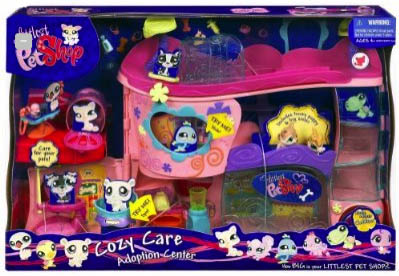
The original box photograph says Cozy Care Adoption Center. Hasbro’s 2009 announcement describes this larger setting with a dog and puppy, a training course, a rotating playpen and a grooming area. It also advertises more than 30 accessories; that is the manufacturer’s historical count, not a new inventory of the pictured box.
The similarly named Cozy Care Center, product 62990, is a different medical-themed package with three pets and 20 accessories. Its bandages and check-up description should not be used to fill gaps in the Adoption Center’s contents.
Start with the actual box, markings and pieces you have. This guide does not provide assembly or mechanism directions for the Adoption Center because an exact matching manual has not been verified.
Create a quiet arrival
For this original activity, choose one pet as the newcomer and another character as its helper. The helper can also be an offstage voice supplied by the player. Pick a visible place to arrive and a second place where the newcomer can settle.
Give the helper one question: “Where would you like to wait?” Offer two destinations that are easy to reach. Move the figure by hand to its choice and describe what makes that place appealing in the story.
A toy dish or other identified accessory can become part of the welcome. Pretend supplies and spoken descriptions are enough; no real food, grooming products or medicines belong in this activity. Leave unfamiliar moving features out of the sequence.
Make a small character card
On paper beside the playset, write or draw three details for the fictional pet. These are invitations to continue the story, not a real adoption form.
- Name
- What will the other characters call the newcomer?
- Favorite place
- Which visible spot did the pet choose, and why?
- Next visit
- Who might arrive next, or what would the pet like to explore?
Another player can use the card to continue the scene. They might introduce a visitor who asks about the favorite place, or have the helper show the newcomer a different room. The first player then decides how the pet responds.
Finish with a clear ending: a goodbye, a return to the resting place or a plan to meet again. Keep real-world animal adoption and care questions separate from the fictional routine.
Let the setting serve the story
The manufacturer’s announcement emphasizes several activities, but a visit does not need to include all of them. Begin with one or two reachable areas and add another only when the story calls for it.
If an accessory is absent, describe the intended event aloud rather than borrowing a part that does not fit. A picture of a complete retail box is useful historical evidence, not a requirement to rebuild the entire package before playing.
At the end, gather small pieces and keep your character card alongside them. A later visit can begin from the same favorite place, giving the new story a familiar starting point.
The historical record
Original Toysit coverage
The two complete original paragraphs remain below. Their broad claims about empathy, responsibility and pet care are historical commentary, not measured outcomes from this playset. The new welcoming activity is fictional and uses toy accessories only.
Take care of pets until they are placed in a good home
Colorful pet-sized playset lets pet-lovers feed, groom and dress pets and then send them to scamper through the training course or play games. Playset comes with one husky puppy pet, one big sister husky pet, and accessories. Keep toy pets well fed, healthy, looking their best and feeling their best with this activity-filled playset. Take care of the littlest pets until they find a good home. Your care will help these pets make it in life.
Playsets themed around pet adoption centers offer a wonderful opportunity for children to delve into a world of compassionate care and responsibility. These sets often include miniatures of animals, adoption paperwork, feeding bowls, and even small pet habitats. When playing, kids can take on the roles of adoption counselors, veterinarians, or new pet owners, making the experience diverse and educational. The scenarios that can be enacted encourage empathy, as children learn about the importance of giving a home to animals in need. This type of imaginative play not only nurtures a love for animals but also teaches valuable life lessons about kindness, responsibility, and the joy of caring for a pet. It's a heartwarming and educational addition to any child's playroom.
Sources and editorial notes
Reviewed October 16, 2026 against the original box image, Hasbro’s September 30, 2009 product announcement and its separate 62990 Cozy Care Center record. The announcement confirms an Adoption Center with a dog and puppy, training-course and rotating-playpen features, and a manufacturer claim of more than 30 accessories. The 62990 medical set has different contents and is not the pictured product. The announcement was read successfully in a browser after automated requests returned 403. No exact Adoption Center manual, complete parts inventory or physical operation was verified.
- Hasbro: September 30, 2009 holiday product announcement — Includes the Cozy Care Adoption Center and its manufacturer-described features.
- Hasbro: Cozy Care Center, 62990 — A different medical-themed set; included to distinguish the similar names, not as this playset’s instructions.
Images and descriptions are retained as historical material. How Toysit covers toys.
Created for Toysit by Tabbloza — the artwork in our header.