
From the Toysit archive
Lucky Ducks
Lucky Ducks as a hidden-color collecting game, with an edition check for the original nest cards and a simple observation activity.
The play at a glance
Find your ducks as the pond turns
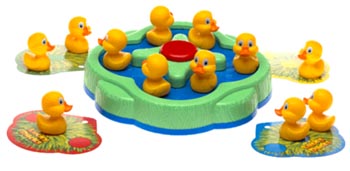
The original Toysit version asks players to collect three ducks whose underside colors match their nests. The moving pond changes where to look; the hidden marking determines whether a duck belongs with you.A set of three, rather than pairs
Toysit’s earlier description identifies twelve ducks, colored underside stickers and separate cardboard nests. A player’s goal is to collect three ducks matching their nest. Looking under a duck provides the information needed to decide where it belongs.
The later official 2005 instructions support the same basic collecting idea, but use color-and-shape home symbols on the pond. In that version, show the chosen duck’s underside to everyone, keep a match and return a nonmatch to the moving pond. This is not the familiar pairs game in which two matching cards are turned over together.
The difference matters when explaining a turn. Ask “Does this belong to my group?” rather than “Where is its identical partner?” Players are collecting a category, not necessarily finding a twin.
Look, name, return
For a short Toysit observation warm-up, pause the competition and let each player inspect one duck in turn. Name the visible marking, point to its matching group, then return it. Use the identifiers actually present on your edition; do not assume an older sticker set also includes shapes.
After the pond moves, ask whether anyone recognizes a duck they saw earlier. Treat an uncertain answer as a reason to look again. The useful conversation is about what was observed and what was guessed, not about whether a child ought to remember perfectly.
If several players want to reach at once, agree on a simple spoken handoff such as “your turn” before resuming. This warm-up changes the competitive game and is not an additional official mode.
Identify the pond before finding rules
Look at the original photograph: the nests sit beside the pond. The 2005 manual’s drawing puts the home symbols around the pond itself. Those are useful visible clues even when the title on two boxes is identical.
- Find the product identifier and any edition information on the box or base.
- Count the ducks and compare their underside markings.
- Check whether the targets are separate nests or part of the pond.
- Match the layout to the manual before following assembly or battery directions.
A listing that says only “Lucky Ducks” does not resolve those details. Ask for an underside photograph and a picture of the complete set when identifying a secondhand copy.
What kind of play does it offer?
The attraction is a small, repeated reveal: pick, look and decide. Movement and quacking add another layer, while the choice itself stays concrete. Consider whether the players want that repetition and sound, or whether a quiet matching activity would suit the moment better.
For an incomplete set, make a parts list before inventing replacement rules. An unbalanced group of remaining ducks can change which player has a chance to finish. Keep any house activity clearly separate from the instructions for a complete game.
The historical record
Original Toysit coverage
The original coverage is retained below. Its first paragraph describes collecting three ducks of one color; the later paragraph’s matching-pairs description should not be treated as the rule. Setup-time and universal-appeal claims remain historical wording.
Fun party game for children
A sound-and-motion version of the typical color-matching game. An adult will need about 15 minutes to prepare the game (installing batteries, labeling ducks, and punching out cardboard nests), and then it's time to start selecting lucky duckies. A quacking sound effect is heard as the motorized board moves the 12 ducks around the pond. The first player to pick three ducks with colored stickers, which match the color of their nest, is the winner.
The Lucky Ducks matching game is a hit at parties, offering a blend of nostalgia, excitement, and quick-paced action that people of all ages can enjoy. Imagine a vibrant pond filled with adorable, motorized ducklings, each hiding a colored shape beneath its wings. Players take turns picking ducks and trying to find matching pairs, which adds a delightful sense of suspense and competition to the gathering. The game’s simple yet engaging mechanics make it accessible even for younger participants, creating a level playing field that encourages social interaction and laughter. The quacking sounds and the way the ducks move around the pond add whimsical touches that elevate the overall party atmosphere. Whether it's a children’s birthday bash or a casual get-together, the Lucky Ducks game offers a mix of fun and strategy that captivates everyone present, making it a must-have for any celebratory occasion.
Sources and editorial notes
The original photograph shows separate nest cards. Hasbro’s 2005 guide instead uses home symbols printed on the pond, so it is cited as a related edition, not an exact match. No battery specification or setup time has been transferred between them. The observation prompt is an editorial suggestion; no toy was physically tested.
- Hasbro: Lucky Ducks 2005 rules (PDF) — Related edition: twelve ducks, printed pond symbols, collecting three matching ducks and returning nonmatches. Its layout differs from the original photograph.
Images and descriptions are retained as historical material. How Toysit covers toys.
Created for Toysit by Tabbloza — the artwork in our header.