
From the Toysit archive
Marc Ecko’s Getting Up for Mobile Phones
Discover the mobile Getting Up game’s city-art idea and its documented animated graffiti effect, then create a folded paper mural walk.
The play at a glance
A little screen with a city inside
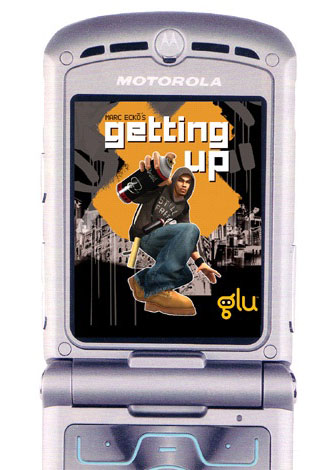
The original image places Getting Up’s title artwork inside a silver flip phone. It captures a particular era of mobile games: a small display, a handful of buttons and a whole fictional city compressed into a pocket-sized object. Toysit’s 2005 report describes Glu Mobile’s version through Trane’s movement and the artwork he adds to the imagined city of New Radius.
Movement gives the picture a setting
The earlier account describes routes that extend across and up the screen: city, underground and bridge environments, with moving platforms and places to reach. Within that fictional world, Trane’s artwork gives a destination a purpose. The report also describes a personal “black book” for completed images.
That combination offers an easy scene to picture: a small character travels through an urban layout, reaches a place for a design, and leaves a visible change. The mobile title has its own scale and presentation; the larger console and PC game belongs to a separate edition.
How the graffiti appears
In their 2005 Game Developer article, five members of Glu’s technical team use Getting Up as an example of animated artwork. Their figure shows a design emerging through a sequence of color changes. They explain that switching color palettes helped create the airbrush effect while keeping the artwork compact enough for phone hardware.
Seen as a visual idea, the appealing detail is the reveal: a design gradually becomes legible. The authors’ wider discussion also shows why games for that era were adapted for different screen sizes and handset limits.
Create a folded paper mural walk
Fold a sheet into three panels and imagine that a community has invited you to design an outdoor art exhibition. Give the panels three settings: a city square, an underground station and a bridge walkway.
- Draw an empty picture space in each setting. Choose a shared theme, such as local birds, changing seasons or welcome messages.
- Add a mural to each space and make a small artist label giving its title and one detail to notice.
- Use a spare paper flap to cover part of a picture. Slide it aside slowly to create your own reveal.
- Tell the walk through a visitor’s eyes: what draws their attention first, and what do they notice on a second look?
This original activity uses ordinary paper and an imagined invitation to make art. The finished sheet can stand like a little exhibition or fold into a pocket gallery.
The historical record
Original Toysit coverage
The complete earlier product account and commentary are preserved below as historical coverage.
Action-adventure game features fluid movement through twenty-seven levels in three environments
In 2005, Glu Mobile launched Marc Ecko's Getting Up, an action-adventure game based on the title born from collaboration between ecko and Atari.
Developed by The Collective, Marc Ecko's Getting Up: Contents Under Pressure is inspired by graffiti's historically rich and diverse culture and is the culmination of seven years of story and character development by Marc Ecko.
Like its console and PC counterparts, "Getting Up" puts mobile gamers in the shoes of Trane, a talented graffiti artist and headstrong New Radius citizen striving for freedom of expression in a city where free speech has been outlawed by a corrupt government. As he develops his graffiti skills, Trane must inspire a revolution through his artwork, ultimately transforming the world around him from a colorless, urban sprawl into a fresh and vibrant city.
The critically-acclaimed mobile title earned IGN.com's Editor's Choice Award and an 8.4 from GameSpot, whose reviewer said, "Glu Mobile has created a genuinely compelling mobile action game with Marc Ecko's Getting Up."
Execute fluid ninja-style moves in vertically and horizontally designed layouts. Complete works of graffiti art and save the images into a personal black book. Twenty-seven levels feature three environments: city, underground, and bridge. A unique hip-hop score from producer RJD2 accompanies the action. Reach the highest spots and get your graf up while avoiding flyers, search lights, and motion detectors. Progress through levels by guiding Trane through one-way doors, onto moving platforms and off of trampolines.
Getting Up for mobile is now available on major wireless carriers in the U.S. Glu has ported the game to more than 320 handsets for the global launch.
"Marc Ecko's first video game, Getting Up, is one of the most anticipated titles of the Fall and one of the most exciting projects to come to mobile," said Robert Nashak of Glu Mobile. "With Getting Up for mobile, Glu has again taken a console title and successfully reinterpreted it for the mobile platform."
Sources and editorial notes
The city, movement, 27-level and three-environment descriptions are attributed to the preserved launch account; a matching mobile operating manual and independent original Glu launch release remain unrecovered. Glu technical-team authors independently document the mobile game’s animated art effect in Game Developer, September 2005, pp. 23–26; that article was read, with its byline and Figure 2 visually reviewed. The pictured handset model and gameplay representation remain unverified. Carrier lists and handset counts are historical, not modern compatibility advice. The Collective credit in the archive refers to the console/PC title.
- Original Toysit image — Existing same-site image reviewed and retained unchanged.
- Mobilizing Content — Game Developer, September 2005 — Michael Ying, Jacob Abrams, Vikas Gupta, Bob Whiteman and Kal Iyer of Glu Mobile; printed pp. 23–26 (PDF 25–28). First-person technical article read; byline and Getting Up animation figure visually reviewed. Historical magazine scan hosted by a third-party mirror.
- Original Toysit coverage — Complete historical account retained, including its original claims and wording.

Images and descriptions are retained as historical material. How Toysit covers toys.
Created for Toysit by Tabbloza — the artwork in our header.