
From the Toysit archive
Barbie Jam with Me Electric Guitar
Picture a pink guitar with flower buttons and a headset, then plan a pretend performance with an opening, a short middle and a closing bow.
The play at a glance
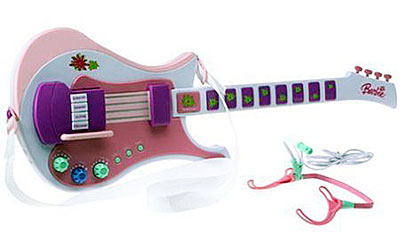
A pink guitar ready for a pretend stage
Flower-shaped buttons run along the neck of this pink-and-white guitar. Purple details frame the string area, colored round controls sit below it, and a headset rests beside the body. The original photograph makes the two stage roles easy to imagine: playing a guitar part and adding a voice.
Toysit’s earlier account describes the Barbie Jam with Me Electric Guitar as a karaoke toy with a song cartridge, several play modes, flower-keypad riffs and a whammy bar. A small paper stage card can give that pretend performance an opening, a middle and a clear finish.
Set up a small performance
Choose an imaginary venue before the first sound. It might be a flower garden, a cardboard theater or the corner of a toy town. Give the band a made-up name and decide who will introduce it.
Let the performer choose a short passage using the toy’s own matching directions, or sing an original line with an ordinary voice. Keep the sound comfortable for the people nearby and leave a little space between the introduction and the music.
Try a three-part stage card
This original Toysit activity uses three pictures to organize a short show. Draw a flower, a star and a person taking a bow across a large card.
- Point to the flower for the opening. The host announces the band name and welcomes the audience to the imaginary venue.
- Point to the star for the middle. The performer plays a short supported toy passage or sings an original phrase.
- Point to the bow for the finish. Let the last sound end, then give the audience a small wave or bow.
- Swap host and performer. The new host can choose a different venue while keeping the same three-part card.
- Invite an audience member to draw a new star or flower for the next show.
A cardboard guitar and an ordinary voice work for the whole performance. Players can also use the card to introduce a puppet, a dancer or a spoken poem they have made up themselves.
Change the mood with the announcement
Try a gentle garden introduction, then a lively parade introduction. Notice how a different voice and a longer or shorter pause change the beginning of the same pretend show.
Keep the announcement short enough that everyone gets a turn. The fun is in choosing a scene together, making a little music and recognizing the shared ending.
The historical record
Original Toysit coverage
The original product account and commentary are preserved below as historical coverage.
Barbie karaoke pretend guitar with vocal tracks cartridge, whammy bar and headset microphone
Barbie karaoke guitar looks and plays like a real electric guitar. Comes with a cartridge that plays top hits, with and without vocals. The freeplay option and automatic chords let kids rock out while accessories like the whammy bar and headset microphone add to the fun. Song cartridge includes three top hits to sing along to. Four modes of play allow kids to jam, strum, or play along karaoke style. Flower keypads produce different guitar riffs.
The electric guitar, an iconic instrument that has shaped multiple genres of music, has its roots in the early 20th century when musicians began experimenting with amplifying acoustic guitars to combat the issue of low volume in ensemble and orchestral settings. By the 1930s, inventors like George Beauchamp and Adolph Rickenbacker had produced one of the first commercially available electric guitars, known as the "Frying Pan." Over time, the technology evolved with significant contributions from pioneers like Les Paul, who developed solid-body designs that reduced feedback and allowed for a variety of new sounds. The 1950s and '60s saw the rise of Fender and Gibson models, solidifying the electric guitar's role in the burgeoning genres of rock 'n' roll, blues, and later, hard rock and metal. Artists like Jimi Hendrix, Eric Clapton, and Jimmy Page showcased the instrument's versatility and expressive power, ushering in a golden age of innovation in guitar design and playing techniques. Nowadays, the electric guitar continues to be a staple of modern music, its technology ever-advancing with new electronic effects, materials, and playing methods. From its humble beginnings to its current status as a cultural and musical symbol, the electric guitar remains a cornerstone of artistic expression.
Sources and editorial notes
The original text, ASIN B000219X6E and photograph are preserved. KIDdesigns BE-644 appears in trade and manual-index leads, but a matching complete guide for this photographed edition was not recovered. Cartridge tracks, modes and control effects remain attributed to the original account; later listings with an iPod dock are not specifications for this image. The electric-guitar history remains historical coverage. No current compatibility, musical-training outcome or physical test is claimed.
- Original Toysit image — Existing same-site photograph reviewed and retained unchanged.
- Original Toysit coverage — Complete original product account and historical commentary preserved.

Images and descriptions are retained as historical material. How Toysit covers toys.
Created for Toysit by Tabbloza — the artwork in our header.