
From the Toysit archive
iDog Music Toy
Meet the little white iDog with moving ears and seven face lights, then make a music-companion color journal from what you actually notice.
The play at a glance
A little white listener with a face full of lights
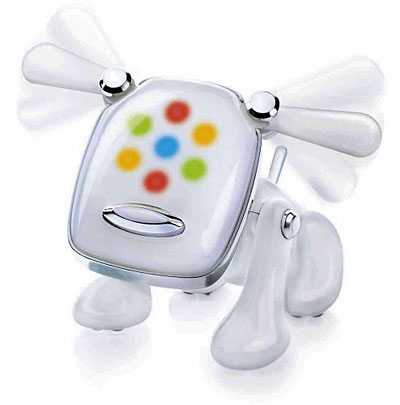
Wide ears spread from iDog’s small white head, above a face dotted with colored lights. Its short legs and rounded body give it a perched, attentive pose. The oval nose is a button, and the seven lights can form changing patterns as the toy reacts.
The original I-DOG guide describes a music companion with moving ears, a rotating head, a microphone and a speaker. Watching a short piece of music with this little listener can become a game of noticing: which lights appeared, what moved and what happened next?
Listen together and notice a change
The guide describes two listening arrangements: a supplied audio cord connected to a suitable music player, or nearby sound picked up through the toy’s microphone. It also shows a light sensor on the head and a nose button that call up responses.
Use the matching guide for a particular unit and any audio connection. For a simple observation session, choose a short piece played through an ordinary speaker at a comfortable level. Give the ears and head room to move, then watch from a settled position.
Try a music-companion color journal
This original Toysit activity records what a player sees. Fold a sheet into two large panels and keep colored pencils nearby.
- Choose two short pieces of music or two brief passages.
- During the first, notice one light pattern or movement. Draw it afterward in the first panel.
- Add a simple mark for motion: an arrow beside an ear, a curved line beside the head or a dot beside a light.
- Listen to the second passage and make another drawing.
- Give each picture an invented title, such as “Red Lanterns” or “Little Head Turn.”
Let the notes describe what happened, even if the two drawings look similar or very little changes. A still moment is something a player can record too.
Turn the pictures into a listening story
Ask a partner to point out one detail in each picture. Together, imagine where this little music companion might be sitting: beside a pretend stage, at a window or in a toy band’s rehearsal room.
A plush dog can join a fully pretend version. Players choose colors for the music and draw them around the plush listener, making their own illustrated scene. Those colors are creative choices supplied by the players.
The historical record
Original Toysit coverage
The original product account and commentary are preserved below as historical coverage.
Listen to your music while connected responsive toy pet rocks out with lights and motion, moving and grooving to the beat
iDog is a little dog with a big sound. iDog Rocks to your music. And when you plug it in, it even plays your music. With a built-in speaker, an array of moods, and a personality that changes with the music you feed it, iDog is a faithful music companion. Included cable plugs into your music player so you can play tunes through iDog. Listen to your music through your headphones while iDog rocks out or simply place it near a speaker and watch iDog move and groove to the beat. Flashing lights change color depending on the type of music you play. Changing light patterns respond to your touch or the amount of music your feed iDog to express moods. Compatible with most portable and non-portable music players.
Electronic pets with mood changes based on care and feeding tap into a fascinating blend of technology and emotional engagement, capturing the imaginations of both children and adults alike. These interactive companions come equipped with sensors, voice recognition, and often a display or LED indicators that signal the pet's current emotional state, creating a surprisingly authentic emotional bond with their caretakers. Providing food, play, and attention as prompted by the pet leads to happy, contented 'moods,' while neglect may result in 'sad' or 'angry' expressions. The responsive nature of these electronic pets encourages a sense of responsibility and empathy, as the pet's well-being is directly linked to the care it receives. This adds an educational layer to the play experience, teaching important life skills like routine care and emotional attentiveness. Children particularly find this feature appealing as it makes the electronic pet feel more like a living creature, which is immensely satisfying and engrossing. Moreover, achieving a 'happy' state often unlocks special features like new songs, games, or interactive stories, which serve as rewards for responsible care. The complexity and realism of these pets have evolved significantly with advancements in technology, making them increasingly compelling and endearing companions.
Sources and editorial notes
The original 2005 Hasbro/SEGA I-DOG guide, 75024 PN 6484920000, was reviewed in all 16 pages from a mirrored copy and compared with Hasbro’s indexed document. Its body and controls match the image; later AMP D, Dance, Pup and Soft Speaker features are excluded. Mood and personality terms describe programmed toy responses, not felt emotions or reliable genre identification. Voice recognition, unlockable stories and empathy claims in the later essay remain general historical commentary. Current-device compatibility and physical testing are not claimed.
- Original Toysit image — Existing same-site photograph reviewed and retained unchanged.
- Hasbro/SEGA: original I-DOG user’s guide, mirrored copy — 75024, PN 6484920000, 2005; all 16 pages and diagrams reviewed. Manufacturer artifact hosted on a third-party site.
- Original Toysit coverage — Complete original product account and historical commentary preserved.

Images and descriptions are retained as historical material. How Toysit covers toys.
Created for Toysit by Tabbloza — the artwork in our header.