
From the Toysit archive
Buckaroo
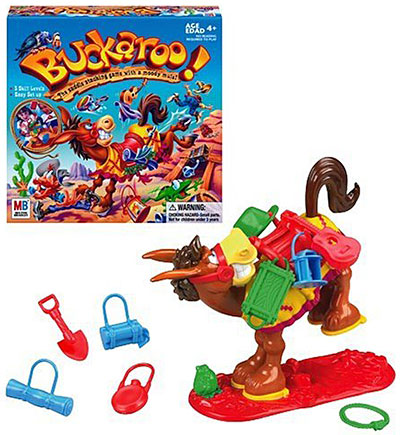
Choose a piece, plan a gentle placement and take turns loading the mule in Buckaroo’s saddle-stacking game.
The play at a glance
The next piece is a small decision with a surprise attached
Buckaroo asks players to add equipment to a mule without making it buck or dropping the load. The theme is a trip to the gold mines, but the activity is placing pieces carefully, one turn at a time.
Before a scored game, let each player examine a piece and explain where they might place it. That short pause makes the choice part of the fun.
Set up for a careful first turn
Use the matching guide to assemble and reset the mule on a flat surface. The 48380 sheet provides three sensitivity settings; a higher setting makes bucking more likely. Follow its diagrams rather than trying to hold or force the mechanism into position.
Put the supplied equipment where everyone can reach it. Choose a short practice round before deciding whether to play the full elimination game. A player who prefers watching first can observe a placement and join the next round.
Look before placing
Pick up one piece and look at its shape. In your practice discussion, point out a possible place for it and say what you expect to happen. A second player can suggest another position without moving the piece for you.
The official game starts with the saddle, then players add one piece to the saddle, a hook or equipment already there. Avoid touching the mule while placing it. Use the supplied parts rather than adding objects to see how much weight the toy will take.
Let the placing player finish before the next person reaches in. That gives the group time to see whether the equipment remains in place.
Know what ends a turn
In the documented rules, bucking or falling equipment eliminates the player making the placement. A player wins by successfully adding the final piece or by being the last player remaining. The full guide explains resetting after a buck.
For an introductory practice, you can agree to reset together instead of eliminating anyone. Say that this is your practice variation before starting. It gives everyone another chance to try a placement without changing the rules halfway through a competitive round.
Compare another attempt
After a round, choose one detail to discuss: which piece was awkward to hold, which position looked promising or what changed after another item was added. Describe what you saw without assuming that you have discovered a fixed weight limit.
On the next attempt, try a different piece order while keeping the same setting. Or keep the approach familiar and use another setting as the guide permits. Changing one thing at a time makes the comparison easier to follow.
Finish by collecting the intended equipment and using the guide’s storage procedure. The mining story can continue in conversation; the mechanism needs only its own game pieces.
The historical record
Original Toysit coverage
The original game description and complete gold-mining essay remain below. The essay discusses generic digging playsets; it is not a list of Buckaroo features or a reason to add sand, rocks or other props to this game.
Stack plastic equipment on a plastic mule to see how much gear can you load
An exciting stacking game for children's parties. Load the mule for your gold mining trip, but watch out. You never know when he'll buck and send everything flying. Be the last to load the mule without losing your gear, and win. Three skill levels. No reading required to play. Two or more players.
A playset focused on gold mining taps into the innate sense of adventure and discovery in children. The idea of unearthing hidden treasures from the earth is exciting and offers a tangible goal that keeps kids engaged. These playsets often come with miniature mining equipment, such as shovels, pickaxes, and sifters, adding a layer of realism and tactile pleasure to the play experience. They may also include small pieces of "gold" (often just plastic or painted rocks), which can be "discovered" as the child digs through sand or soil. The act of searching, digging, and ultimately finding gold pieces provides a satisfying and rewarding experience, bolstering a child's confidence and problem-solving skills. Overall, a gold mining playset can offer endless hours of imaginative and hands-on fun.
Sources and editorial notes
Reviewed October 16, 2026 against the original image, ASIN B0006216GO and Hasbro’s 48380 instruction sheet, copyright 2004. Its mule, base, saddle and equipment diagrams correspond to the pictured game. The English rules and diagrams were visually reviewed. The guide describes sensitivity settings, not a measured weight capacity. The practice and reflection ideas are editorial suggestions; no physical game was tested.
- Hasbro: Buckaroo, 48380 instructions (PDF) — Setup, sensitivity settings, turn rules and two ways to win.
Images and descriptions are retained as historical material. How Toysit covers toys.
Created for Toysit by Tabbloza — the artwork in our header.