
From the Toysit archive
Electronic Toss Across
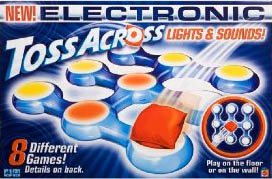
Electronic Toss Across P1713: choose among eight light-pod games, understand player counts and compare target choices with a paper activity.
The play at a glance
The same target board can ask different questions
Electronic Toss Across turns beanbag hits into changes on a light-up board. Before throwing, choose the goal: making a pattern, remembering a location, following a route or collecting points.Choose a goal before choosing a target
The P1713 guide groups eight games around one nine-pod board. Tic-Tac-Toe, 4 Corners, X Marks the Spot and Match 2 are two-player games. Relay Race allows one to three players; Darts allows one to six. Follow the Leader is solo practice, while Stop Pop takes one or more players in separate turns.
These are different tasks, not simply faster levels of one task. A useful first question is whether the group wants to make a pattern, remember a place or compare scores. Explain that goal before introducing the controls.
A good aim does not guarantee the color you want
In Tic-Tac-Toe, striking a pod can produce red, green or no color. A hit on an already lit pod can change it again. Follow the Leader instead asks you to remember a briefly highlighted location. Darts assigns values to different positions; Relay Race works through a column in order.
This makes intention and result worth separating. A player can choose a sensible target and still get an unhelpful color. When talking about a round, ask which spot they intended to hit, where the beanbag landed and what the board did afterward.
Try a target-choice comparison on paper
This optional Toysit activity needs only a drawn three-by-three grid. Give its rows and columns names so two people can describe the same square without pointing.
- Mark two squares in one row. Ask which empty square would complete that row.
- Change the goal to four corners. Ask whether the same choice still helps.
- Point briefly to a square, cover it and ask the other person to name its position.
Take turns inventing the question. The exercise compares pattern choice with location memory; it does not reproduce the toy’s random color changes, scoring or official rules. There is no need to time it.
Identify the board and prepare its space
The documented set has a two-part base and six beanbags. Use the P1713 diagrams for assembly and orientation: the center pod confirms a game selection. The manufacturer shows a wall-hanging slot and floor use, but the slot alone does not establish a suitable fixing for every wall.
Before using an older set, compare its label and shape with the guide, check the joined sections and account for the supplied beanbags. Keep the throwing area and the route used to retrieve bags clear. Use a supported setup appropriate to the room; this article is not a wall-installation guide.
The historical record
Original Toysit coverage
The original product description and tic-tac-toe history remain below. The blanket one-to-three-player description is incomplete: player counts vary by mode. The historical origin discussion is not the basis of the new game explanation.
Make trick shots with lights and sounds in eight different games including follow the leader
Electronic Toss Across Game is a fun party game inspired by the classic game of Tic-Tac-Toe. The twist with this new electronic version is that the X's and O's switch back and forth with lights and sounds. Includes eight games designed for one to three players including matching games, darts, and the ability to play on either the floor or the wall. This flexibility, combined with the interaction of the participants, makes it a fun game for kids used to sports like interactions.
The game of tic-tac-toe, also known as noughts and crosses, has ancient origins that can be traced back over two millennia. The earliest known version of the game was called "Terni Lapilli" and was played during the Roman Empire. Boards for this game have been found scratched into surfaces all over Rome. In this early version, like in modern tic-tac-toe, the objective was to get three of your symbols in a row. The game made its way to England where it was named "Noughts and Crosses," and eventually, it was brought to America where it gained its current name. Tic-tac-toe remains a popular game because of its simplicity and accessibility; it can be played virtually anywhere on any surface, from drawing it out in the sand or on paper, to more sophisticated electronic and online versions.
Sources and editorial notes
This guide uses Mattel’s P1713 product record and complete instruction sheet. The paper comparison is an original Toysit activity, not an additional electronic mode. No physical game, wall mounting or throwing performance was tested.
- Mattel: Electronic Toss Across P1713 — Product identity and floor/wall design.
- Mattel: Electronic Toss Across rules (PDF) — All eight modes, their player counts, controls and setup diagrams.
Images and descriptions are retained as historical material. How Toysit covers toys.
Created for Toysit by Tabbloza — the artwork in our header.