
From the Toysit archive
Giraffalaff Limbo
Giraffalaff Limbo: spinner-led movement, adjustable supports and edition differences in the archived Hasbro instructions.
The play at a glance
Choose a movement before changing the height
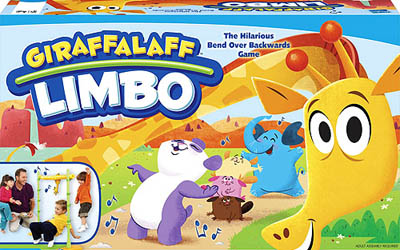
Giraffalaff Limbo combines a spinner with a supported bar and a laughing giraffe character. The chosen movement and the bar’s height are separate parts of the challenge.The supports and the spinner do different jobs
The archived Hasbro guide shows two upright poles, leaf-shaped supports and a foam-covered bar carrying the giraffe plaque. Adult assembly is required. The spinner chooses a position; moving the bar to another support changes the height.
Keeping those decisions separate makes the game easier to explain. First agree on the instruction, then identify the setup for that round. A player should be able to ask what the cue means before attempting it.
What changes between rounds?
In the scanned guide, everyone attempts the same spun position. Knocking the bar off triggers laughter and ends that player’s attempt. After the group’s turns, the game moves to another position and lower support when appropriate. Players return for the next level; more than one can finish as a winner.
The scan’s spinner labels include Limbo, Crab Walk, Forward Bend, Backward Bend, Crawl and Bird Walk. Other period copy uses different wording. Match the spinner actually supplied with the unit instead of combining labels from different descriptions.
A seated cue-making activity
This optional Toysit activity uses paper and conversation, without a bar or a physical challenge. Draw a few simple arrows or position symbols. Have one person describe a symbol and another choose the matching card.
Then swap roles: show a card and ask the other person to explain it in their own words. Notice whether an instruction such as “forward” needs a starting direction to make sense. Add that missing information and try the description again.
The activity explores how a shared cue becomes understandable. It is not an official game mode, a movement lesson or a test of flexibility. Participants can contribute by naming, pointing or drawing.
Check the actual set before physical play
Use the set’s own age label, instructions and battery-compartment markings. A family name or an archived photograph is not enough to settle an electrical revision. Do not use a lower age from one document to override a higher age on your package.
Check the poles, bases and supports against the applicable assembly diagram. Choose a clear space and movements comfortable for the participants; passing, observing or using the seated activity should remain options. A lower bar is not a reason to push through discomfort.
The historical record
Original Toysit coverage
The original product description and limbo-history paragraph remain below. The older battery statement and movement labels differ from the archived Hasbro instruction sheet. The speculative origin discussion is preserved as historical commentary rather than repeated as a verified finding.
Bend over backwards Giraffalaff party game that is fun for family and friends
How low can you go? Find out in this crazy, laughter-inducing limbo game. Crouch, duck, scoot and crawl your way under this giraffe as the music plays. The spinner will tell you which technique you must use: classic limbo, crabwalk, crawl, giraffe walk, forward, and backward. This is a limbo party in a box. It is an electronic toy that requires C batteries, so be sure to have some on hand before the gift is opened, because you'll want to play right away.
The game of limbo, with its origins shrouded in the mists of time, is a captivating and lively activity that challenges participants to bend their bodies backwards and pass under a horizontal bar without touching it or falling. While its precise beginnings are unclear, it is believed to have emerged from the Caribbean region, possibly tracing back to traditions rooted in African dance and rituals. The game's name, "limbo," itself signifies a state of uncertainty or in-between, which mirrors the physical contortions required to succeed. Over the years, the game has been embraced globally, becoming a popular party activity, beach pastime, and even a competitive sport. Its playful nature and the joyful challenge of defying physical limitations have ensured that limbo remains a source of laughter, camaraderie, and friendly competition for people of all ages.
Sources and editorial notes
The complete two-page Hasbro instruction scan was read visually through the Transformers At The Moon archive. It is a manufacturer-authored source hosted by an independent archive. It labels ages 3+ and three AAA batteries; Hasbro’s 2009 announcement labels ages 4+, while the original Toysit copy refers to C batteries. The exact electrical revision in the pictured package remains unconfirmed: follow the actual unit’s label and matching guide. No physical or surface testing was performed.
- Hasbro: Giraffalaff Limbo instructions (archived PDF) — Manufacturer-authored assembly diagrams, spinner positions, rounds and battery information; hosted by Transformers At The Moon.
- Hasbro: 2009 holiday announcement (PDF) — Period description with different age and movement wording.
Images and descriptions are retained as historical material. How Toysit covers toys.
Created for Toysit by Tabbloza — the artwork in our header.