
From the Toysit archive
Mindflex
Mindflex P2639: how the fan, headset and steering knob divide control, plus careful limits on interpreting its concentration feedback.
The play at a glance
Separate the ball’s height from its route
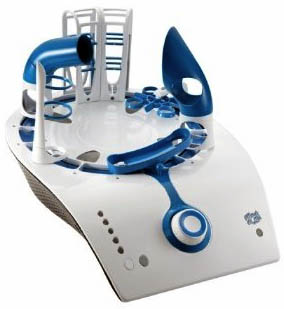
Mindflex lifts a foam ball on moving air. The headset supplies the height-control input, while a hand-turned knob moves the fan nozzle around the course. Those are two different controls.Air lifts the ball; a knob chooses its route
In the P2639 guide, a forehead sensor and two ear clips feed the headset system. The console varies the airflow that supports the ball. Turning the control knob moves the fan nozzle left or right around the circular course. Raising the ball and steering it are therefore separate parts of the task.
The menu includes Freestyle, Mental Marathon, Danger Zone, Chase the Lights and Thoughtshot. Freestyle offers untimed practice; the other modes introduce different course or scoring goals. Use the guide for each mode’s layout and rules rather than assuming every obstacle arrangement works for every game.
What the headset description does—and does not—show
NeuroSky identifies Mindflex with its EEG-processing technology. Its ThinkGear documentation describes relative, proprietary eSense values and warns about poor skin contact, excessive movement and non-EEG noise, including muscle and eye activity. A sensor touching skin is part of acquiring a signal; contact alone does not prove that the toy is merely a facial-tension detector.
Equally, a ball rising is not evidence that the system reads the content of a thought. The manufacturer’s description of a “concentration” signal should not be turned into a judgment of intelligence, attention ability or a medical condition. These sources explain the intended interface and its limitations; they do not independently validate this particular toy’s accuracy.
Check the connection before interpreting a result
The guide distinguishes connection messages from game feedback. It calls for the forehead sensor above the left eye, flat skin contact and correctly attached ear clips. Its status chart separates low console batteries from low headset batteries. The console uses four C cells; the headset uses three AAA cells.
A frustrating round can raise a practical question about setup without saying anything about the player. Consult the actual unit’s instructions when the console reports a sensor problem. Avoid explaining every rise or fall as a direct change in concentration.
Keep an observation log, not a mental scorecard
For an optional Toysit activity during ordinary, correctly set up play, write three headings: what I did, what the toy did and what remains uncertain.
- Record the chosen mode and whether the hand control moved.
- Describe a visible event, such as a ball rising or a connection message appearing.
- Leave the cause open when the observation cannot distinguish it.
This is a way to discuss an unusual toy interface, not a controlled experiment or an assessment of anyone’s mind. The most useful result may be a clearer question about the device rather than a higher score.
The historical record
Original Toysit coverage
The original promotion and commentary remain below. Neither the “power of your mind” language nor the assertion that the device merely detects facial tension establishes how accurately it measures attention. The general claims about skin temperature, conductance and guessing thoughts are not a verified account of this product.
Mindflex is a game that uses a lightweight headset with sensors to control a ball on a column of air with brainwaves (actually face tension from concentration)
Mind Flex lets you move a ball with just the power of your mind (actually the tension of your face when you concentrate). A wireless headset monitors your brain activity. The more you concentrate, the higher the ball rises. Mind flex is the obstacle course game you can customize in hundreds of combinations. Think it, move it, believe it. Can you conquer mind flex? A lightweight headset containing sensors for the forehead and earlobes measures your brainwave activity (really the making of contact with your skin). When you focus your concentration, a small foam ball will rise on a gentle stream of air. Relax your thoughts (and your face) and the ball will descend. By using a combination of physical and mental coordination, you must then guide the ball through a customizable obstacle course–the various obstacles can be repositioned into many different configurations. We wanted to see how people react to playing mind flex for the very first time: "Awesome. Mind blowing. This is the future of games, right here."
Mind control games that purport to read your thoughts often operate on the principle of facial tension and other subtle physiological changes, rather than any form of genuine "telepathy" or "mind control." These games usually employ sensors to measure micro-movements in the facial muscles, changes in skin temperature, or even variations in electrical skin conductance. Such changes often correlate with specific emotional or cognitive states. The game's software algorithm then interprets this data to make an educated guess about what the player might be thinking or feeling. While these games create a captivating illusion of mind control, they're essentially utilizing advanced biometric technologies to gauge physical reactions and present them as a form of gameplay.
Sources and editorial notes
This profile uses Mattel’s P2639 guide and product record, with NeuroSky’s own technical documentation for signal-quality and algorithm context. Relevant control, headset and troubleshooting sections were checked; this is not an independent sensor validation or a clinical assessment. The observation log is Toysit’s own suggestion. No physical device was tested.
- Mattel: Mindflex P2639 — Original product identification and linked instructions.
- Mattel: Mindflex guide (PDF) — Fan and steering controls, headset fit, game menu and troubleshooting.
- NeuroSky: ThinkGear module — Manufacturer identifies the EEG-processing technology and its connection to Mattel Mindflex.
- NeuroSky: ThinkGear data and signal quality — Relative eSense values, contact problems, movement and non-EEG noise.
Images and descriptions are retained as historical material. How Toysit covers toys.
Created for Toysit by Tabbloza — the artwork in our header.