
From the Toysit archive
Red Rover
Red Rover’s electronic dog and hidden bones: two matching modes, how a find is checked, and a quiet attribute-naming warm-up.
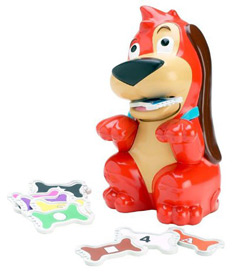
The play at a glance
Listen for a clue, then find a bone
Red Rover asks for a color, shape, number or letter. Players search among the hidden bone faces, bring a likely match to the dog and let it check the piece in its mouth.Choose what players will listen for
Mattel identifies this as R3191, an electronic dog supplied with twelve bones. Puppy Color Game asks only for colors. Big Dog Challenge also uses numbers, shapes and letters. The nose selects the mode and can repeat a forgotten request.
The distinction is useful when introducing the toy. Naming the color of a piece and looking for a symbol on that same piece are different instructions. Before adding a timer and a search, make sure everyone understands which kind of clue they are hearing.
This Red Rover is the dog-and-bones toy. It is separate from the playground game in which teams link arms.
What happens after a find?
The instructions place the bones face down, white side up. Players search at the same time. Turn a bone over to inspect it; return a nonmatch face down. Present a likely match firmly in Rover’s mouth, where the unit reads it. The toy does not need a spoken answer.
An accepted bone stays with the finder. A rejected bone goes back. The guide also explains timeouts and mix-ups that relocate the remaining pieces. After nine bones have been successfully found, whoever holds the most wins.
That last distinction corrects an ambiguity in the older description: being first on one request earns a bone, while the accumulated collection decides the game.
A quiet warm-up with the bones
Try this optional Toysit activity with the electronic game off. Lay a few bones face up where everyone can see them. Invite a player to describe one without picking it up: name its color, then name its printed mark. Another player points to the described piece.
Now ask whether the same piece could answer more than one kind of clue. A color describes one feature; a number or shape describes another. Let players take turns supplying the descriptions, and use the actual markings in your set rather than an invented combination.
For a second round, turn over one piece and ask what everyone remembers about it. Reveal it together to check. There is no score or penalty in this warm-up, and it is not an official additional mode. Its purpose is to make the clues familiar before a competitive search.
Prepare the space and the set
For the official game, choose a search area that the players can move around without obstacles or crowded approaches to the dog. Keep the starting place clear. If the room does not suit simultaneous searching, use a seated activity instead and label it as a house variation.
Count all twelve bones before play and again when putting them away. A missing piece can make a requested match unavailable. For a secondhand set, compare the dog and bones with the R3191 instructions rather than assuming any toy bone is compatible.
Follow the matching guide for battery handling and storage. These preparations support using the game as documented; they are not a claim that the toy has been tested here or that it produces a particular developmental benefit.
The historical record
Original Toysit coverage
The original product description and educational commentary are preserved below. Winning a single search is different from winning the whole game. The broader developmental claims and television comparison remain historical commentary, not tested findings about this toy.
Memory-matching game with run-around play
An educational party game which teaches kids shapes and colors. The object of the game is to collect the most bones by matching colors, numbers, shapes, or letters. Press Red Rover's nose and he speaks out which bones to bring. Whoever brings the matching item back first wins. The bones are placed randomly around the area. This is a lot like the games that are played in the Big Brother house as houseguests must find items that are named.
Games that match colors, numbers, shapes, and letters serve as powerful educational tools for children, offering a range of cognitive, social, and motor benefits. These games stimulate cognitive development by enhancing problem-solving skills, logical thinking, and pattern recognition. They also help with language acquisition, as children learn to identify and name different shapes, numbers, and colors. Furthermore, they lay the groundwork for more advanced math and literacy skills by familiarizing kids with numbers and letters in a playful setting. Socially, these games encourage teamwork, cooperation, and turn-taking, key social skills that children will use throughout their lives. On a motor level, such matching games often involve a physical component, like fitting a shape into a corresponding hole or moving game pieces, which can improve fine motor skills and hand-eye coordination. All these benefits come together to make color, number, shape, and letter matching games a valuable addition to any educational or recreational setting.
Sources and editorial notes
This guide uses Mattel’s R3191 record and complete instruction sheet. The dog checks inserted bones; it is not described as understanding a child’s spoken answer. The quiet warm-up is an original Toysit activity, separate from the competitive modes. No physical testing was performed.
- Mattel: Red Rover R3191 — Product identity, twelve bones and the electronic matching concept.
- Mattel: Red Rover rules (PDF) — Two modes, face-down setup, bone submission, repeated prompts and the nine-bone finish.
Images and descriptions are retained as historical material. How Toysit covers toys.
Created for Toysit by Tabbloza — the artwork in our header.