
From the Toysit archive
Scatterpillar Scramble
Scatterpillar Scramble: a moving-target marble game, an observation activity and careful context for the preserved caterpillar commentary.
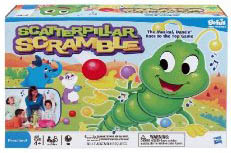
The play at a glance
A moving target changes a simple placement task
Scatterpillar Scramble asks players to place colored balls on a caterpillar that will not hold still. The interesting choice is when to approach a moving hand, not merely how quickly to move.What the original game asks players to do
Hasbro’s 2009 announcement describes a musical caterpillar with wobbling hands. Players race to place their colored marbles, and the first to place all eight securely wins. That is more specific than a general claim that the toy improves coordination.
The challenge combines choosing a destination, approaching it and leaving the piece supported. Those are useful things to notice even when a player does not finish first. A fast attempt and a controlled attempt need not look the same.
Watch one placement, then describe it
For an optional Toysit observation activity, let one person watch an ordinary attempt with an appropriately identified, complete set. The observer can describe three moments: the approach, the release and what happens after release.
Ask which moment was hardest to see clearly. Did the player wait for the target to come nearer, or follow it? Did a piece stay where it was placed? Keep these as observations of that attempt rather than claims about a hidden sensor or a repeating motor pattern.
Switch roles so the observer also has a turn. If you do not have the game or its applicable instructions, use the photograph instead: describe where a piece is intended to rest and what movement might make that difficult. The photograph cannot tell you the toy’s speed or whether a stored unit works.
Keep the photographed edition distinct
Retain the package and rule sheet when identifying a secondhand game. Compare the character, supports and tools, rather than treating every dancing-caterpillar toy as the same product. Use the matching instructions for assembly, age guidance, handling and the treatment of pieces that fall.
Small balls should remain with their intended set and away from children who mouth objects. Do not improvise replacements or use this profile as a complete operating manual. Its purpose is to explain the play idea while keeping unverified details separate.
A toy character is not a biology lesson
The historical essay connects caterpillars with children’s curiosity. That can be a conversation starter, but it does not establish that an unfamiliar real caterpillar is suitable to touch or keep. Enjoying a cartoon creature and observing wildlife are different activities, with different information needs.
The historical record
Original Toysit coverage
The original game description and caterpillar essay remain below. The suggestion that real caterpillars are generally safe to handle or care for is not adopted as advice. This toy is a fictional character, not a guide to handling insects.
Can you get the balls to the top?
Scatterpillar wiggle and dances to the music in this fun race of fast-paced marble placing. Put your marbles on his row of hands in front of you. Race to place your colored balls from the bottom row up to the top row to win. The first player to set all eight marbles in Scatterpillar's hands wins. The caterpillar is constantly dancing and grooving.
Children are often fascinated by caterpillars due to their vibrant colors, unique patterns, and intriguing life cycle. The metamorphosis of a caterpillar into a butterfly or moth offers a captivating educational experience for kids, allowing them to witness firsthand the wonders of nature and biology. Caterpillars are also relatively easy to handle and care for, providing a safe way for children to interact with the natural world. Their slow movements are easy to follow, and their fuzzy or smooth textures can be intriguing to touch. Moreover, caterpillars often feature in children's literature and educational material, such as Eric Carle's famous book "The Very Hungry Caterpillar," which enhances their appeal and provides additional layers of educational and emotional engagement.
Sources and editorial notes
Hasbro’s September 30, 2009 announcement confirms the moving-caterpillar game and eight-marble goal. A securely matched full original manual was not established, so this article does not invent assembly steps, a complete parts inventory or rules for dropped pieces. The observation activity is Toysit’s own suggestion; no physical testing was performed.
- Hasbro: 2009 holiday toy announcement (PDF) — The Scatterpillar Scramble section describes the moving hands and eight-marble finish.
Images and descriptions are retained as historical material. How Toysit covers toys.
Created for Toysit by Tabbloza — the artwork in our header.