
From the Toysit archive
Twister Hopscotch
Twister Hopscotch’s connected rings, spinner and changing routes, with a paper-planning activity and the pictured edition’s age guidance.
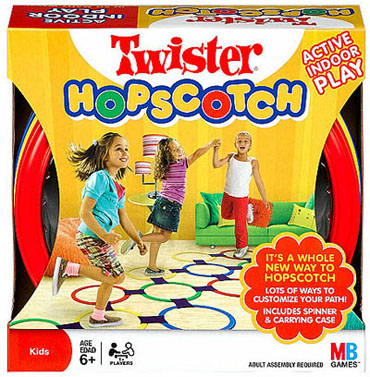
The play at a glance
The route can change before the hopping starts
Twister Hopscotch uses connected colored rings instead of a permanent court. Players arrange a path, spin for a restriction or action, and work out how that instruction changes their trip through it.Build the path, then read the spinner
The documented set contains thirteen rings, sixteen clips, a spinner and a carrying case. An adult connects the rings on a flat surface. The basic route challenge is to avoid the spun color while moving through the rings.
The guide illustrates single rings and side-by-side rings, with different foot placements. It also offers variations involving selected colors and action symbols. Choose a version before starting so everyone understands what the spinner is asking them to do.
Changing the layout and changing the rule are two separate design decisions. Keep one fixed while trying the other; that makes it easier to explain why a route feels different.
Try the route on paper first
This is a Toysit planning activity, not an official board layout. Draw a short route as colored circles. Mark a start and finish, then pretend the spinner has selected one color to avoid. Trace the permitted route with a finger.
Look for a point where avoiding that color creates a gap or an awkward change of direction. Move a circle on the drawing and see whether the route becomes easier to explain. A path that works on paper still needs an adult to judge whether it suits the actual space and players.
Give the drawing a simple name, such as “the bend” or “the two-lane stretch.” Ask another player to describe the route back to you. If the two descriptions differ, revise the plan before arranging the real pieces.
For another round, leave the circles in place and choose a different excluded color. Notice whether the same layout creates a new problem. The aim is to discuss choices, not to make the largest possible gap or the hardest possible jump.
Decide how the group will use it
The instructions include solo runs, paired play from opposite ends and arrangements for larger groups. Successfully completing the path is the winning condition; it need not become a race to push past someone else.
For an introduction, one player can explain a route while another traces it on the paper plan. During physical play, keep waiting players away from the active path. Agree on where a turn starts and ends before using the spinner.
If a layout or action does not suit the available space or a player, stop and revise it. The product name does not require every group to use every suggested variation.
Use the pictured edition’s guidance
The retained box photo and matching guide say ages 6+, with adult assembly in the guide. This matters because a regional listing gives a lower age for the same product number. Check the instructions supplied with the actual set rather than choosing whichever listing is most permissive.
Inspect the rings and clips, confirm that the assembled path lies flat, and keep the surrounding area clear. The original promotional language about grip does not establish performance on every surface. For a used set, count the connectors as carefully as the rings and keep the matching instructions in its case.
The historical record
Original Toysit coverage
The original product description and hopscotch-history paragraph remain below. The Roman-soldier origin story is not established by the product documentation and is not repeated as a verified historical fact in the new guide. The older gripping-surface wording is not a guarantee for every floor.
Customizable Twister layout with durable rings that fit together on a non-slip surface
Twister Hopscotch is a new form of hop scotch. You can hop in a straight line, a diamond, a zig zag, or some other way that you make up. Hop on red; dance on blue. Establish a pattern with rigid rings and hopscotch according to a completely new way. The movable rings let you change your path and customoze your game. A great way to have interactive indoor fun. The party game includes thirteen rings, sixteen ring clips, spinner with arrow and base, carrying case and instructions. It comes with a gripping surface.
The game of hopscotch has ancient origins, tracing back over two millennia. It's believed to have been invented by Roman soldiers, who played the game in a more strenuous form to train both their strength and agility. The soldiers would carve the court into the ground, stretching over 100 feet, and hop it in full armor. The game would later evolve into a children's activity, spread across various cultures, and take on numerous variations. In Britain, where it was popularized, it was known as "scotch-hop" or "scotch-hoppers" because players would "hop" over "scotches," lines scratched into the soil. Today, hopscotch is enjoyed worldwide by children who draw chalk courts on pavement and use stones or other small objects as markers. The game's simple rules and minimal equipment have made it a universally accessible and enduring form of outdoor recreation.
Sources and editorial notes
The original box image and Hasbro’s 2008 40459 guide both specify ages 6+; the guide also requires adult assembly. A regional product listing says 4+, so its lower age has not been substituted. The paper activity is original Toysit commentary. No physical play or surface testing was performed.
- Hasbro: Twister Hopscotch 40459 rules (PDF) — Matching 6+ guide, assembly, route examples, spinner actions and player formats.
- Hasbro: regional 40459 product record — Confirms contents but lists a different age; use the pictured box and matching guide for this page.
Images and descriptions are retained as historical material. How Toysit covers toys.
Created for Toysit by Tabbloza — the artwork in our header.