
From the Toysit archive
Playmobil Advent Calendar: let a winter park story grow one piece at a time
Build a winter park story around the original Playmobil Advent Calendar, with one new arrival at a time and a shared ending.
The play at a glance
A whole park, one arrival at a time
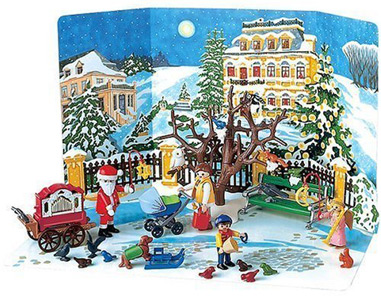
A blue pram passes the bench. A child brings a sled, while a red organ cart waits near the snowy fence. The original Playmobil Advent Calendar picture gives these little arrivals a place to meet: a winter park with buildings glowing behind it. Begin with one visitor and let the next piece change the story.
A scene with places to pause
The bare tree and bench give the little figures a meeting point. The pram suggests an ordinary stroll; the sled suggests a child with a different plan. Santa and the angel can join a holiday story, while the same park can host an everyday meeting or a winter concert. Ask where each visitor is going and what might persuade them to stop.
Playmobil’s archive and illustrated guide connect this particular scene to set 4152. Its numbered boxes build up figures, animals, furniture and scenery. For a story using pieces already out of the calendar, choose the order that suits the tale. A paper park and drawn characters work too.
Try a one-piece winter story
- Make three story cards. Label them arrival, small problem and shared finish. Lay them beside a drawing of a park.
- Begin with one visitor. Place a figure or drawing at the entrance and give it a purpose: “I am bringing a song to the bench.”
- Add one piece per turn. Each new arrival must connect to something already there. A child wants to hear the song but cannot find the meeting place; another visitor offers directions.
- Let an object help. The bench becomes the gathering point, or the sled marks the path in the pretend story. Leave room for each player to suggest a solution.
- Finish together. Gather the characters and retell the three events. Players can hum their own tune for the finale.
Keep the scene between sessions and choose just one arrival each day, or tell the whole story in one sitting. A player can narrate, point to a character or draw the next event while someone else moves the pieces.
Change the visitor, change the ending
Retell the story from the viewpoint of a small animal beside the tree. What did it notice before anyone else? Then leave one newcomer waiting outside the scene and imagine tomorrow’s first sentence. The pleasure is in seeing a small addition give familiar surroundings a new purpose.
The historical record
Original Toysit coverage
The original product account and commentary are preserved below as historical coverage.
Diverse backgrounds and figures to celebrate the holiday season
There may have once been a time when reference to the religious side of Christmas was taboo in the world of mainline toys, but not here. It is as if the makers of Playmobil have imagined a good use of their miniature characters. Also, the themes of the calendars span the different ways that people view Christmas, from secular to religious. The figures have a backdrop. The kits even play music.
The tradition of Advent calendars dates back to the 19th century and has its roots in the Christian faith, specifically in the observance of Advent, the four-week period leading up to Christmas. Early versions of Advent calendars were quite simple; families would mark off the days from December 1st to 24th with a simple chalk line or by lighting candles. The concept evolved over time, and the first printed Advent calendar is commonly attributed to Gerhard Lang in Germany, around the early 1900s. Lang's version was inspired by a calendar his mother had made for him, featuring 24 colored pictures attached to a piece of cardboard.
By the 1920s, the calendars began to include small doors that could be opened to reveal images, Bible verses, or treats. Post-World War II, the tradition gained global popularity, especially in Western countries. The calendars started featuring chocolates in the 1950s, a practice which remains popular to this day. Over time, Advent calendars have diversified to cater to a wider audience, now including small toys, cosmetics, and even beverages like tea or wine behind the little doors. They've grown to encompass various themes, from religious to popular culture, making them a versatile and much-anticipated tradition for both the young and old as they count down to Christmas.
Sources and editorial notes
The pictured scene matches Playmobil’s archived Christmas in the Park set 4152-A (2006). All 12 pages of its illustrated 4152 guide were visually reviewed, including numbered contents, scene assembly and the organ unit’s non-replaceable-battery notice. This does not establish the working condition of an older example. The retained calendar history is the original account: Sellmer’s history describes several early forms and competing first-print dates, so a single inventor/date and the chocolate-calendar chronology should not be treated as settled here. The activity is original Toysit storytelling, not the manufacturer’s opening sequence; no physical testing was performed.
- Original Toysit image — Existing same-site photograph reviewed and retained unchanged.
- Playmobil: Christmas in the Park 4152-A — Official archive identifies the matching park scene and the year 2006.
- Playmobil 4152 illustrated guide (PDF) — All 12 pages visually reviewed; numbered contents and assembly pictures match the original scene.
- Sellmer: history of the Advent calendar — Publisher history describes nineteenth-century practices, several early printed forms and doors around 1920; chronology is more varied than a single first.
- Original Toysit coverage — Complete original product account and historical commentary preserved.

Images and descriptions are retained as historical material. How Toysit covers toys.
Created for Toysit by Tabbloza — the artwork in our header.