
From the Toysit archive
Playmobil Egyptian Adventure
Identify the separate sets in Playmobil’s Egyptian Adventure range, then use the pyramid as a setting for an original map-and-return story.
The play at a glance
One pictured pyramid, several separate playsets
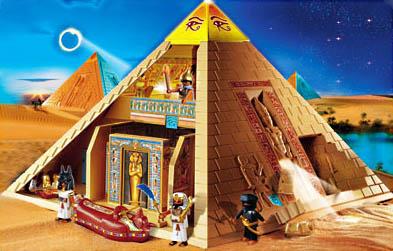
The pyramid is the center of Toysit’s Egyptian Adventure image, but the old article describes a wider group of PLAYMOBIL sets. The ship, sphinx, temple, chariot and smaller tomb are separate settings and vehicles.
Start by identifying the set you actually have. Then choose a small journey through that setting, with a beginning, a destination and a return route.
Keep the boxes distinct
- Pyramid — 4240
- The large pictured structure, with chambers, an amulet key and adventure traps.
- Royal Ship of Egypt — 4241
- A separate ship and crew; its equipment is not part of the pyramid inventory.
- Sphinx with Mummy — 4242
- A separate sphinx setting with a concealed mummy space.
- Pharaoh’s Temple — 4243
- A separate temple with two amulet-opened shrines.
- Egyptian Chariot — 4244
- A separate chariot with a pharaoh figure and two horses.
- Tomb with Treasure — 4246
- A smaller hiding-place setting with its own figures, animals and accessories.
These numbers distinguish the sets named in the old account. They do not imply that every item in the range is needed to play. Keep each booklet with its own pieces when checking a mixed collection.
Look at the pyramid as a layout
The 4240 booklet builds the interior before adding the sloping outer sections. Use its diagrams to identify the assembled rooms, passages and moving parts. The small 4246 tomb has a different structure and its own instructions.
Before making an adventure, point out an entrance, a destination and a route back. Choose places you can see and reach without forcing a panel or putting a hand into a mechanism. A toy photograph shows a scene; it is not an assembly sequence.
Leave unfamiliar mechanisms alone until their parts and instructions are matched. The activity below can use a paper plan alongside an assembled model and does not depend on triggering traps.
Make a map and bring a message home
For this original story, a visitor must deliver an imaginary message to someone at a chosen destination, then return. Draw three landmarks on a sheet of paper and connect them with a route. Place the map beside the model rather than inserting paper into its moving parts.
One player describes the route while another moves a figure. Stop at a landmark and check whether both players mean the same place. If the map is confusing, revise its marks or labels before continuing.
Add one story decision: a passage is unavailable, or the visitor learns that the recipient has moved. Choose a new route and explain why it works. The obstacle can be narrated; there is no need to drop an object or activate a launcher.
End with the figure returning and the players retelling the journey. Put small accessories back in their own container and keep the map if the adventure will continue.
Give historical questions their own source
The amulet key and trap sequence are documented toy features, not evidence of how an Egyptian burial monument operated. The retained desert picture is a publicity scene for a model.
For a real historical starting point, Egypt’s Ministry of Tourism and Antiquities describes Djoser’s Step Pyramid at Saqqara as developing from his tomb. That is a different kind of claim, tied to an identified monument and an archaeological authority.
Write down a question such as “Which monument does this shape remind us of?” and investigate it separately. The play story can remain invented while the answer comes from a museum or archaeological source. This guide does not provide boat, underwater-motor or launcher setup instructions for the separate sets.
The historical record
Original Toysit coverage
The complete original multi-set description and pyramid-history paragraph remain below. The boat’s motor-upgrade sentence is retained as historical coverage, not setup advice. The toy’s traps and adventure story are distinct from evidence about actual Egyptian monuments.
Protect the royal treasure of the pyramid
The amulet unlocks several traps and opens the secret entrance. The Egyptian pyramid is one of several Egyptian-themed playsets from Playmobil. The Royal Ship of Egypt floats or rolls on wheels when on land. Can be upgraded with underwater motor. Another kit is Sphinx with Mummy. Also is Pharaoh's Temple with amulet for the two shrines and Egyptian Chariot. Tomb with Treasure has a secret chamber for treasures. The roof is detachable.
The Egyptian pyramids are ancient monumental structures primarily built as tombs for pharaohs and their consorts during the Old and Middle Kingdom periods of Ancient Egypt. The most famous pyramids are the three located at Giza, on the outskirts of Cairo, with the Great Pyramid of Giza being one of the Seven Wonders of the Ancient World. Constructed from massive limestone and granite blocks, the pyramids were meticulously engineered and remain a testament to the ingenuity and craftsmanship of ancient Egyptian builders. They are not only symbols of Egypt's historical and cultural heritage but also continue to intrigue archaeologists and tourists alike with their architectural complexity, astronomical alignments, and mysterious inner chambers.
Sources and editorial notes
Reviewed October 16, 2026 against PLAYMOBIL archive records for 4240, 4241, 4242, 4243, 4244 and 4246, plus the eight-page 4240 and four-page 4246 manufacturer assembly sheets hosted on PLAYMOBIL’s content service. Both booklets were visually inspected. The current on-site 4240 manual search returned no result, but the manufacturer-hosted PDF was retrieved through a catalog reference. The retained picture corresponds to the 4240 pyramid design. Historical context uses Egypt’s Ministry of Tourism and Antiquities; no physical mechanism, boat or motor was tested. The mapping story is editorial.
- PLAYMOBIL archive: Pyramid, 4240 — German-language record identifying the pyramid and its toy features.
- PLAYMOBIL: 4240 building instructions (PDF) — Eight-page manufacturer sheet for the pictured pyramid design.
- PLAYMOBIL archive: Royal Ship of Egypt, 4241 — French-language record for the separate ship.
- PLAYMOBIL archive: Sphinx with Mummy, 4242 — German-language record for the separate sphinx.
- PLAYMOBIL archive: Pharaoh’s Temple, 4243 — German-language record for the separate temple.
- PLAYMOBIL archive: Egyptian Chariot, 4244 — German-language record for the separate chariot.
- PLAYMOBIL archive: Tomb with Treasure, 4246 — French-language record identifying the separate hiding-place set.
- PLAYMOBIL: 4246 building instructions (PDF) — Four-page manufacturer sheet showing the small tomb and its separate inventory.
- Egypt’s Ministry of Tourism and Antiquities: Old Kingdom — Historical context for Djoser’s tomb and Step Pyramid.
Images and descriptions are retained as historical material. How Toysit covers toys.
Created for Toysit by Tabbloza — the artwork in our header.