
From the Toysit archive
Penbo Penguin
Give Penbo and its small penguin companion a shared story, with documented robotics history and a clear distinction between imagined dialogue and toy responses.
The play at a glance
Two penguin characters can share one small adventure
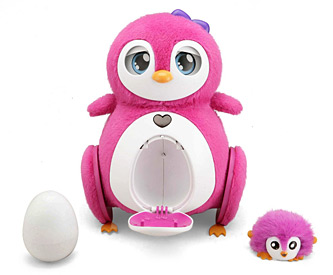
Penbo pairs a larger penguin with a small toy companion. In this context, the baby is another toy character, not a description of the child who should use the product.
The pair suggests a simple story: one character goes exploring, returns to the other and shares what happened. A working toy’s documented responses can join the scene, but the players can supply the whole story themselves.
Choose two roles
Give the larger penguin and the smaller companion a reason to be together. Perhaps one is showing the other a new place, welcoming it home or listening to an account of an adventure. Let the child decide which character leads.
With two players, each can speak for one penguin. Playing alone, the child can alternate voices or simply describe the actions. Keep the story nearby and use the toys as characters without forcing moving parts or opening a compartment as a shortcut.
Tell an outing and a return
Begin with a greeting, invent one event during the outing and finish with a reunion. The little penguin might discover a new friend or bring back an imaginary message. Three short scenes are enough to give the story a beginning and an ending.
On the next round, let the smaller character be the guide. Ask what it would show the larger penguin. Reversing the roles changes the story without needing a new accessory or a different electronic feature.
Observe a documented response separately
If you have the matching operating guide and working toys, choose one interaction that the guide describes. Try it in the stated conditions, then pause to notice what moves or makes a sound. Keep the egg mechanism and any built-in games tied to that guide rather than guessing from the photograph.
Describe the response before giving it a meaning in the story. “The penguin moved” is an observation; “the penguin came to hear the news” is an invented motive. Both can belong in play as long as the difference stays clear.
If the guide or small companion is missing, use the characters already present for a narrated scene. There is no need to improvise a control sequence to complete the adventure.
Place Penbo in its robotics history
Carnegie Mellon reported in July 2009 that Bossa Nova Robotics, a Robotics Institute spinoff, introduced Penbo and Prime-8. It linked their animal-like movement to earlier work on the six-legged RHex robot and described Penbo as a waddling penguin with an egg containing an interactive baby robot.
That history adds a second way to look at the toy: a character for a story and an example of robotics ideas entering a plaything. It does not establish that Penbo understands the player’s dialogue. Let the documented mechanism provide observable actions while the child supplies the adventure and its meaning.
The historical record
Original Toysit coverage
The complete original description and penguin essay remain below. Their references to your baby and developmental benefits are preserved historical wording, not evidence that Penbo is an infant toy or that a particular benefit has been established. The new activity concerns the pictured pair of toy penguins.
Responsive dancing plush
Penbo is a plush penguin that interacts and plays games with your baby. A baby penguin is inside for your baby. Penbo cuddles and gives surprises in a way that promotes interactive development in the child's mind. A good for you toy that children will remember for a long time. Tell me what you want to say - you have a surprise - baby - cuddle - interacts and plays games with your baby.
Penguins have a special charm that seems to captivate children and adults alike. Their waddling gait, tuxedo-like appearance, and playful antics make them irresistibly adorable to young eyes. Many children first encounter penguins in storybooks, cartoons, or movies, where these lovable creatures often take on human-like qualities and go on grand adventures.
The fascination often goes beyond their cute appearance; children are enthralled by penguins' unique behaviors and habitats. The way penguins slide on their bellies, swim gracefully in the water, and huddle together for warmth captivates the imagination. Educational content that reveals these characteristics, whether it's a documentary or a visit to a zoo or aquarium, often leaves a lasting impression.
Penguin-themed toys, from stuffed animals to LEGO sets, also feed into this fascination, allowing children to bring a piece of that magical Antarctic world into their own lives. Whether it’s mimicking their funny waddles or engaging in imaginative play that involves icy adventures, children derive a unique joy from penguins that blends both learning and fun.
Sources and editorial notes
Reviewed October 16, 2026 against the original photograph and text and Carnegie Mellon’s July 9, 2009 announcement. That primary source documents Bossa Nova’s robotics origin and Penbo’s waddling penguin, egg and interactive baby concept. An exact operating guide was not verified, so button combinations, built-in games and egg-release steps are not specified here. No physical toy was tested. The story and observation framework are editorial suggestions.
- Carnegie Mellon: Robotics Institute spinoff unveils toy robots, July 9, 2009 — Contemporary primary source for Bossa Nova and Penbo’s robot-and-companion concept; not an operating guide.
Images and descriptions are retained as historical material. How Toysit covers toys.
Created for Toysit by Tabbloza — the artwork in our header.