
From the Toysit archive
JLX Overdrive
Explore JLX Overdrive’s large inflatable tires and two-sided body, distinguish scale speed from actual speed, and compare movement in body lengths.
The play at a glance
Big wheels, a reversible body and a claim worth decoding
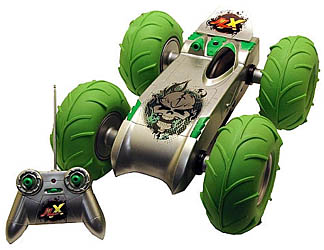
JLX Overdrive pairs a two-sided body with four large inflatable tires. The manufacturer’s 37575 guide depicts the layout shown in Toysit’s original photograph and describes two-stick driving controls.
The archive’s 225 MPH figure is explicitly a scale-speed claim. It should not be read as the toy’s actual speed across the ground. The word “Overdrive” is also the toy’s name, not evidence that it contains the automotive gearbox described in the later paragraph.
Ask what a speed number measures
Actual speed describes distance traveled in a given time. A scale-speed comparison also brings size into the calculation. Without a stated scale and a measured travel speed, the old promotional number cannot be converted into a verified real-world result.
A simpler comparison is body lengths per second. It gives size a visible role while keeping the distance and time explicit. Two objects can travel at the same actual speed but cover different numbers of their own lengths.
Keep the terrain claims within the guide
The guide directs operation on dry surfaces. It separately excludes salt water and says the transmitter is not waterproof. Those additional warnings do not cancel the dry-surface instruction or establish permission to drive through fresh water or snow.
Its tire instructions specify a hand pump and an inflation template rather than a guessed pressure. Match the exact components and full instructions before considering a surviving example; the original photo cannot establish their condition.
Compare the layout with Air Rebound
Count the wheels in each photograph and compare their sizes. JLX’s four large tires surround a low body; Air Rebound uses two smaller drive wheels and one much larger tire.
Those visible differences make a good starting point for questions about contact with the ground. A photograph alone does not prove which toy would grip better, jump farther or survive an impact.
The same journey, two measures
- Draw one imaginary vehicle 10 cm long and another 20 cm long.
- Give both the same fictional journey: 100 cm in 2 seconds.
- Work out actual speed: both cover 50 cm each second.
- Count their own lengths: the smaller covers 5 body lengths per second; the larger covers 2.5.
- Explain why the two size-relative numbers differ even though the actual speeds match.
This independent arithmetic example uses invented dimensions and travel times. It does not estimate JLX’s size, speed or scale, and it requires no powered run.
The historical record
Original Toysit coverage
Both original paragraphs remain below. The scale-speed and jump-distance language is historical promotion, not a Toysit measurement. The broad land/water/snow claim should not override the manufacturer guide’s instruction to operate on dry surfaces. The general explanation of automobile overdrive is background terminology, not a specification for this RC vehicle.
With ultra fast motor, green rc vehicle travels at race car speeds over dirt, water, snow, and big air
The JLX Overdrive radio control car is fast and versatile. RC drivers can take the wheel of the ultimate R/C experience with this miniature ATV that reaches scale speeds of 225 MPH, performs stunts with self-propelled flipping action tires and has the ability to drive on almost any terrain, including land, water or snow. Kids can even take to the air with a ramp-assisted jump that can propel the JLX more than six and a half feet.
Overdrive is a gear setting in an automobile that allows the engine to run at lower RPMs while maintaining the vehicle's overall speed, thereby improving fuel efficiency and reducing engine wear. Essentially, it permits the output shaft of the transmission to spin faster than the input shaft, using a gear ratio less than 1:1. Overdrive is particularly beneficial for highway driving as it allows for better fuel economy and quieter operation. Modern vehicles often have automatic overdrive systems that engage based on driving conditions, although manual control is sometimes available for specific needs like towing or climbing steep grades.
Sources and editorial notes
The manufacturer-authored 099-37575 guide from the 2008 FCC filing was downloaded from an FCC-document mirror, rendered and visually reviewed. Its Learning Curve branding, layout and product illustrations match this family. No vehicle, tire, speed, jump or water use was tested. The body-length comparison is independent editorial work.
- Manufacturer JLX Overdrive 37575 guide, FCC mirror — Manufacturer-submitted instructions hosted by a third-party document mirror, not an FCC.gov page.
Images and descriptions are retained as historical material. How Toysit covers toys.
Created for Toysit by Tabbloza — the artwork in our header.