
From the Toysit archive
Shell Shocker
Explore Shell Shocker’s opening armor and paired controls, with its October 3, 2005 report, quotation and historical price preserved.
The play at a glance
Changing the shell is part of the driving idea
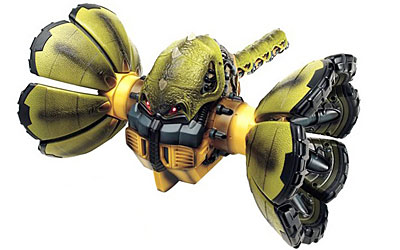
Shell Shocker makes its moving surfaces part of its character. Opening the shell changes its outline from a compact form into the wide creature pictured here.
Start by distinguishing the transformation controls from the driving controls. A short comparison of the two shapes can make this unusual Tyco toy easier to understand before considering its more energetic routines.
Find the shell controls first
The guide assigns the left and right driving buttons to the corresponding shells. Separate lower toggles close and open the armor. Its open configuration is called explore mode.
Compare the pictured closed and open forms before operating the toy. Notice how much more space the open form occupies. Keep that whole outline in mind when choosing a clear play area, rather than judging the space by the compact shape alone.
Use the transmitter for the transformation shown in the guide. Watch it finish before adding a driving input so you can distinguish a change of shape from a change of position.
Steering uses a pair of inputs
- Forward
- The basic-driving diagram shows both driving buttons pushed up together.
- A turn
- The diagram uses one side rather than the same input on both sides.
- A spin
- Opposite inputs on the two sides produce the separate spinning action.
Begin with a short movement and release the controls before trying another. A turn and a spin are different intentions; give each its own space in the practice rather than calling every change of direction steering.
Ask a partner to predict which way the body will point afterward, then compare the prediction with the result. Keep people outside the moving area.
Compare the outlines, then the movement
Sketch the compact and open shapes side by side. Give each a simple arrow showing where you expect it to go. Once the basic controls are familiar, compare a short turn in each configuration using the matching guide.
Describe what changed: the width of the outline, the direction it faced, or the space occupied during the turn. Leave claims about traction or speed for actual measurements rather than inferring them from an impressive appearance.
The tail-snap routine is separate and forceful; the manual warns that the tail comes down quickly. It is not needed for this comparison. Keep hands and feet clear and do not pick up the toy while it is moving.
Use the operating limits alongside the old report
The manual explicitly excludes driving through water or snow. Its power supplement specifies the Tyco Pro FlexPak NiCd system and adult-supervised preparation, with damaged equipment excluded from use.
Read both documents before preparing an older set. The original news report records how the toy was presented in 2005; its broad terrain language is not a substitute for those instructions. Keep the historical quotation intact while using the more specific operating guidance for decisions about a play session.
The historical record
Original Toysit coverage
The complete October 3, 2005 report remains below, including Paul Fish’s attributed quotation and the $79.99 historical price. The report’s terrain and range claims are retained as period coverage. In particular, its reference to mud should not override the operating manual’s explicit exclusion of water and snow. No current price or availability is implied.
Radio controlled alien cyber beast machine attacks with its tail and and transforms by turning its shell inside out for traction
In 2005, the engineering marvel from Tyco R/C, Shell Shocker, appeared on store shelves nationwide. The new radio controlled toy had parents pondering over, and kids delighting in, its operation.
A transforming beast, Shell Shocker ushers in a new era of radio control products. Initially a ball wrapped in a protective rhino-like skin while in shield mode, the creature can turn its shell inside out while in motion to gain traction and explore, and also to reveal its scorpion-like tail to attack. Shell Shocker can easily traverse all sorts of terrain, from pavement and grass to sand and even mud. Two glowing red eyes indicate that this is something more than your normal radio controlled toy.
"This is completely different from anything else in the RC aisle, which is precisely why it's attracting so much attention," said Paul Fish of Tyco R/C. "Adults are the ones asking the questions, but it's the kids who have the answers. Part alien. Part machine. Part beast.
It's a concept that kids grasp, while the rest of us just scratch our heads and think its weird. Fortunately, kids seem to have no problem letting their imaginations run wild."
Designed for kids ages eight and up, the open-ended nature of the product is proving to be central to its play appeal. Is it alive - is it a machine - is it alien or terrestrial in nature? Kids will have to decide for themselves as they explore all transforming capabilities of Shell Shocker from a range of up to seventy feet over a series of various terrains.
Indeed, transformation is the right term for Shell Shocker; not just for the toy, but for the entire R/C category, which up until now has been known primarily for producing vehicle replicas. With the frenzy and excitement surrounding this innovative radio controlled creature, the category has been opened wide.
Shell Shocker sold for $79.99.
Sources and editorial notes
Reviewed October 16, 2026 using the original dated report, image and Mattel’s G3457-0920 / G3457-9993-S1 guide, copyright 2005. Control and transformation diagrams and the linked Pro FlexPak power supplement were visually reviewed. New context is documented guidance and editorial observation; no physical vehicle, range or power equipment was tested.
- Mattel/Tyco: Shell Shocker G3457 operating guide (PDF) — Illustrated shell controls, driving, transformations and operating limits.
- Mattel/Tyco: Shell Shocker power-system supplement (PDF) — Instructions for the specified Pro FlexPak NiCd pack and charger.
Images and descriptions are retained as historical material. How Toysit covers toys.
Created for Toysit by Tabbloza — the artwork in our header.