
From the Toysit archive
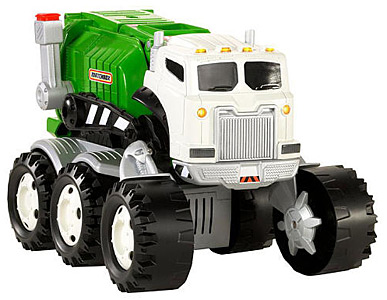
Stinky the Garbage Truck
Explore the original Matchbox Stinky R0858 through documented controls, loading play and sound responses, with the commercial-era coverage preserved.
The play at a glance
A character vehicle with a load, react and unload play loop
Stinky gives an ordinary truck route a comic personality. The original R0858 instructions show a mix of hands-on movement, controls, sounds and loading actions that can become a short pretend collection round.
Learn those interactions before assigning the truck a job. A sound-triggered response is different from understanding speech, and a toy loading sequence is different from cleaning up a room.
Learn the controls with an empty truck
The original guide distinguishes On, Off and Try Me on the switch. Its illustrations show pushing or pulling the truck, operating the smokestack, opening the rear door and pressing the belly button as ways to produce actions or sounds.
Start with one control and no load. Observe what follows before adding another input. If you are sharing the toy, let one person operate it while the other describes the reaction. Swap after a short turn.
Make a simple list of interactions you can recognize confidently. You do not need to reproduce every performance from an old commercial to have a useful starting point for play.
Follow the illustrated loading sequence
The foldout demonstrates loading with a small toy car and shows the truck’s standing, mouth and unloading actions. Use the complete matching illustrations for the sequence; the photograph on this page does not establish what will fit into a particular unit.
Do not turn a demonstration with one type of object into a promise that arbitrary toys can be fed through the mechanism. Keep real rubbish and liquids out. If the intended load or procedure is unclear, continue the route story with an empty truck while checking the guide.
Separate the steps in your narration: arrive, collect, react, depart and unload. Pause at each step so the player can connect the control they used with the result they observed.
Listen for the sound cue
For singing, the guide shows using the smokestack until Stinky requests noise, followed by a clap. That is a documented sound response; it does not establish that the truck understands the words someone says.
Try predicting what will happen at the prompt before making the sound. Afterward, describe the trigger and response separately. You can invent a conversation around the performance, while recognizing that the player supplies that conversation’s meaning.
Give the collection round a beginning and end
The guide specifies indoor use and warns that sand, dirt and water can damage the toy. Choose a clear play area and invent two or three collection stops without placing obstacles in the vehicle’s path.
One player can name the stops and another operate the truck. End with an agreed unloading or parking moment rather than continually adding objects. On a second round, change the story while keeping the familiar controls.
When you finish, ask which part felt most like driving a vehicle and which felt like performing with a character. That comparison makes Stinky’s appeal easier to describe without assigning it unverified sensing or autonomous-driving abilities.
The historical record
Original Toysit coverage
The original commercial observations and Matchbox essay remain intact. Their broad claims about load sensing, obstacle sensing and understanding speech are not independently established by the matching R0858 instruction sheet. The new context below follows its documented controls and demonstrations instead.
When you talk to Stinky, he talks back
Funny that the commercial says Stinky the Garbage Truck is a boy's best friend. Intended to be a clean-up toy, the commercial shows it gobbling up toy cars. The vehicle is activated by sound, has a motion sensor, can sense direction, detects when it is carrying something, senses obstacles, and produces sound and moves in a synchronized way. When you speak to him, he speaks back, so he becomes a friend to you as you are playing with him. He says dozens of funny sayings. He gets hungry, tells jokes, and interacts as a friend would. Robotic toy vehicle from Matchbox.
Matchbox is renowned for creating high-quality die-cast toy vehicles that have captured the imaginations of children and collectors alike for generations. Founded in 1953, the brand initially gained fame for its small-scale replicas of everyday vehicles like cars, trucks, and buses, all designed to fit inside a matchbox-sized package. Over the years, Matchbox has expanded its range to include various types of machinery, aircraft, boats, and even fantastical vehicles from movies and television shows. The brand's focus on detail, durability, and realism has made it a staple in the world of toy vehicles, standing the test of time in an ever-evolving toy market.
Sources and editorial notes
Reviewed October 16, 2026 against the original green-and-white truck image and Mattel/Matchbox R0858-0920 G1 instructions, copyright 2010. The full foldout and its illustrated operating panels were visually reviewed. This is the original R0858 guide, not the later DXT65 edition. The route activity is an editorial suggestion; no vehicle, sensor or loading operation was physically tested.
- Matchbox/Mattel: Stinky R0858 instructions (PDF) — Original illustrated foldout covering controls, character reactions, loading, dumping and care.
Images and descriptions are retained as historical material. How Toysit covers toys.
Created for Toysit by Tabbloza — the artwork in our header.