
From the Toysit archive
Tri-Bot
Compare steering, stored movement and pattern games on WowWee’s three-wheeled Tri-Bot, with clear limits on obstacle response.
The play at a glance
Learn the direction before planning the route
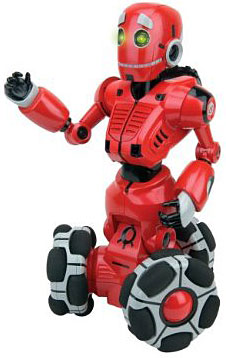
Tri-Bot’s three-wheel base makes sideways movement part of the attraction. A first session can explore that movement directly, then compare it with a stored route or a built-in pattern game.
The useful question is what controls the next move: your hand on the remote, a recorded command, or the rules of the selected game.
Give each direction a name
Use a large, clear, smooth floor away from edges. The controller distinguishes directional movement from clockwise and counterclockwise turns. Think from the robot’s viewpoint when identifying left and right.
Before driving, point to where you expect one short movement to end. Try it, stop, and describe the result. Stand in a different position and repeat the prediction. The robot’s left has not changed just because you are looking at it from another side.
Keep the first route simple enough to explain aloud. Reaching a destination matters less here than recognizing which control produced which movement.
Compare the control methods
- Directional buttons
- Choose movement and turning with the separate controls shown in the guide.
- Tilt control
- Hold the rear tilt trigger while tilting the controller. This method does not supply every button-controlled movement.
- Program playback
- The robot repeats stored driving commands, including their durations.
The guide allows up to 60 driving commands in one program and records a Stop interval as a pause. Switching off erases that program. Plan a few moves on paper first, then use the guide’s recording procedure.
Give a partner the sketch and ask them to describe the planned route. After playback, compare the sketch with the actual path. Keep the same starting position when comparing attempts, and change one instruction at a time.
Understand the obstacle limits
The manual limits obstacle detection to forward and backward movement. It is unavailable while moving sideways or diagonally, turning, or playing back a program. A clear route remains necessary even when the robot has obstacle sensors.
Avoid building a course that depends on the toy stopping itself at every boundary. You can describe an imaginary route without placing objects in its path. Let an observer watch the space while the driver concentrates on the controller.
Try a pattern as a separate activity
The built-in Pattern game asks the player to follow a movement pattern. Read its selection and response rules before starting; it is a different task from recording your own route.
After a short attempt, discuss what helped you follow the movement: direction names, body orientation, or remembering a shape. Take turns describing the pattern before comparing performance. The robot’s jokes can add character, but they do not establish conversation or an understanding of the route you imagined.
The historical record
Original Toysit coverage
The original product introduction and general robot-history essay remain intact. The history essay has not been reverified for this renovation and is not a description of Tri-Bot’s mechanisms. New operating context follows the matching 8042 manual.
Tribot talking three-wheeled robot from Wowee robotics
WowWee Tribot Talking Companion. Tribot is one of the latest in WowWee line of personal robots. This innovative junior robot talking companion is more than just your average robot. Tribot is ready to interact with you whether it is playing with his built in games or telling you jokes. Give him commands using the remote controller. Move Tri-Bot forward, backward, left and right by tilting the remote controller. Play games such as Pattern, Maze or Minefield. Guide his movements to help him succeed; moves around on three wheels with distinctive omni-directional motion.
In the 1930s, the concept of robots was heavily influenced by the realm of science fiction and the burgeoning field of mechanization. Robots were often depicted in literature, films, and illustrations as either humanoid automata, capable of mimicking human actions and emotions, or as specialized machines designed for labor-intensive tasks. Works like Karel Čapek's play "R.U.R." (Rossum's Universal Robots), which actually introduced the word "robot," presented them as synthetic beings made in laboratories and designed to work for humans. However, these fictional accounts often carried cautionary tales of robots rebelling against their creators or society grappling with the ethical implications of using such beings. In reality, the technology of the time was far from achieving the sophisticated robots imagined, but these early conceptualizations did set the stage for the future development of robotics.
Sources and editorial notes
Reviewed October 16, 2026 against the original image and WowWee item 8042 instructions, copyright 2007 (8042US04FLA), preserved by The Old Robots. The manufacturer-authored guide’s body, wheel and controller diagrams match this edition; relevant driving, programming, game and limitation pages were visually reviewed. The archival host is independent of WowWee. No physical robot or controller was tested.
- WowWee: Tri-Bot 8042 manual (PDF, The Old Robots archive) — Manufacturer-authored instructions, including driving limits, stored commands and built-in games.
Images and descriptions are retained as historical material. How Toysit covers toys.
Created for Toysit by Tabbloza — the artwork in our header.