
From the Toysit archive
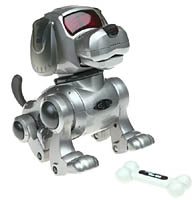
Super Poo-Chi
Understand Super Poo-Chi’s voice training, play modes and expressive feedback, with original coverage and an independent command-card activity.
The play at a glance
A robot dog built around a small command vocabulary
Super Poo-Chi adds trained voice commands to the robot-pet idea. Its display and movements give feedback while the player takes part in a structured training game.
The important distinction is between recognizing a small set of trained cues and understanding ordinary conversation. Super Poo-Chi’s guide describes the former.
Two kinds of training are involved
The guide first has the player train voice recognition for a name and a small command set: paw, good dog, let’s sing, lie down and sit. It then describes how play influences the toy’s performance.
Those are different tasks. Recognizing a cue is one part of the system; selecting a response within the toy’s current state is another. An unexpected action does not by itself tell you which part caused it.
Choose the play style
- Nourish mode
- A progression through baby, puppy and adult states makes training part of the play.
- Adult mode
- The tricks are already available, while voice training is still required.
The guide uses development and personality language to describe these outcomes. They are designed game states, not a living animal’s development or evidence of general-purpose learning.
Watch for feedback before another command
The documented command flow uses the trained name first, then question-mark eyes as the cue for a command. The manual supplies the complete setup and timing details.
Feedback makes a system easier to follow: it tells the player when an input has been noticed and when another input belongs. That design principle can be explored with paper and a willing partner, without a surviving electronic toy.
Build a tiny command game
- Draw a paper dog and choose two original commands, such as “turn” and “wave”.
- Make three cards: waiting, ready and finished.
- One player holds waiting until the other says the dog’s chosen name.
- Show ready, accept one command, and move the paper dog to perform it.
- Show finished, then return to waiting. Try giving a command before ready and agree on what should happen.
These are invented rules, not Super Poo-Chi’s setup instructions. Discuss how a visible ready signal changes the experience, and how you might make the game work without spoken words.
The historical record
Original Toysit coverage
The complete original description remains below, including its size, display, development and compatibility claims. “Lazy”, “faithful” and “talented” are labels for toy outcomes, not judgments about a child or a real dog. The guide confirms examples of interaction with Poo-Chi and another Super Poo-Chi; the archive’s wider I-Cybie claim was not verified and is not repeated as current guidance.
Product description and buying information.
Almost twice as big as the original Poo-Chi, Super Poo-Chi measures 10 inches by 5 inches by 8 inches and is super-smart. Like the original Poo-Chi, Super Poo-Chi reacts to sound and touch and appears to learn and mature, but Super Poo-Chi can also learn his name and recognize his master's voice. This super pooch can be set to either nourish or adult mode. In nourish mode, Super Poo-Chi starts out as a baby, grows to puppy, and then to adult. If trained, encouraged, and fed well, the adult Poo-Chi will become "talented dog" with an impressive repertoire of tricks. If neglected, Super Poo-Chi grows up to be "lazy dog." If set directly to adult mode, Super Poo-Chi will automatically respond to the commands: lie down, sing, sit, and paw. Like the original Poo-Chi, Super sings songs, sleeps, "eats" his bone, and expresses his moods by displaying LCD pictures in his eyes.
Super Poo-Chi will interact and play with other Poo-Chis and all the Robo-Chi Pets. For best performance, it should be played with on a smooth surface and not on a shaggy carpet or the lawn. Poo-Chi should not be submersed in water or left outside. Super Poo-Chi reacts to light, sound, and touch. Three motors for highly expressive animations: crawling, streching and protecting his owner. The eyes show happiness, confusion, sadness and love. It interacts with friends I-Cybie and Poo-Chi. Also sings up to 12 songs.
Sources and editorial notes
Both pages of the Tiger Electronics/Sega Toys Super Poo-Chi Care and Play Guide were visually reviewed, including voice training, mode differences, eye feedback and infrared communication. Display technology is not inferred from the archive’s LCD wording. No recognition accuracy, development progression or compatibility was physically tested. The paper activity uses original rules.
- Super Poo-Chi Care and Play Guide — Manufacturer scan preserved by The Old Robots; commands, play modes and feedback.
Images and descriptions are retained as historical material. How Toysit covers toys.
Created for Toysit by Tabbloza — the artwork in our header.