
From the Toysit archive
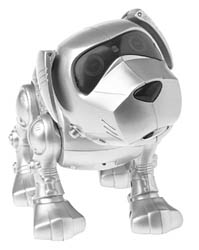
Tekno the Robotic Puppy
Explore Tekno the Robotic Puppy through sensors, pretend care and the distinction between the original and Newborn models, with historical coverage preserved.
The play at a glance
A robot puppy turns small signals into a pet story
Tekno invites a familiar kind of play: offer attention, watch for a response, and imagine what the puppy wants next. Its sounds and movements give the character personality, while sensors and programmed routines make those responses possible.
This page preserves a particularly rich piece of Toysit history. It also untangles an important detail: the old heading says Newborn, but much of the longer description concerns the original Tekno puppy.
Start with the right puppy
- Original Tekno
- The guide pairs a bone with a card trick and identifies separate head and neck inputs.
- Tekno Newborn
- Its guide adds a special ball, a hidden-ball frame and a magnetic sensor near the mouth.
Those differences matter more than a shared silver body or similar name. For an actual toy, compare its controls and accessories with the appropriate manual before using a setup or trick sequence. The historical text below should not be used as a universal instruction sheet.
From a cue to a character
Both guides describe light and sound inputs. Hearing a noise is not the same as understanding its words, and detecting a change in brightness is not the same as recognizing a room. A varied response can still come from a designed set of possibilities.
Keep the fiction enjoyable
A bark can become a greeting in a child’s story. A pause can become a nap. Neither interpretation needs to be a literal claim about an electronic animal’s feelings.
The Radtek tale below belongs in that imaginative tradition. Read it as a character origin story, then invent a different reason why your own paper robot puppy came to visit.
Make a cue, response and story log
- Draw a puppy and three boxes labeled cue, response and story.
- Choose an invented cue, such as a gentle tap on a paper button.
- Choose one response: a drawn tail wag, a bark written in a speech bubble, or a turn toward a door.
- Write two possible stories for that same response.
- Change only the story. Notice that the visible action has stayed the same.
If you later observe a working toy using its own guide, record what actually happens in a separate log. Leave a blank when a response is unclear; a good observation does not need a confident explanation.
The historical record
Original Toysit coverage
The complete original description, Radtek origin story and Instructions for Play remain below. Rob and Roberta Radtek and their institute belong to the toy’s fictional backstory. The original heading and image label say Newborn, while the eight-week-old puppy language, bone/card trick and neck-sensor material correspond to the original-puppy guide. These mixed references are retained as history, not combined into one model’s instructions. Claims about genuine feelings, seeing everything and grinding noises being harmless are historical wording, not findings from a modern test.
Superb technology.
Traditional toys, video games, and action figures tend to operate on pretty simple principles. You push a button, something happens; you push the button again, and the same thing happens again. Not so with Tekno, the Electronic Robot Puppy, one of the most popular entries in the electronic dog craze. And that unpredictability is part of the charm. A seemingly simple little silver pooch, Tekno becomes more engrossing the more time you spend with it. Various commands, buttons, and actions lead to an entertaining assortment of walks, barks, yelps, tail-waggings, and even words. Even those skeptical about robotic pets may find themselves shouting out commands, petting Tekno, trying to figure out what will happen next, and beaming with pride when the electronic pup does something new. Some may even realize that what they're feeling is the same parental pride that accompanies a successful dog training. Tekno comes with a plastic bone, a card trick to perform, and, mercifully, an on/off switch.
Tekno is an authentic robot friend who does everything a puppy can do... and more! He walks, barks, talks and even cries. With your help, he can also learn to perform amazing tricks! Thanks to his artificial intelligence program (and a few barks, whines and pants), Tekno will let you know how he's feeling and provide feedback on the care you provide. Tekno knows how long it's been since you've fed him and he's quick to remind you when he's in need of some playtime. Tekno is programmed to respond just like any 8-week-old-puppy. His state-of-the-art sensors allow him to see and hear everything around him, including you and your own voice. Tekno's sensors also enable his powerful computer brain to know when it's getting dark, if your house lights suddenly turn on or if a friend is knocking on your door.
Introducing Tekno the fully interactive electronic robot puppy. Tekno has advanced computer software, giving realistic emotions and actions, including sleeping, eating, barking, snoring, and walking. LED eyes indicate mood and sleepiness. Tekno sings in 'Bark Language', and has sensors for recognizing touch, changing light levels, and voices. Tekno requires four AA batteries, which are included.
Tekno was created by Rob and Roberta Radtek, inventors who had everything two people could wish for... except a puppy to keep them company. Since their busy lives at the Institute of Robotics demanded that they work long hours, Rob and Roberta couldn't own a pet. Or could they? One stormy afternoon the couple put their enormous brains together and came up with a brilliant idea. A robotic dog. But an ordinary creation would simply not suffice for these two ordinary people. So, Rob and Roberta set out to develop a robotic dog that could share their fun and feelings. Rob created the dog's irresistible look and talents, while Roberta set out to build his personality and intelligence. The end result of their efforts is Tekno, a puppy that has changed their lives in an incredible way! After weeks of fun with their new friend, however, the Radteks began to feel a bit guilty. They had this amazing pet all to themselves and felt that others should share their enjoyment. So, now that Rob and Roberta have started their own company, Tekno Robotics, everyone can have their own Tekno the Robotic Puppy.
The more you teach him the smarter he gets. Straight from the labs of the Institute of Robotic Technology. Tekno features the latest in HiTech circuitry and digital sensory input devices. All the technology housed within the puppy enables true emotions and real time moods. Fully articulated, with animated eyes, ears, and tail, Tekno possesses voice activation and an internal clock to adjust to your lifestyle. Learning and memory are empowered by the integrated circuitry and microprocessor that controls all of Tekno's functions. Instructions for Play Tekno's Basic Functions Powering up Tekno: Turn the on/off switch to the on position and you'll hear a beep. Tekno will begin to sense his surroundings automatically. If you yell his name or clap for him, he may give a number of reactions (bark, cry, whine or yelp with anticipation). If Tekno is crying, he may be unhappy or startled. If he pants or barks, he's usually in a great mood. Keeping Tekno happy: Tekno needs attention and stimulation to be happy. Just like a real puppy, it's important to play with him and not forget to take care of him. Patting him on the head, scratching him behind the ears, talking to him and clapping your hands are met with joyous results. you'll see his ears move, his eyes flash, his tail wag... and he'll parade around seeking adventure. Tekno loves to eat! So, remember to feed him at least once a day (or more, if you prefer). By holding his bone next to his mouth sensor, you'll hear the crunching noises that indicate he's one satisfied puppy. How you can tell Tekno is unhappy: Tekno's ears and voice will let you know his mood. If his ears are down, he may be feeling a little blue. If you hear him crying, begging or moaning, it's time to turn his frown upside down. To make him happy again, just feed him, touch him and play with him. As a social puppy, Tekno doesn't like to be left alone. If you haven't played with him as often as he'd like, Tekno will cry for several minutes before quieting down. When you return, in most cases, he'll be extremely happy to see you again. However, if you leave him for a very long time, expect a growl or two until you play with him again. When Tekno gets sleepy: As nighttime approaches, Tekno's light sensors will let his computer know it's time to go to sleep. Like you, he isn't always ready for bed. At first, you may hear a groan or a whimper. Next, his eyes will change from round to rectangular slits. A few minutes later, Tekno will begin to snore softly and his eyes will shut off. Now he's asleep. You can wake Tekno up by talking to him, making a loud noise, turning on the lights, or touching him. He may wake up a bit startled and will either bark or cry. It's always a good idea to let Tekno know you're there by patting him on the head or scratching behind his ears. Making Tekno sniff: Since tekno is very curious and has a keen sniffer, he'll take a whiff of anything you press against his nose. Making Tekno lick: Tekno will show his affection (and let out a happy licking sound) when you place his face against your cheek so that his nose and mouth sensors are pressed. Making Tekno beg: Waving Tekno's beloved bone in front of his eyes will make him walk towards you, bark for the bone or even beg for it. But don't be a tease! It's always kind to feed Tekno if he knows you are offering him his bone. Tekno's emergency stops: Tekno will automatically stop moving his legs when he hits an object with his nose while walking. You may also hear a grinding noise occasionally if he cannot move. This is normal and won't cause any damage. If you want to make Tekno stop walking at any time, tap him gently on the nose. When you do, you'll hear a little bark as if Tekno were saying ouch! Now you are ready to teach Tekno tricks. See the instructions included with the toy to teach Tekno tricks like: Speak Fetch Howl or Moan Talk Laugh Sing and Dance Make Rude Noises Play Wake-Up Songs Advanced trainers can even teach him to wake you up at a certain time and play a card trick!
Sources and editorial notes
The original Tekno and Newborn manufacturer manual scans were compared for their introductions, accessories and sensor diagrams. The small photograph and mixed source text do not establish one exact edition for every claim. The overview therefore separates the manuals and avoids a universal operating sequence. No surviving toy or sensor was tested. The observation activity is an independent editorial exercise.
- Tekno the Robotic Puppy owner’s manual — Manufacturer scan archived by Virtual Pet; original model, sensors and accessories.
- Tekno the Newborn Puppy operating manual — Separate manufacturer guide with different accessories and sensor arrangement.
Images and descriptions are retained as historical material. How Toysit covers toys.
Created for Toysit by Tabbloza — the artwork in our header.