
From the Toysit archive
VideoNow XP Interactive Video System
Explore VideoNow XP’s folding screen and interactive controls, then direct an original paper theater with two possible endings.
The play at a glance
A little screen with choices beside it
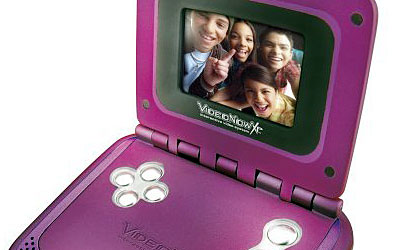
The purple VideoNow XP opens like a small clamshell theater. Its screen rises above the controls, with a directional pad on one side and A and B buttons on the other. Those extra choices give this edition its particular character: alongside watching a PVD, the player can respond to interactive features supplied by compatible content.
From watching to making a choice
The XP guide separates the familiar playback controls from the interactive ones. Play/Pause, Stop, Previous and Next handle viewing, while the directional pad and A/B buttons respond to the interactive material. The folding screen and sliding disc latch are separate parts of the case.
The guide describes playback of VideoNow color and black-and-white PVDs, with monochrome recordings remaining monochrome. The disc determines the program and the opportunities to participate. A button’s role belongs to that program’s instructions, so watching its prompts is part of finding the next move.
Imagine the pleasure of reaching a moment where the viewer has something to decide. A companion can pause to discuss an on-screen choice or talk afterward about the response. Keep any invented sequel clearly your own: the possibilities in a paper story can grow in directions beyond the recorded program.
Build a fork-in-the-story theater
This original Toysit activity turns a choice into two handmade endings. All the scenes stay on paper.
- Fold a large sheet into a little standing stage. Draw a traveler arriving at a garden gate with a mysterious parcel.
- Make two choice cards. A says “Follow the lanterns”; B says “Ask the owl.”
- Draw an ending for each route. The lanterns might lead to a surprise birthday supper, while the owl might reveal that the parcel belongs to a moon gardener.
- Invite an audience member to choose A or B. Show the corresponding ending and add a sound effect: a gentle clink of imaginary dishes or the owl’s thoughtful hoot.
- Return to the gate and choose the other route. Decide which detail could appear in both endings while meaning something different.
Try a second round in which the audience invents the two choices and the performer draws the endings. Mark the cards clearly so everyone can follow the route they selected. The little theater becomes a collection of possible stories, each beginning at the same gate.
The historical record
Original Toysit coverage
The complete earlier product account and commentary are preserved below as historical coverage.
Experience interactive video system with three-inch backlit screen, video and volume controls, directional pad, and speaker
Portable PVD player for watching shows and interactive gaming. Watch many of your favorite shows, celebrities, and music videos and play games and interactive features. Plays all VideoNow personal video discs. Directional pad for interactive features and gaming.
Here is a brief overview of the evolution of personal video players:
- 1970s - Early personal video players like the Sony Betamax and VHS players emerge. These allowed people to watch prerecorded videotapes at home for the first time. However, they were large, heavy, and expensive.
- Early 1980s - Portable video players like the Sony Watchman are introduced. These had small black and white screens and allowed people to watch videos on the go. However, they were still quite heavy and offered limited battery life.
- Late 1980s - The introduction of the Sony Walkman paved the way for portable video. It showed there was demand for watching videos away from home.
- Early 1990s - Full color LCD screens become affordable and lightweight enough to incorporate into handheld devices. This allows the development of the first portable media players with larger screens and the ability to play longer videos.
- Mid 1990s - Personal media player and recorder devices like the Apple Newton and various MP3 players hit the market. They can store and play digital audio and video files loaded from computers.
- Late 1990s - True pocket-sized video players emerge, like the Diamond Rio PMP300. They have tiny hard drives that can hold several hours of digital video.
- Early 2000s - Apple introduces the iPod, which can play lengthy videos on its small screen. Other competing video players also emerge to play various proprietary and open video formats.
- Mid 2000s - Playback of higher quality digital video becomes possible with better screens and more storage. Longer battery life also improves the watchability of handheld video players.
- Late 2000s - Smartphones largely displace dedicated portable video players. With cellular data and WiFi, videos can be streamed on phones too.
Early bulky analog players paved the way for smaller digital devices with longer playback and more features. This evolution ultimately led to video capabilities being incorporated into multipurpose mobile devices.
Sources and editorial notes
Hasbro’s four-page 75068 guide, P/N 6469410000, was read in full and its control diagram visually reviewed. Interactive actions depend on the PVD’s content. The preserved portable-video timeline contains errors: Sony dates the original cassette-audio Walkman to 1979; Apple introduced the original music-playing iPod in 2001 and the video-playing fifth generation in 2005. The older Newton and Rio descriptions are not relied on here. The paper theater is an original activity; no physical testing was performed.
- Original Toysit image — Existing same-site image reviewed and retained unchanged.
- Hasbro: VideoNow XP instructions (PDF) — Four-page 75068 guide; full text and control diagram reviewed.
- Sony: Walkman’s twentieth anniversary — Manufacturer history identifies the July 1, 1979 TPS-L2 as a stereo cassette player. Text reviewed through the web reader; direct automated access returned 403.
- Apple: original iPod announcement — October 23, 2001 announcement describes an MP3 music player.
- Apple: fifth-generation iPod announcement — October 12, 2005 announcement establishes video playback for this later generation.
- Original Toysit coverage — Complete historical account retained, including its original claims and wording.

Images and descriptions are retained as historical material. How Toysit covers toys.
Created for Toysit by Tabbloza — the artwork in our header.