
From the Toysit archive
Wit’s End
Explore Wit’s End’s four kinds of question and multilevel board-game idea, with original riddles and ordering prompts to make together.
The play at a glance
Four ways to turn a question around
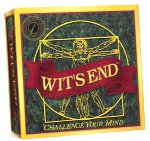
The old Wit’s End box pairs a dark green background with a gold border and a broad red title band. Inside the game’s question-driven world, a turn might ask for a connection, an odd one out, an ordered sequence or a surprise answer. That change of approach gives the table something new to discuss with each card.A different kind of answer
The four categories give the game its variety. In the 2012 rules, Teaser uses a rhyming riddle; Odd1Out asks which choice does not fit; Sequence asks for a specified order; and Wild Card brings assorted question formats. A player may move from spotting a relationship to arranging a set of facts on the very next turn.
Those later rules describe movement through colored board levels toward a final question in the center. Some cards add promotion or demotion effects. Use your own edition’s instructions for its board and card details; the central pleasure is hearing how a question invites a particular kind of answer.
Try four ways to ask
Original Toysit activity: make four paper prompts for a separate conversation game. Read each aloud, invite an answer and ask the solver to explain the clue that helped.
- A riddle: “Fold me shut and tuck away; open me on a rainy day.” An umbrella is the intended answer. Try writing a second line that makes your chosen object clearer.
- An odd one out: spoon, fork, plate, bicycle. Bicycle is the intended outsider in this table-setting group. A different answer can start a discussion if the player supplies a clear grouping rule.
- An order: place five minutes, one minute and ten minutes from shortest to longest. Then make a new set using things whose order everyone can check.
- A surprise: name an object that could help both a painter and a gardener, and explain both uses. A bucket is one possibility; welcome other well-explained ideas.
Swap papers and invent a fresh prompt in the category you enjoyed most. Keep these homemade questions beside the commercial game as an optional break, with their own open discussion instead of board movement or scoring.
The historical record
Original Toysit coverage
The original product account and commentary are preserved below as historical coverage.
The game is called Wit's End, which is just where you might find yourself when playing this lively contest of lateral, literal, and level-lifting thinking.
Wit's End is one of the most challenging and entertaining games you are ever likely to play. You will quickly find out how much you know, and how well your brain really works. This remarkable collection of brain teasers and mind riddles is drawn from every area imaginable - popular culture, history, geography, arts, science, etc. Four unique card categories will baffle and amuse you. Wrap your mind around a Teaser (what's the relationship?), deduce the Odd-1-Out (which one doesn't belong?), figure out the Sequence (what's the right order?), or try your luck in the Wild Card category (Brain Trivia, True or False, Quotations and much more). Wit's End will exercise those parts of your brain that you forgot you had. Look out for special features which add fun social twists to the play - promote yourself up the multi-level board or get revenge by demoting someone else! Wit's end is a must-have, must-play game.
Wit's End is a challenging trivia board game that takes players on a journey through various levels of difficult questions across diverse categories. Unlike traditional trivia games that rely solely on factual knowledge, Wit's End also tests players on their analytical abilities, requiring them to solve brain teasers, sequence puzzles, and even mathematical problems. The game aims to engage multiple facets of intelligence and cognition, making it a favorite for those who love to challenge their mental agility. It's a hit in social gatherings where participants are eager for an intellectual duel and provides an entertaining medium for cognitive exercise. Whether playing in a family setting or with friends, Wit's End pushes boundaries and sparks stimulating discussions.
Sources and editorial notes
The retained image shows the box only. Game Development Group’s complete one-page 2012 rules sheet, hosted by Board Games Wizard, supports the four-category explanation and is a later comparison; an exact rule-sheet match to this pictured edition remains unresolved. The archive’s brain-training language is preserved as historical promotion, not evidence of a cognitive outcome. The four new prompts are original Toysit activities, not commercial card questions. No physical testing was performed.
- Original Toysit image — Existing same-site photograph reviewed and retained unchanged.
- Game Development Group Wit’s End rules, 2012 — Complete one-page publisher sheet visually reviewed on a third-party host; later comparison edition.
- Original Toysit coverage — Complete original product account and historical commentary preserved.

Images and descriptions are retained as historical material. How Toysit covers toys.
Created for Toysit by Tabbloza — the artwork in our header.