
From the Toysit archive
Game Boy Color — Pokémon Crystal Bundle
A kiwi-green handheld and Pokémon Crystal package invite a pocket-sized adventure, with an original four-color garden activity.
The play at a glance
A green doorway into a small world
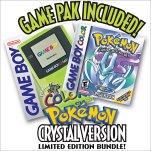
The kiwi-green body frames a little screen above the direction pad and two round action buttons. Beside it, the Pokémon Crystal box turns the picture into an invitation: choose a cartridge, settle into an adventure and discover what lies beyond the next small patch of landscape. The original image presents the handheld and game together as a bundle.
A landscape held between the controls
The upright layout gives the screen a place above the player’s thumbs. A small path, a doorway or a character can become the point of attention. The cartridge supplies the world; the player follows its particular rules, reads its clues and chooses what to explore next.
Color is part of this handheld’s character. Nintendo’s legacy overview describes selectable color palettes for older monochrome Game Boy games, alongside games designed for Game Boy Color. That makes an interesting invitation for a paper experiment: how much can the same scene change when only its colors change?
Try a pocket-world palette
Draw three small rectangles on paper. In each, repeat the same tiny garden: a winding path, one tree, a gate and a resting place. Choose four colors for the first panel, then a different set of four for each of the others. Leave the outlines in the same places.
One garden might look sunny, another moonlit and the third like a place discovered in a dream. Invent an explorer and give each version a short greeting: “The blue gate opens only when the birds begin their evening song.” Ask a companion which garden they would visit first and what they think is behind its gate.
For a second round, exchange palettes. Keep your original drawing but borrow the other person’s colors. Add a name below each garden and arrange the panels as three stops on one imaginary journey. These are your own worlds, ready to enjoy on paper with the handheld resting nearby.
Return to the cartridge’s own instructions
For a surviving console, match its label, battery compartment and game to the appropriate instructions. Cable linking and infrared communication are separate, game-dependent features; the presence of a port alone does not establish what a particular cartridge can do. An adult can help check the equipment and choose a comfortable, well-lit place for play.
The historical record
Original Toysit coverage
The complete earlier product account and commentary are preserved below as historical coverage.
Limited Edition Pokemon Crystal Game Boy Color Bundle
This limited-edition Game Boy Color console in the color of kiwi comes with a free copy of the game Pokemon Crystal. Quantities are limited, so catch yours while you can. The Game Boy Color was a significant handheld gaming console that introduced various features.
- Color Display: The Game Boy Color featured a 2.32-inch color TFT LCD screen, capable of displaying 56 colors simultaneously from a palette of 32,768 colors.
- Processor: Powered by a custom 8-bit Z80 CPU running at 4.19 MHz, providing enhanced performance compared to its predecessors.
- Memory: Included 32 KB of RAM and 16 KB of VRAM, allowing for more complex games and graphics.
- Backward Compatibility: Compatible with original Game Boy games, allowing players to enjoy a vast library of classic titles.
- Cartridge System: Utilized interchangeable game cartridges, enabling a wide variety of gaming experiences.
- Power Supply: Operated on two AA batteries, providing approximately 10-30 hours of gameplay, depending on usage.
- Sound: Featured stereo sound through headphones and mono sound through the built-in speaker, enhancing the audio experience.
- Multiplayer Capability: Supported multiplayer gaming through a link cable, allowing players to connect multiple Game Boy Color devices.
- Portability: Compact and lightweight design made it highly portable and suitable for gaming on the go.
- Infrared Port: Included an infrared communications port for wireless data transfer between devices.
- Physical Controls: Featured a directional pad, A and B buttons, Start and Select buttons, providing intuitive and responsive controls.
- Accessories: Supported various accessories, such as the Game Boy Printer, Game Boy Camera, and others, expanding its functionality.
- Color Variants: Available in multiple color variants, allowing users to choose according to their preferences.
Sources and editorial notes
The original offer and its May 18, 2005 date and August 7, 2023 update are preserved. The promotional image supports the bundle description, but complete retail packaging and its region remain unconfirmed; limited-bundle wording does not establish a unique hardware design. The paper garden is an original Toysit activity, not a Pokémon Crystal feature. No physical testing was performed.
- Original Toysit image — Existing same-site image reviewed and retained unchanged.
- Nintendo: Game Boy Color overview — Spanish support page identifies kiwi among the colors and explains monochrome palettes and cartridge categories; it does not identify this bundle.
- Nintendo: legacy technical data — Lists Game Boy Color as 8-bit, 8 MHz, 160 × 144 pixels and up to 10 hours. The archive’s 4.19 MHz and 10–30-hour figures are not adopted as current specifications or measured endurance.
- Nintendo Game Boy Color instruction booklet, archived by ManualsLib — Manufacturer text for the introduction and components reviewed; infrared requires supporting software. Complete diagrams and exact bundle revision were not verified. Direct access returned HTTP 403; the manufacturer text was read through the web reader.
- Original Toysit coverage — Complete historical account retained, including its original claims and wording.

Images and descriptions are retained as historical material. How Toysit covers toys.
Created for Toysit by Tabbloza — the artwork in our header.